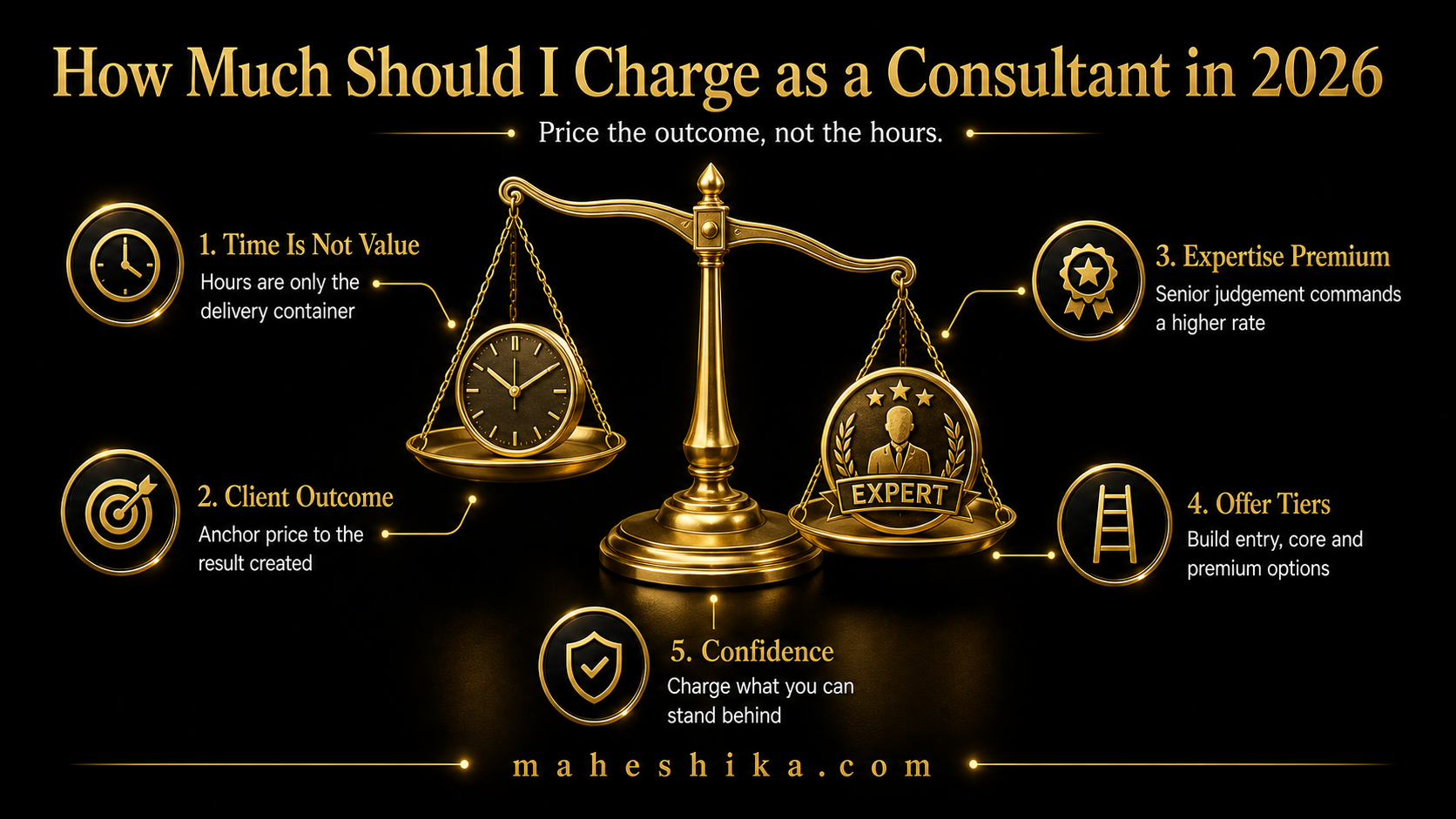
The question comes up in almost every conversation with someone transitioning to independence: what should I charge? It is a reasonable question, and the answer is less complicated than most people fear, once you understand what actually determines consulting rates.
The short answer is this: for senior professionals with ten or more years of domain experience, realistic day rates in the UK sit between one thousand and three thousand pounds. Project fees and retainers often translate to effective hourly rates well above that. The longer answer is that the right number for you depends on several specific factors, and understanding those factors is more useful than any generic figure.
What Drives Consulting Rates in 2026
Consulting rates are a function of several intersecting factors, and the most important of them has nothing to do with your years of experience. It is the specificity and scarcity of what you know.
A generalist management consultant with twenty years of experience earns less than a highly specific expert in a narrow, high-stakes domain with ten years of experience. The market pays for the combination of expertise that is difficult to replicate and the ability to solve problems that are expensive to leave unsolved.
The key factors that move rates upward: deep specialism in a high-value domain, a track record of measurable results, experience working at senior or board level, expertise in a regulated or technically complex sector, the ability to operate internationally, and credentials or authority signals such as published work or a significant industry profile. Any one of these factors alone justifies a premium. Several of them together justify significant pricing above the market median.
Factors that create downward pressure: operating as a generalist, targeting small businesses with limited budgets, lacking a visible track record or authority signal, and positioning your work as task fulfilment rather than outcome delivery.
Realistic Rate Ranges by Context
These are indicative ranges for UK-based independent consultants in 2026. They are starting points for your thinking, not ceilings.
Strategy and commercial consulting: Day rates typically range from fourteen hundred to two thousand five hundred pounds for experienced practitioners, rising above three thousand for those with a strong track record and premium positioning in their sector.
Technology and digital transformation: Technical depth commands a premium. Senior technology consultants and architects commonly charge between fifteen hundred and three thousand pounds per day. Highly specialised AI and data roles can go higher, particularly where the skill set is scarce.
Finance, risk, and regulatory: Regulated sectors pay well for the combination of domain expertise and credibility. Rates of fifteen hundred to two thousand five hundred per day are common for senior practitioners, with compliance and regulatory specialists at the upper end during periods of regulatory change.
HR, talent, and organisational development: This discipline has a wider range. Generalist HR consultants tend to sit at the lower end of the market. Specialists in executive assessment, organisational design, or major change programmes can command rates comparable to strategy consultants.
Speaking and facilitation: Corporate keynote fees range from a few hundred pounds for smaller events to several thousand for major conferences and corporate leadership events. Half-day and full-day facilitation typically ranges from two thousand to six thousand pounds depending on the audience, the organisation, and the consultant's profile.
One important note: these are day rates. Project fees and retainers, structured well, almost always produce a better effective rate per hour of work invested. A three-week project billed at twenty thousand pounds represents a very different economics to three weeks of day rate billing.
Related Reading
The Floor You Must Not Fall Below
Before you name a number to a client, you need to understand your floor: the minimum you need to earn per day to run a viable, sustainable business.
The calculation is more involved than most people expect. Start with your target annual net income. Add back your tax liability. Add your business costs: insurance, accounting, software, travel, professional development, your home office, your pension contributions. Add the cost of unbillable time: business development, proposal writing, administration, holidays, downtime between projects. Now divide the total by the number of days you realistically intend to bill in a year, factoring in that not all working days are billable days.
For most independents, that floor lands higher than they expect. Two hundred thousand pounds target gross income across one hundred and forty billable days per year requires a day rate of approximately fourteen hundred and thirty pounds. At one hundred billable days, it requires two thousand. Understanding this arithmetic removes the temptation to accept work at rates that erode rather than build your financial position.
Free Tool
Start free: where do you actually stand?
Two free tools give you an honest answer in minutes. The AI Risk Score shows how exposed your role is. The Expertise Ownership Score shows how findable and owned your expertise is.
AI Risk Score Expertise Ownership ScoreHow to Test Your Rate Before You Commit
There is a practical way to calibrate your rate before you go to market with it: tell people your rate and observe their reaction.
If potential clients respond to your rate with an immediate and unconditional yes, you are almost certainly too low. If every single person pushes back, you may be ahead of where your current authority signals can support, and the answer is usually to build those signals rather than lower the price. The healthy zone is somewhere in between: occasional pushback, occasional negotiation, but a clear sense that the right clients see the value and proceed.
Start by having conversations with people who know your work well. Former employers, colleagues, and network contacts who understand your capability are the most reliable calibrators. Ask them honestly: given what you know I can deliver, what would you expect to pay for my time? Their answers will tell you more than any benchmarking exercise.
The Number Behind the Number
So there is your answer: your rate is not a lookup table, it is the sum of your specificity, your proof, and your floor. Get specific about what only you know, gather the evidence that you deliver it, do the arithmetic on what you actually need to earn, then test the number in the real world and adjust. Most people who feel underpaid are not undercharging. They are under-proven.
But here is what that arithmetic does not show you. Every factor that pushes your rate up, the track record, the authority signals, the published work, the industry profile, depends on one thing: that a client can find the evidence before they ever speak to you. A day rate lives or dies on proof, and proof that only exists in your memory, your old job title, or a former employer's website is proof a client cannot see. AI can already quote a generic day rate for a generic consultant. It cannot show anyone your body of work, because it does not exist anywhere.
That is the quiet cost of staying invisible. It is not that you charge too little for one project. It is that every project starts the negotiation from zero, because there is nowhere for a prospective client to see, before they call, exactly what you are worth. The consultants who sit at the top of every range in this article are rarely the most experienced person in the room. They are the ones whose evidence is already visible, under their own name, before the conversation even starts.
That is what a personal website under your own name does for your pricing power. It is not a brochure. It is where your track record lives, permanently, findable, and unmistakably yours, so your rate is proven before you say a number out loud. If you want help building that, let us talk.