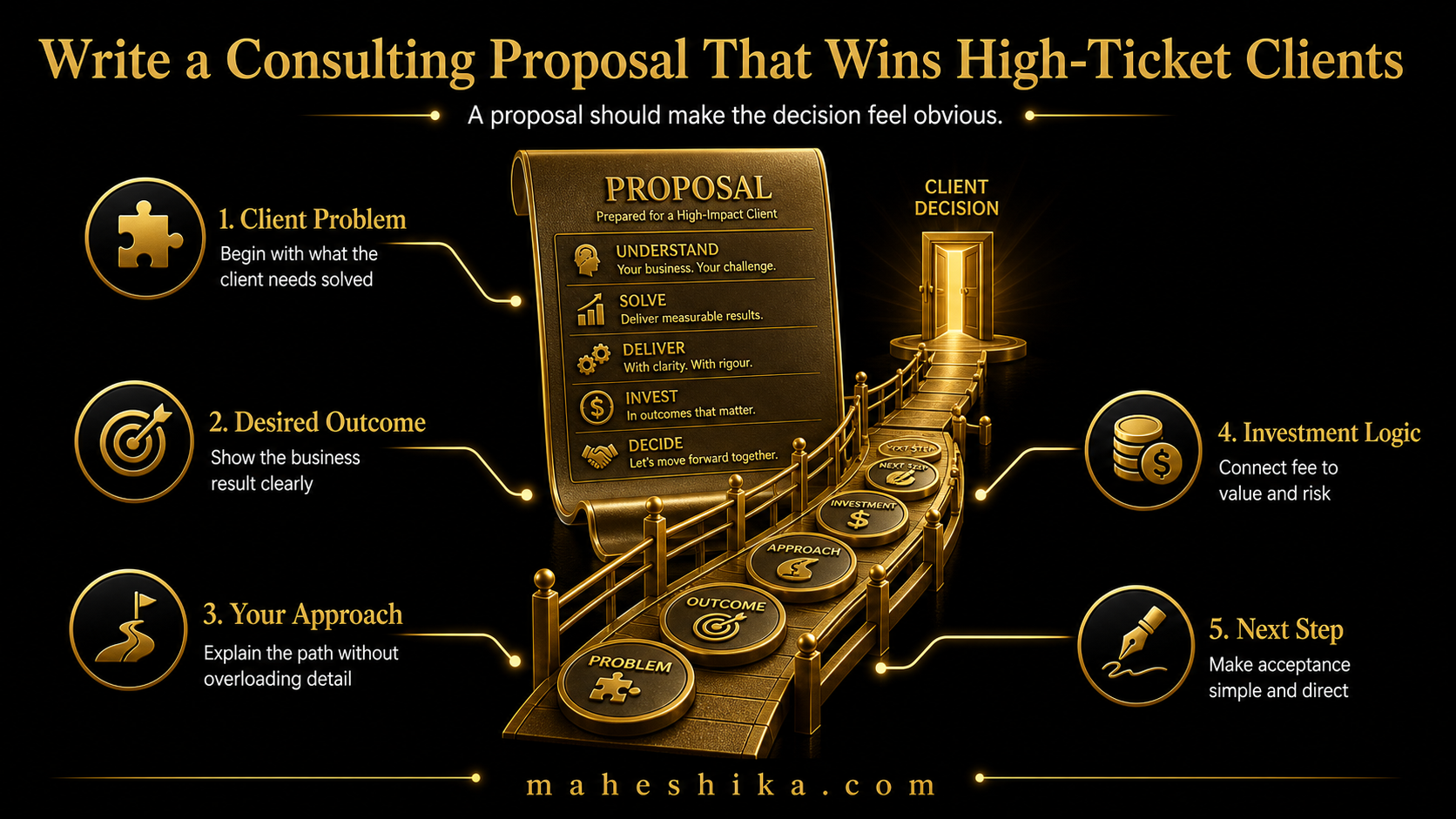
A consulting proposal is not a document. It is a decision-making tool. Its purpose is to make it easy for the right client to say yes, and to make clear to the wrong client that this engagement is not for them. Most consulting proposals fail at both.
The proposals that win high-ticket engagements share a specific set of characteristics, and almost none of them are about length, formatting, or the number of appendices. They are about clarity, specificity, and the confidence to position your work as the logical solution to a problem the client is already feeling.
The Proposal Starts Before You Write a Word
A proposal that wins has already done most of its work in the conversation that preceded it. If you are writing a proposal without having had a substantive discovery conversation with the client, you are guessing. Proposals built on guesses lose, even when the guess is educated.
The discovery conversation should answer five questions clearly. What specific problem is the client trying to solve? What have they already tried, and why did it fall short? What does success look like in specific terms? What is the consequence if the problem is not solved? Who else is involved in the decision? Without clear answers to these questions, your proposal is a generic document. With them, it is a mirror that shows the client exactly what they need to see.
Never send a proposal without having had this conversation first. Requests for a proposal without a prior conversation should be treated as requests for capability, not as genuine buying intent, unless the client has a prior relationship with you. In those cases, respond with a brief statement of capability and an invitation to speak before proposing.
The Structure That Works
Senior clients read proposals differently from junior buyers. They scan first. They read what catches their attention. They look for the problem statement, the fee, and the evidence that you understand their situation before they read anything else. Structure your proposal accordingly.
A winning high-ticket consulting proposal has these sections, in this order.
The situation summary. Two to three paragraphs that demonstrate you understood exactly what the client told you. Use their language, not yours. Name the specific problem, the specific context, and the specific consequence of not solving it. If this section reads like something you wrote for every client, it will lose. If it reads like you were paying close attention to this client specifically, it will win.
The proposed approach. A clear description of how you will work, broken into phases or stages if the engagement is complex. This is not a methodology lecture. It is a reassurance that you have a credible, structured approach. Three to five stages, each with a named output or outcome, is usually sufficient. Clients do not need to understand the detail of how you work. They need to trust that you do.
What success looks like. Name the outcomes you expect to deliver. Be specific. "Improved commercial clarity" is not an outcome. "A commercial strategy document with prioritised revenue opportunities and a clear twelve-month execution roadmap" is an outcome. Specificity creates confidence.
Timeline and logistics. When you will start, when key outputs will be delivered, what you need from the client in terms of access and time. Keep this section brief and factual.
Investment. Your fee, clearly stated, with the structure explained if it is a phased or milestone-based arrangement. Do not apologise for the number. Present it in the same tone as the rest of the document: confident and matter-of-fact.
Why you. A short section, or even a sidebar, that makes the case for your specific background and track record. Not a biography. The relevant evidence for this particular engagement.
Related Reading
The Language That Wins and the Language That Loses
Language matters more in proposals than in almost any other business document. Every word choice signals how you think about the client's situation and how confident you are in your ability to address it.
Winning language is specific, confident, and client-centred. It talks about the client's outcomes rather than your process. It uses precise terms drawn from the client's own description of the problem. It presents your approach as the natural, logical response to the specific situation, not as a templated service applied to a generic problem.
Losing language is hedged, generic, and consultant-centred. Watch for: "leveraging our extensive experience", "a tailored approach to your unique challenges", "best-in-class frameworks", "working collaboratively to explore opportunities". These phrases are so common in consulting proposals that they have become meaningless. They signal template, not thought.
Write in plain sentences. Short paragraphs. Specific nouns. Active verbs. A proposal that sounds like you wrote it for one specific client in one specific situation will almost always outperform a proposal that sounds like a capable consultant who could work with anyone.
Free Tool
Start free: where do you actually stand?
Two free tools give you an honest answer in minutes. The AI Risk Score shows how exposed your role is. The Expertise Ownership Score shows how findable and owned your expertise is.
AI Risk Score Expertise Ownership ScoreCommon Proposal Mistakes That Kill High-Ticket Deals
After years of working with senior professionals building their independent consulting practices, I see the same proposal mistakes appear repeatedly. Each of them is fixable once you know what to look for.
Writing the proposal before understanding the decision process. Who signs off? Who influences? What is the timeline? A proposal sent to the wrong person or at the wrong time loses regardless of quality.
Pricing without discussing value first. If your first conversation about money is in the written proposal, you have skipped a step. Explore budget and value expectations in the discovery conversation so the number in the proposal is broadly anticipated, not a shock.
Over-explaining the methodology. Clients hire consultants for their judgement, not their processes. A detailed description of your analytical framework does not build confidence. It builds doubt about whether you can think flexibly when the situation demands it.
Providing options when there should be one recommendation. Many consultants offer tiered options in proposals as a way of accommodating different budgets. This dilutes your authority. You are the expert. Make a recommendation. If budget is genuinely a constraint, discuss it in the conversation, not through a menu of options in the document.
After You Send: Following Up Without Losing Dignity
A proposal sent is not a proposal considered. Senior decision-makers operate in complex environments with competing priorities. Chasing with dignity means following up once, specifically, and not interpreting silence as rejection.
A follow-up sent three to five days after a proposal is professional and expected. Keep it brief: a single sentence acknowledging the proposal has been sent, a question about whether any additional information would be helpful, and an offer to speak if it would be useful. That is sufficient for one follow-up. If there is no response after a second follow-up at two weeks, shift the proposal to your pipeline as uncertain and redirect your energy.
The best consultants view proposal writing as a craft that improves with practice. Keep a file of your best proposals, the ones that converted and the ones that did not. The patterns become clear quickly, and the quality compounds over time.
The One Asset No Proposal Can Replace
So a winning proposal is never really about the document. It is proof, in writing, that you understood one client's specific problem better than the other two consultants they are quietly comparing you against. Get the situation summary specific, mirror their language, name the consequence of inaction, make one clear recommendation, and the fee stops being a number you defend. It becomes the obvious way through.
But every proposal you write now faces the same quiet threat. AI can draft a competent one in under a minute, in a voice that sounds like every other consultant's. Your edge was never the document itself. It was the depth behind it, the years of pattern recognition that let you name a client's problem before they finish describing it. If that depth only ever shows up in proposals that vanish into a single inbox, the client has no way to see it before they ask you to write one.
That is the real risk sitting quietly inside every RFP you get. You lose ground the moment a client cannot find proof of your thinking before the first call, because somewhere else, another expert already has a body of work sitting in public view under their own name, doing the persuading before the proposal stage even begins. The consultants who keep winning high-ticket work are not writing cleverer proposals. They own a place where their judgement is already on display, findable in a search, impossible to mistake for a generic answer.
That place is worth building properly, and you do not have to work it out alone. If you want your own thinking findable before the first conversation ever starts, let us talk.