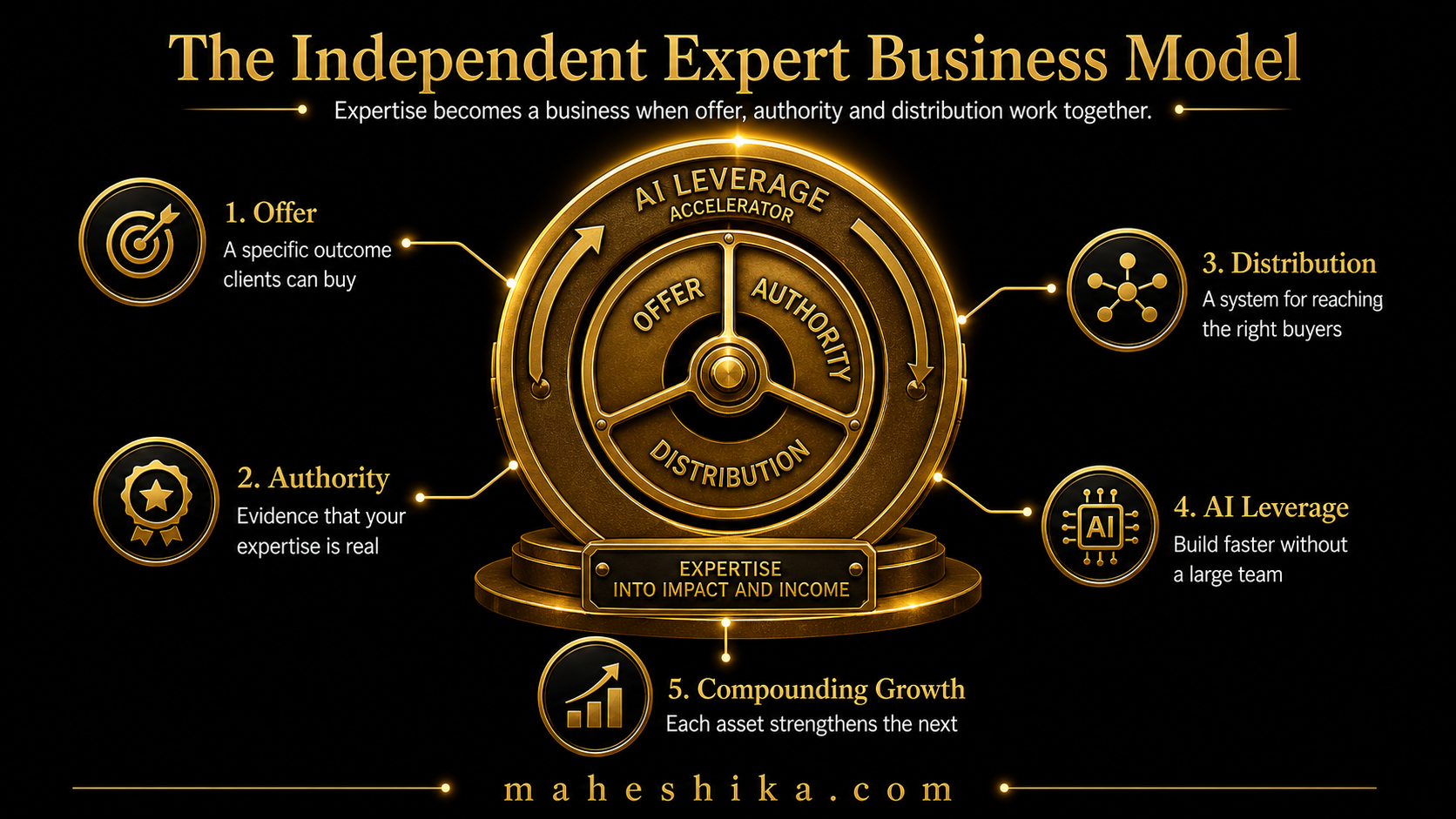
Most senior professionals leave corporate life having built extraordinary expertise, and then spend the first year of independence undercharging, over-explaining, and waiting for clarity that never arrives through waiting. The independent expert business model solves that. It is a specific architecture for turning professional knowledge into a sustainable, high-margin business, and it is structurally different from freelancing, contracting, or simply "consulting".
I built this guide because when I went independent after 18 years of enterprise commercial experience, I had to reverse-engineer almost everything. The frameworks that existed were built for generalists, for solopreneurs starting from scratch, or for digital product sellers. None of them mapped to what I was: someone with deep domain expertise, a senior network, and the ability to deliver real results for organisations. If that describes you too, this is your guide.
What the Independent Expert Model Actually Is
The independent expert model is not about selling your time by the day. It is about packaging your knowledge, your judgement, and your network into a business that solves high-value problems for organisations or individuals who cannot afford to hire you full-time but desperately need your capability.
This distinguishes it from contracting (where you fulfil a role) and from traditional freelancing (where you fulfil tasks). An independent expert operates at the level of outcomes. You are hired because the client does not have the perspective or the capability you carry, not because they need a pair of hands.
The model has four defining characteristics. First, your positioning is specific: you are known for solving a particular category of problem for a particular type of client. Second, your pricing reflects value, not time. Third, your business operates on a small number of high-quality engagements rather than a large volume of low-margin work. Fourth, your authority grows over time through writing, speaking, and reputation, which means your pipeline compounds rather than starting from zero every year.
When I wrote The Job Well Done, it was not just a book. It became the physical embodiment of my authority as a practitioner, a proof of thinking that opened doors no CV could. That is the independent expert model in action: your ideas carry commercial weight.
The Three Income Streams
A well-structured independent expert business has three layers of income, and they compound each other.
Consulting and advisory work is the foundation. This includes project-based engagements (a defined scope, a defined outcome, a fixed fee), retainer arrangements (ongoing access to your thinking for a monthly fee), and advisory board roles (structured time commitment at the strategic level). Most experts begin here and build the other streams from the credibility this creates.
Speaking and facilitation sits at the mid-tier. Conference keynotes, corporate workshops, leadership retreats, and facilitated strategy days all fall here. Speaking is a high-leverage activity: you invest preparation time once and deliver it to rooms of decision-makers who may become clients. The fees vary significantly by context, but the client acquisition value of a well-placed keynote exceeds the fee many times over.
Products and programmes form the leverage layer. Books, frameworks, online courses, digital guides, group programmes, and cohort-based learning all belong here. These are created once and deliver value repeatedly. A book like The Job Well Done generates trust and inbound enquiries continuously. A structured programme allows you to serve more people without trading proportionally more time.
The strategic insight is that these three streams feed each other. A speaking engagement creates consulting clients. A book creates speaking invitations. A consulting engagement generates the case studies that populate the next book or programme. Build all three deliberately, even if you start with just one.
How to Price Your Expertise
Pricing is where most independent experts leave the most money on the table, and it is almost always because they are pricing their time rather than their value.
The calculation I recommend: start with the outcome your client achieves and work backwards. If your commercial strategy engagement helps a company win contracts worth an additional two million pounds over three years, your fee is not a function of the days you spent. It is a function of the outcome you enabled. Even a fee of thirty thousand pounds is a fraction of the value created.
For day rates, the realistic range for senior independent consultants in the UK in 2026 sits between one thousand and three thousand pounds per day, depending on specialism and sector. Highly technical or regulated sectors command the upper end. But day rates are a starting point, not a ceiling. Once you can demonstrate consistent results, project fees and retainers are almost always more profitable per hour of actual work invested.
The full pricing guide is here: How to Price Your Expertise: A Complete Rate Guide for 2026.
Building Your First Offer
Your first consulting offer does not need to be a complete product suite. It needs to solve one specific problem for one specific type of client, and it needs to be described in the language of the outcome, not the process.
Bad offer framing: "I provide strategic consulting to businesses in the technology sector."
Good offer framing: "I help Series B technology companies build the commercial infrastructure to scale revenue from five million to twenty million without hiring a full commercial director."
The specificity is not limiting. It is magnetic. The right clients self-select immediately. The wrong clients opt out early, which saves everyone time.
For your first offer, keep the structure simple. A diagnostic or audit engagement of one to two days is an accessible entry point that delivers immediate value and creates natural progression to a larger project. Price it at a level that reflects your seniority, not your nervousness about charging.
The offer stack evolves as you accumulate evidence of results. Start with one clear, specific offer. Add complexity only when your first offer is consistently converting.
Getting Your First Client
Your first consulting client almost certainly already knows you. They are a former employer, a former colleague, a peer from an industry association, or someone who has watched you work and respected what they saw.
The mistake most new independents make is building infrastructure before building pipeline. They design logos, debate company names, and build websites while their network cools. The sequence should be reversed: have a conversation about what you are doing before you have a business card to show for it.
The most effective approach: make a list of fifteen to twenty people who know your work well enough to recommend you or to hire you directly. Reach out to each of them with a clear, honest description of what you are doing and who you are trying to help. Not a pitch. A conversation. Ask who else you should be talking to. Referrals from trusted sources close at a far higher rate than cold outreach.
The goal is to have your first paid engagement before you formally "launch". This is entirely achievable if you start the conversations early, ideally before you leave your corporate role. Full guidance is here: How to Get Your First Consulting Client Before You Leave Your Job.
Related Reading
Legal and Financial Setup
The structure question most people agonise over is sole trader versus limited company. For most UK-based independent consultants starting out, a limited company is worth setting up early. It provides liability protection, creates a more professional perception for corporate clients, and offers tax efficiency through the combination of salary and dividends. It also matters for IR35 purposes: if you work primarily through your own company, the IR35 rules determine whether HMRC treats your income as employment income. This is not a simple assessment and is worth a conversation with an accountant who specialises in contractor and consultant structures before you take on your first engagement.
Beyond structure, the practical priorities are: a separate business bank account (non-negotiable from day one), professional indemnity insurance (required by most corporate clients and genuinely important protection), a standard consulting contract that you own and control, and basic accounting software that keeps your records clean from the start.
None of this is complicated, but the order matters. Do not sign your first client contract without having your own terms of business and your insurance in place. The full setup checklist is here: How to Set Up as an Independent Consultant: Legal, Financial, and Practical Steps.
Free Tool
Start free: where do you actually stand?
Two free tools give you an honest answer in minutes. The AI Risk Score shows how exposed your role is. The Expertise Ownership Score shows how findable and owned your expertise is.
AI Risk Score Expertise Ownership ScoreWhy AI Is a Multiplier, Not a Replacement
The arrival of capable AI tools changes the independent expert model in one important way: it removes almost every operational bottleneck that previously required either significant time or support staff.
Proposals that once took half a day now take thirty minutes. Research that required a junior analyst can be done before a client call. Content that used to be outsourced can be produced in-house. Administrative load, the historic tax on small business, compresses dramatically.
This matters because the independent expert model has always had a ceiling defined by human capacity. One person can only hold so many client engagements, produce so much content, and respond to so many enquiries. AI does not remove the ceiling entirely, but it raises it significantly, and it does so without proportional increases in cost.
I am a daily practitioner of Claude and Claude Code. Not because it is fashionable, but because it materially changes what I can deliver and how fast I can build. An independent expert who uses AI well does not compete with other independents on capacity. They compete on a different axis entirely.
The implications for positioning are also significant. Clients increasingly understand that the best independents are using AI as a force multiplier. If you can articulate how your AI-enhanced process delivers better or faster outcomes, that becomes a competitive differentiator rather than a box-ticking exercise.
All Articles in This Guide
This guide is the pillar page for a complete library of articles on building and running an independent expert business. Each article below goes deep on one specific aspect of the model.
Pricing and Proposals
- How to Price Your Expertise: A Complete Rate Guide for Independent Consultants in 2026
- How Much Should I Charge as a Consultant in 2026?
- How to Write a Consulting Proposal That Wins High-Ticket Clients
Making the Transition
- How to Go Independent as a Senior Professional Without Losing Your Income
- The First 90 Days of Going Independent: What No One Tells You
- How to Get Your First Consulting Client Before You Leave Your Job
- How to Set Up as an Independent Consultant: Legal, Financial, and Practical Steps
- Why Going Independent in Your 40s Is Better Than Doing It in Your 20s
- How to Replace Your Corporate Salary in Your First Year as an Independent Expert
- How to Deal With the Fear of Going Independent When You Have Financial Commitments
Building Your Business
- How to Build a Business Around Your Name
- How to Network as an Independent Consultant When You Hate Networking
Writing and Publishing
- Why Writing a Book Is the Most Powerful Investment in Your Expert Business
- How to Write a Business Book When You Have Never Written One Before
- How to Use Your Book as a Lead Generation Tool for Your Consulting Business
- Self-Publishing vs Traditional Publishing: What Senior Professionals Need to Know
- How to Write a Leadership Book From Your Corporate Experience
- How to Find Your Book Idea From Your Professional Background
- How to Write a Book While Working Full Time
- How to Market a Business Book and Win Awards After Publication
Brand and Visibility
The Business Model Only Works If You Have Somewhere to Run It
So the independent expert business model comes down to this: three income streams, consulting, speaking, and products, that compound each other once your positioning is specific enough for the right people to find you and act. Get the structure right and the pricing right, and the model does the rest. It is not complicated. It is disciplined.
But every stream in that model depends on one thing none of the frameworks tell you outright: somewhere for people to land when they hear your name. A referral finds you and searches. A conference audience member remembers your keynote and looks you up. A reader finishes your book and wants to know what you do next. If what they find is a profile that looks like everyone else's, or nothing at all, the compounding stops before it starts.
This matters more now, not less. AI can answer almost any question in a voice that sounds like everyone. It cannot show a body of work with your name on it, your judgement applied to real problems, your signature unmistakable. The professionals who make this model work long term are not the ones with the cleverest pricing. They are the ones who own a place that is unmistakably theirs, findable in a search, impossible to reduce to a generic answer.
That place is what I build. If you want the Signature that turns every stream in this model into one findable, compounding asset, let us talk.