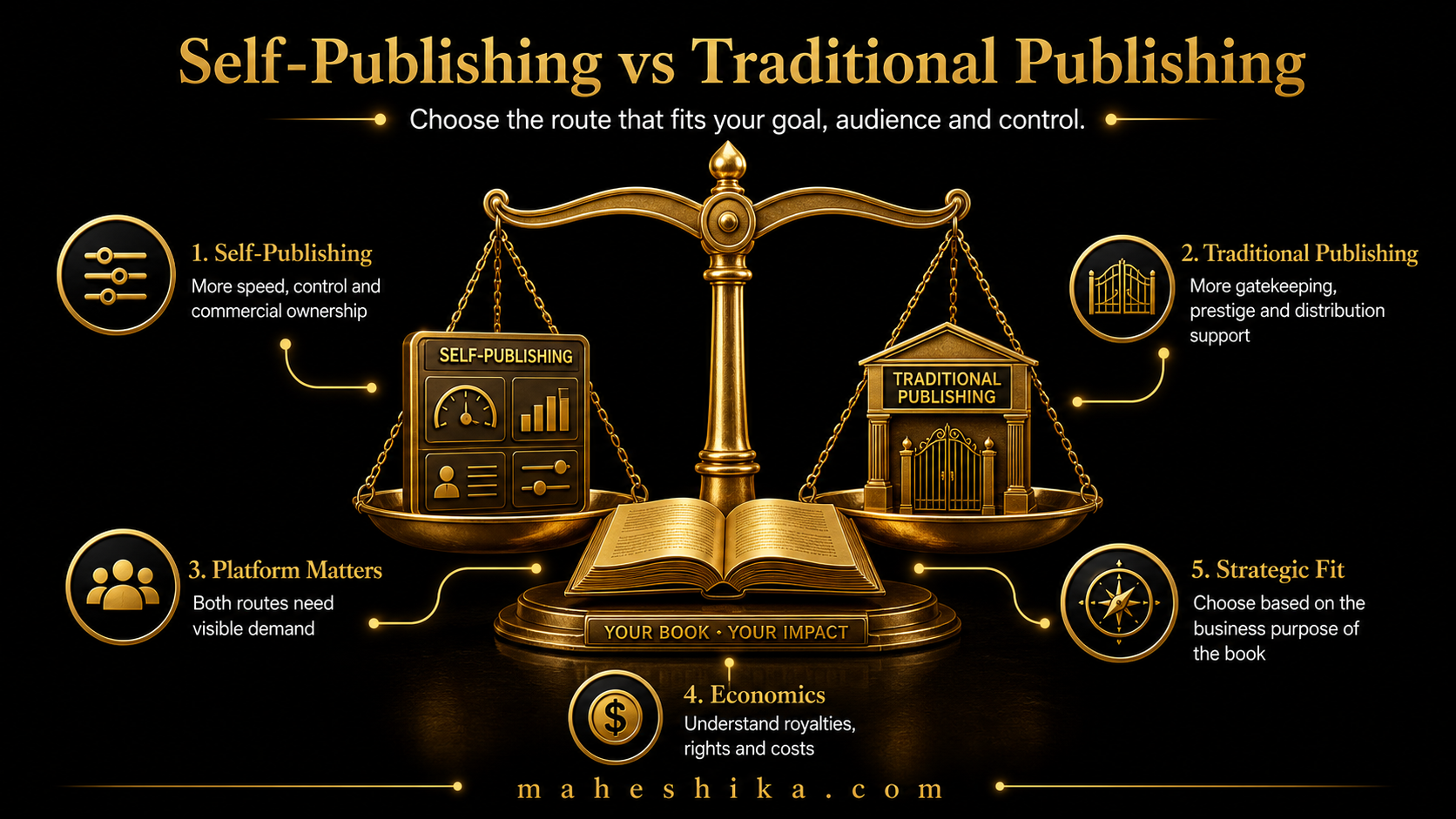
When I was preparing to publish The Job Well Done, the choice between traditional and self-publishing was not obvious. Both routes had genuine advantages. Both had real constraints. The decision came down to what I was actually trying to achieve with the book: not a bestseller chart position, but a positioning asset for my expert business that I could control, activate quickly, and deploy strategically.
For most senior professionals writing their first business book, this is the right frame. The question is not which route is more prestigious. It is which route gives you the most control, the fastest time to market, and the best alignment with your business goals. Here is an honest account of both.
The case for traditional publishing
Traditional publishing, through a major or mid-size publisher, brings genuine advantages that should not be dismissed. The most significant is the credibility signal: a book published by an established house carries an implicit editorial endorsement that self-published books do not. For certain audiences, particularly academic institutions, large corporations, and broadcast media, this distinction still matters.
Traditional publishers also bring distribution infrastructure. Physical bookshop placement, international territory rights, bulk sales channels, and review coverage in mainstream business press are all more accessible through a publisher than through self-publishing platforms. If your primary goal is mass market reach and you are willing to sacrifice control to achieve it, traditional publishing is worth pursuing.
The constraints are significant. Securing a traditional publishing deal requires a literary agent, a detailed book proposal, and a submission process that typically takes 12 to 24 months from first query to publishing offer. Even after a deal is signed, the time from accepted manuscript to published book is usually 18 months. The total timeline from decision to published book is often three to four years. For a business book built around current thinking in a fast-moving field, this is a material disadvantage. And royalty rates from traditional publishers are typically 10% to 15% of cover price. You have written the book. The publisher keeps most of the revenue from selling it.
The case for self-publishing
Self-publishing has transformed since the days of vanity presses and photocopied pamphlets. Professional self-publishing, done properly, produces a finished product that is indistinguishable in quality from traditionally published books. The stigma has largely dissolved, particularly in business publishing, where content quality and author credibility matter more than imprint name.
The advantages are control, speed, and economics. You control the cover design, the interior layout, the price point, the distribution channels, and the marketing strategy. You can publish in four to six months after completing the manuscript. And royalties through platforms such as KDP and IngramSpark range from 35% to 70% depending on format and channel, far above the traditional publishing rate.
For an expert building a consulting business, the control over content is particularly valuable. Traditional publishers sometimes require changes to positioning, title, or emphasis that dilute the book's commercial usefulness as a business tool. When you self-publish, the book says exactly what you need it to say, in exactly the voice that represents your brand.
The constraint is that all editorial, design, and production responsibilities are yours. You must invest in professional editing, professional cover design, and professional interior formatting. Cutting corners on these produces a book that undermines your credibility rather than building it. Budget appropriately: a professionally produced self-published book requires meaningful investment in these services.
Related Reading
The hybrid option: a middle path worth considering
Hybrid publishing sits between traditional and self-publishing. A hybrid publisher provides editorial, design, and production services in exchange for a fee from the author, and offers higher royalties and more author control than traditional publishers. Quality varies enormously across hybrid publishers. Some offer genuinely valuable services. Others are essentially paid vanity presses with professional marketing materials.
A reputable hybrid publisher can be a strong option for a first-time author who wants professional support through the production process but does not want to wait three years for a traditional deal. Research any hybrid publisher carefully: look at their existing titles, speak to authors who have worked with them, and scrutinise the contract terms before signing.
Free Tool
Start free: where do you actually stand?
Two free tools give you an honest answer in minutes. The AI Risk Score shows how exposed your role is. The Expertise Ownership Score shows how findable and owned your expertise is.
AI Risk Score Expertise Ownership ScoreWinning awards regardless of your publishing route
One persistent myth is that book awards are only accessible to traditionally published books. This is not accurate. Many major business book award programmes, including those I entered with The Job Well Done, accept self-published submissions. The evaluation criteria are the content and quality of the book, not the imprint on the spine.
Award wins and shortlistings are available to any professionally produced book with genuinely strong content. They provide third-party credibility that partially compensates for the absence of a traditional publisher's name. A self-published book that wins three or four awards is more credible, not less credible, than a poorly reviewed traditionally published book.
The Book Was Never the Whole Answer
So weigh the decision on control, speed and economics, not prestige. For almost every senior professional building an expert business, self-publishing wins on all three, with a hybrid path worth a look if you want production support without the three year wait. Choose the route that gets your thinking into the world fastest, in the form that serves your business rather than a publisher's catalogue.
But here is what the publishing decision quietly exposes. A book, however it is produced, is still a single asset sitting on a retailer's page you do not own, next to a thousand other titles, governed by an algorithm that owes you nothing. Your imprint, your ISBN, even your author page on someone else's platform can be delisted, deprioritised or simply lost in the scroll. None of that is yours in the way that matters.
And this is the moment AI can answer almost any question a prospective client might have, in a voice that sounds like everyone else's. What cannot be reproduced is a specific person's specific thinking, shown in one place, under their own name, that a search engine finds and a client trusts. A personal website is not a marketing extra sitting next to your book. It is the one property you own outright, where your framework, your case studies and your book itself live together as unmistakably yours, impossible to reduce to a generic answer.
You have already done the harder work of writing the book. Do not let the platform decision be the only thing standing between that work and being found. If you want your website built properly, by someone who has been through exactly this publishing decision herself, let us talk.