When I wrote The Job Well Done, I did not know exactly what it would become. I knew I had something worth saying about leadership, drawn from Queen Elizabeth II's 70-year reign and from my own 18 years operating across four continents. I knew the ideas were rigorous and the research was genuine. What I did not fully anticipate was the way a book changes everything: how people see you, what they invite you to do, and what becomes possible that was not possible before.
The book won four awards, including the BookFest Winner and Literary Titans recognition, as well as a Business Book Awards Finalist placing. But the most significant return was not the awards. It was the positioning. A published book communicates authority in a way that no LinkedIn profile, no website, and no set of credentials can replicate. This is why I consider writing a book the single most powerful investment an expert can make in their business.
A book establishes authority that outlasts every conversation
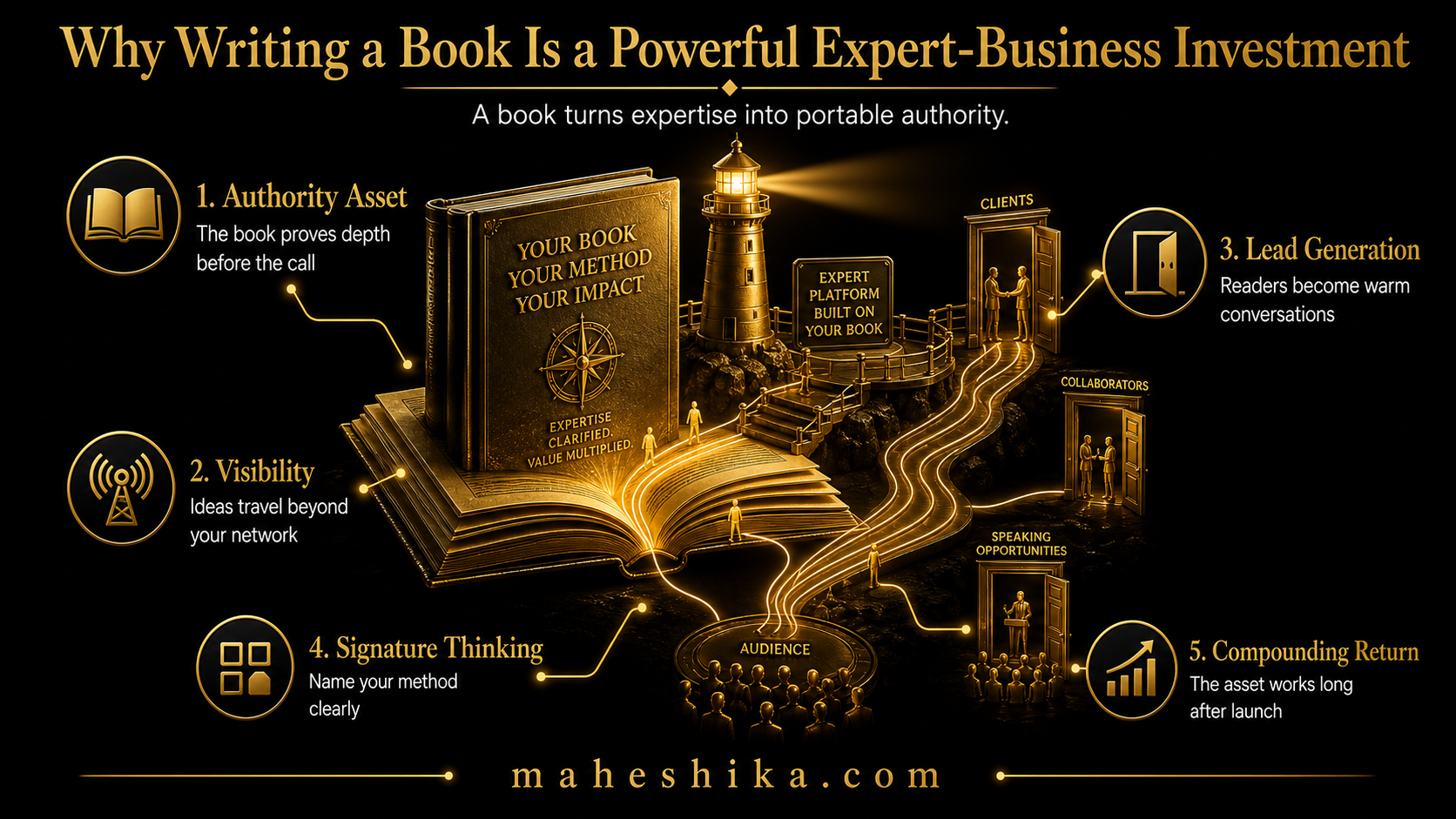
Every other marketing tool requires you to be present. A LinkedIn post performs for a few days and then disappears. A conference talk reaches the people in the room and rarely travels much further. A podcast episode has a shelf life. A book sits on someone's desk, on their shelf, on their Kindle, and continues representing you when you are not in the room.
When a prospective client or speaking organiser picks up your book, they spend hours with your thinking. By the time they reach the final chapter, you have had a conversation that most consultants never get to have. The trust built through a book is qualitatively different from the trust built through social media. It is deeper, slower, and far more durable.
This is the asymmetry that most experts miss. Time spent writing a book is not linear time. It compounds. Every hour you put into the manuscript becomes hundreds of hours of influence across the years that follow publication.
A book reframes how the market categorises you
Before I published, I was a commercial leader with impressive credentials. After publication, I was an author. That distinction matters more than it should, but it does matter. Author status carries a weight that credentials alone do not. It signals that you have not only done the work but have thought about it deeply enough to synthesise it into a body of knowledge worth preserving.
For independent experts, this repositioning is commercially significant. It lifts you out of the commodity tier of "consultant" and places you in the category of "thought leader." The practical difference: thought leaders are sought out. Consultants are sourced. Being sought out changes your pricing power, your client quality, and your negotiating position entirely.
A book generates speaking, consulting, and media opportunities passively
After The Job Well Done was published, I began receiving speaking invitations from organisations I had never contacted. Conference organisers, business schools, corporate events teams. They had found the book. The book had done the outreach for me.
This is the passive lead generation that no other marketing investment delivers at the same scale. Speaking fees, consulting engagements, media interviews, podcast invitations: all of these are downstream of the book. And because the book contains your thinking in full, the people who come to you through it already understand what you stand for. The conversations start three steps ahead of where they would otherwise begin.
The book is not just a product. It is a calling card that works without you, at hours you are not working, in rooms you have never entered, for audiences you have never met.
Related Reading
Free Tool
Start free: where do you actually stand?
Two free tools give you an honest answer in minutes. The AI Risk Score shows how exposed your role is. The Expertise Ownership Score shows how findable and owned your expertise is.
AI Risk Score Expertise Ownership ScoreWriting forces the clarity that consulting requires
There is a secondary return on writing a book that is easy to overlook: what it does to your own thinking. The act of writing a full-length manuscript forces you to articulate your frameworks, confront the gaps in your reasoning, stress-test your assumptions, and arrive at a level of clarity about what you actually believe and why.
Many experts carry profound knowledge that they cannot yet fully articulate. They know what to do in a given situation through intuition built from experience, but they struggle to explain the underlying logic clearly enough to teach it or price it. Writing a book solves this problem. By the time you finish the manuscript, you have a sharper, more structured understanding of your own expertise. And that clarity translates directly into better consulting work, more compelling proposals, and significantly stronger presentations.
The investment is time, not money
Unlike most business investments, writing a book requires primarily time rather than capital. The manuscript itself costs nothing to produce beyond the hours you commit to it. The publishing route, whether self-publishing or hybrid, can be managed at modest cost relative to the commercial return. And the return is not speculative. It is structural. Every expert business with a book in it performs differently from one without.
The question is not whether you can afford to write a book. It is whether you can afford not to. For every year you delay, you leave the calling card undone, the authority signal unmade, the speaking invitations unreceived. The compounding starts on the day the book is published. The earlier that day comes, the greater the return across your career.
The Home Your Book Deserves
So here is the answer to the question this whole article has been circling. A book is the single most powerful investment in your expert business because it is the only marketing asset that keeps working without your attendance, not for a news cycle, not for a season, but for the length of your career. Every hour spent writing becomes hundreds of hours of quiet influence, reaching rooms you never enter and prospects you never meet.
But a book on its own drifts. It sells your credibility for a moment, and then the reader closes it and searches your name to see what else is true. If what they find is a thin LinkedIn profile and a scatter of old mentions, the authority the book built starts leaking away in the very moment it should be converting. This matters more each year, not less. AI now answers most questions in a voice that sounds like everyone else's, and a title or an employer can vanish overnight, taking your visibility with it.
The one thing that holds all of that together is a place that is entirely yours: a personal website under your own name, where the book lives permanently alongside the talks, the case studies, and the thinking that produced it. Owned outright, found in a search, impossible to mistake for a generic answer. That is not a nice add-on to a book. It is what makes the book's authority permanent instead of borrowed.
You have already done the hard part by writing something worth reading. Giving it a home worthy of that work is a shorter conversation than you think. If you would like to talk it through, let us talk.