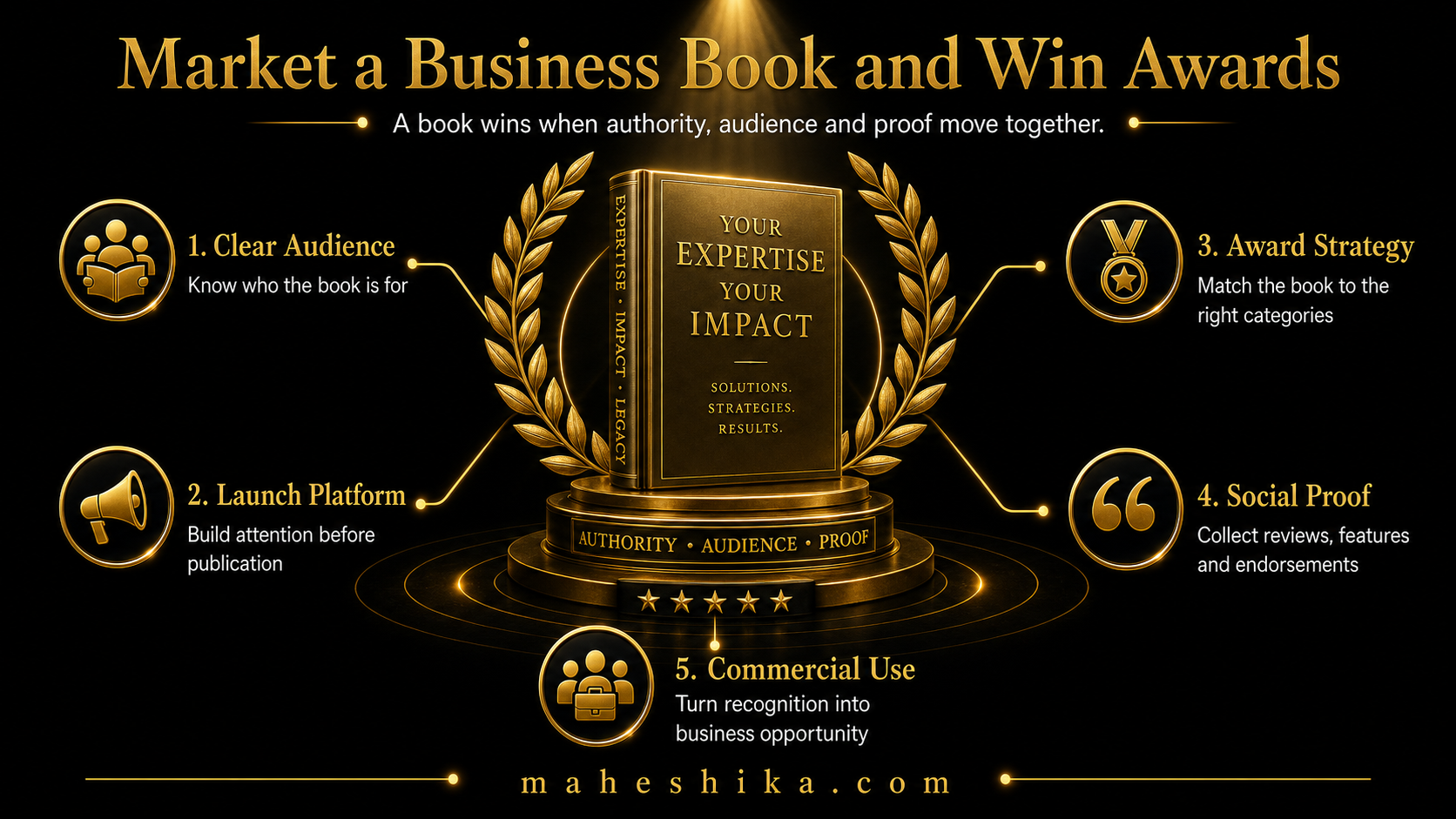
Publishing a business book without a marketing strategy is like launching a product without distribution. The book exists, but reaching the people who need it requires deliberate, sustained effort after the manuscript is complete. Most first-time business book authors underestimate how much of the work happens after publication.
With The Job Well Done, I built a post-publication strategy that generated four award recognitions, including the BookFest Winner, a Literary Titans award, and a Business Book Awards Finalist placing, as well as speaking invitations and consulting enquiries from people who found the book rather than me personally. Here is what I learned about marketing a business book and pursuing awards strategically.
Launch with momentum, not noise
A book launch is not a single announcement. It is a three-to-four-week campaign built around a sequenced release of content that gives different audiences multiple reasons to engage. The sequence typically runs as follows.
Two to three weeks before publication: announce the book with a clear statement of the problem it solves and who it is for. Not a cover reveal and a purchase link. A narrative post that explains why you wrote it, what it cost you to write it, and what the reader will be able to do differently after reading it. This generates anticipation rather than just awareness.
Launch week: serialise the key insights. A separate post or article for each major framework or idea in the book. Each of these drives traffic to the full work. Send advance copies to key people in your network with a personal note. Ask for honest reviews on Amazon, Goodreads, and LinkedIn. A handful of genuine early reviews significantly affects how the book is perceived by subsequent readers.
Two to four weeks post-launch: go broader. Guest articles in publications your target readers trust, podcast interviews, LinkedIn Live sessions or webinars built around the book's core ideas. The launch window is not the end of marketing. It is the beginning of the distribution phase.
Build a system for long-term visibility
The mistake most authors make is treating the launch as the entire marketing effort and then stopping. A business book that is marketed actively for 12 months after publication will outperform a book that had a three-week launch and was then left to find its own audience.
The system is simpler than it sounds: once per month, publish a piece of content that connects directly to an idea or framework in the book. Once per quarter, seek out one new platform for the book's ideas: a new podcast, a new speaking engagement, a new publication that covers your domain. This keeps the book in circulation without requiring a constant investment of time.
Every speaking engagement you deliver is also a book marketing event. Every consulting engagement you complete with a satisfied client is a potential book recommendation. Integrate the book naturally into your work rather than treating it as a separate marketing project.
Related Reading
The practical guide to entering book awards
Many authors do not know that book awards are something you apply for, not something that finds you. The process is not mysterious. It requires research, attention to submission criteria, and a willingness to invest a small amount of time and money in the application. The return, when an award is won or a shortlist is reached, is disproportionate to that investment.
Start by identifying awards that are relevant to your category and available to books of your publishing route. Many major award programmes accept both traditionally and self-published entries. Research each award's submission requirements carefully: some require printed copies, some accept digital, some have specific category designations that affect where your book is placed competitively.
The submission itself usually requires a short statement about the book's content and contribution. Treat this as you would treat a consulting proposal. Be specific about the problem the book addresses, the audience it serves, and what distinguishes it from comparable works in the market. Vague submissions rarely succeed. A submission that articulates clearly why this book matters to this audience, evaluated against these criteria, gives reviewers exactly what they need to advocate for it.
Enter multiple awards. Not every entry will succeed, and the cost of each entry is small relative to the value of a win or shortlisting. I entered The Job Well Done in several award programmes. The BookFest Winner designation, the Literary Titans recognition, and the Business Book Awards Finalist placing arrived from different programmes with different criteria. Each added a distinct layer of third-party credibility. Together, they transformed the book's positioning in a way that no amount of self-promotion could replicate.
Free Tool
Start free: where do you actually stand?
Two free tools give you an honest answer in minutes. The AI Risk Score shows how exposed your role is. The Expertise Ownership Score shows how findable and owned your expertise is.
AI Risk Score Expertise Ownership ScoreDeploy awards as active credibility assets
Winning an award is not the end of the marketing work. It is a new piece of material that needs to be deployed actively. Add award designations to your book cover, your website, your LinkedIn headline, your speaker bio, and your consulting proposals. Reference the award when pitching speaking engagements and media appearances. The recognition only generates commercial value when it is visible.
Award wins also provide a reason to relaunch the book's marketing. "Award-winning" is a different positioning than "newly published." It gives you legitimate grounds to resurface the book with audiences who saw the original announcement and did not act. It opens doors with publications and conference organisers who were not interested in a newly published book but will consider a request from an award-winning author.
Use LinkedIn as your primary book marketing channel
For business books by independent experts, LinkedIn is the single most effective marketing channel. The audience is professional, the content format rewards long-form thinking, and the network effects are strong: when someone engages with your book-related content, their network sees it.
A LinkedIn strategy for a business book is not complicated. Post one piece of content per week that is genuinely useful on its own, drawn from the book's ideas, without requiring the reader to purchase the book to get value from the post. The posts that generate the most engagement tend to be specific, opinionated, and rooted in a concrete insight or story. Each should include a reference to the book, but only as context, not as a sales pitch.
The readers who buy the book from LinkedIn content are rarely the ones who click a purchase link in the post. They are the ones who follow you for weeks, find the ideas consistently useful, and eventually decide they want more. Consistency over months builds this relationship. A burst of launch-week activity followed by silence does not.
Where the Real Marketing Lives
So the answer is not a launch plan, it is a system. Sequence the release, keep publishing monthly, submit to awards deliberately, and deploy every recognition the moment you win it. A book marketed this way for three years outperforms a book that had a brilliant three-week launch and was then left to fend for itself. The compounding is the whole strategy.
But here is what most authors never plan for. Every asset that strategy produces, the award badges, the LinkedIn following, the press mentions, the podcast appearances, lives on platforms you do not own. LinkedIn changes its algorithm. A publication takes an article down. An account gets suspended for no good reason. And now AI answers business questions in a voice that sounds like everyone else's, summarising your ideas without ever sending a reader to you. Years of deliberate marketing, and the proof of it can scatter or vanish, because none of it was ever truly yours.
There is one place that cannot be taken down, deprioritised, or absorbed into a generic answer: a personal website under your own name. Somewhere the book, the awards, the frameworks, and the proof of everything you built all live together, owned outright and findable in a search. It is the one asset in this entire strategy that keeps compounding whether the algorithm favours you that week or not.
You have already done the hard part: you wrote the book and you know how to market it. The next move is giving all of that work a permanent home. If you want it built properly, by someone who has done exactly this, let us talk.