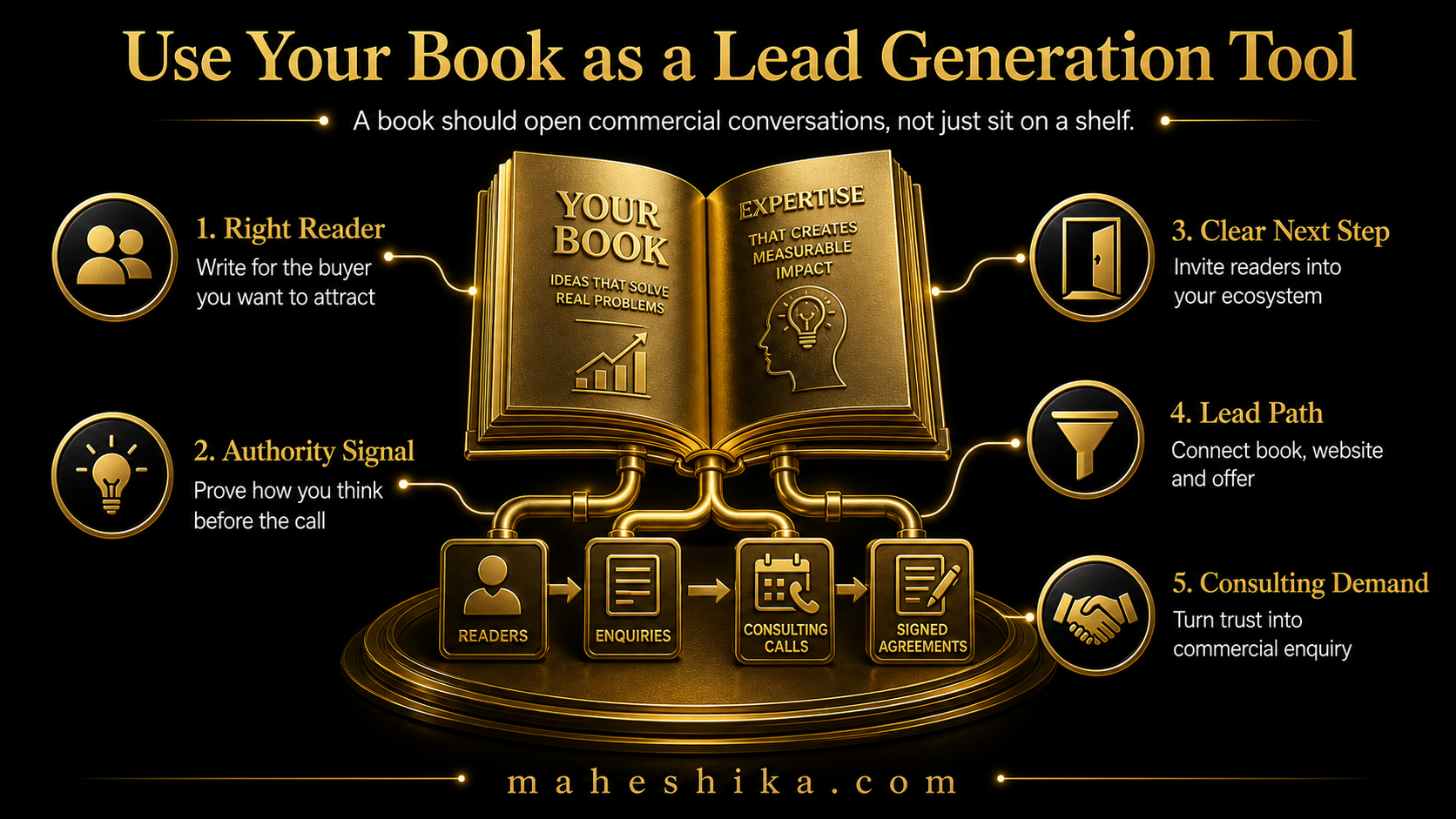
Most consultants who write a book hope it will generate leads but have no specific plan for how that happens. They publish, announce it on LinkedIn, collect congratulations, and then wait. The leads do not arrive in volume because waiting is not a strategy.
A book generates consulting leads reliably when it is deliberately positioned as a gateway to your work, distributed into the hands of the right people, and activated through a handful of simple but consistent mechanisms. Here is how each of those works.
Position the book as the entry point, not the destination
The book should not be positioned as a standalone product that people consume and put on a shelf. It should be positioned as the beginning of a conversation. Every chapter, every insight, every framework in the book should demonstrate your thinking and then leave room for the practical application, which is where consulting comes in.
This means the book's content should be genuinely useful on its own, comprehensive enough that readers feel they have received real value, but also honest about the gap between understanding a framework and implementing it in a specific organisation or career situation. That gap is where you work. The book surfaces the complexity. You navigate it with them.
Make sure the book includes clear, low-friction calls to action. Not aggressive sales pitches, but natural invitations: "If you want to apply this in your context, I work with a small number of senior professionals each quarter on exactly this. You can find out more at [your website]." These belong at the end of key chapters and at the book's close.
Send copies strategically, not broadly
Bulk distribution is usually wasted effort. The people most likely to become consulting clients are the ones in your existing network who hold senior decision-making roles in organisations that face the problems your book addresses. Identify 50 to 100 of these people. Send each of them a copy with a short, personal note: "I thought of you when writing chapter four specifically. Curious whether the situation I describe in the section on [topic] resonates with what you're navigating."
This is not mass marketing. It is precision positioning. A physical book arriving with a handwritten note from a senior professional whose judgement you already respect is one of the highest-quality touchpoints in any relationship. It will generate conversations that a newsletter or LinkedIn post never would.
Also send copies to journalists, conference organisers, podcast hosts, and editors in your field. These are the people who can amplify your authority to audiences you have not yet reached.
Related Reading
Use the book as a speaking tool
Talks and keynotes built around your book's core thesis do two things simultaneously: they position you as an authority in front of an audience, and they direct that audience to a book they can take home and return to. Every speaking engagement is a book distribution event. Every book reader is a potential attendee at a future talk.
When pitching talks, lead with the book. "I am the author of [title], which addresses [specific problem], and I deliver a keynote based on the book's core framework for [type of organisation]." A book makes every speaking pitch more credible and easier for event organisers to justify to their committees.
After each talk, ensure the book is available for purchase or gifting. Some organisations will buy copies in bulk for every attendee. A 200-person event with bulk book purchase is not just revenue. It is 200 new potential consulting leads holding your thinking in their hands.
Free Tool
Start free: where do you actually stand?
Two free tools give you an honest answer in minutes. The AI Risk Score shows how exposed your role is. The Expertise Ownership Score shows how findable and owned your expertise is.
AI Risk Score Expertise Ownership ScoreCreate content that extends the book's ideas
The book is the anchor. Blog articles, LinkedIn posts, podcast appearances, and video content should all reference and extend the book's thinking, creating multiple entry points that funnel readers to the full work. For every central concept in the book, there are five to ten articles you could write that go deeper on one aspect, apply the framework to a specific industry, or respond to an objection the concept typically surfaces.
This content strategy serves two purposes. First, it keeps the book visible and relevant long after the publication launch. Second, it demonstrates ongoing intellectual engagement with your subject matter, which signals to prospective clients that they are dealing with an active expert, not someone who wrote one book and stopped thinking.
The book is the beginning of your content strategy, not its peak. Treat it as a trunk from which all your subsequent content branches, and it will keep generating authority and leads for years after publication.
The One Place Every Lead Should Land
So the book generates leads the moment you stop treating it as a finished product and start treating it as infrastructure: positioned as an entry point, placed deliberately in the hands of the people who can hire you, used to open doors on stages, and extended into content long after the launch fades. None of this requires you to sell in the moment. It requires you to build the mechanism once and let the book keep working for you.
But a book has a ceiling on its own. A reader finishes it, closes it, and goes looking for you next, and what they find in that moment decides whether the lead converts or quietly disappears. If the trail ends at a LinkedIn profile buried under a thousand other consultants, or a contact form that could belong to anyone, the authority you spent a year writing into existence has nowhere to land.
This matters more now than it ever has. AI can answer almost any question a prospective client might ask, in a voice that sounds competent and belongs to no one in particular. A title fades the day you leave the organisation that gave it to you. The one thing that keeps a professional visible and un-replaceable is a place that is unmistakably theirs: a personal website under their own name, where the book's thinking lives permanently, where the work is shown, and where the signature at the bottom is theirs alone. Owned outright. Findable in a search. Impossible to flatten into a generic answer.
That is the natural next step after the book, and you do not have to build it alone or work it out from scratch. If you want your book to lead somewhere worthy of it, let us talk.