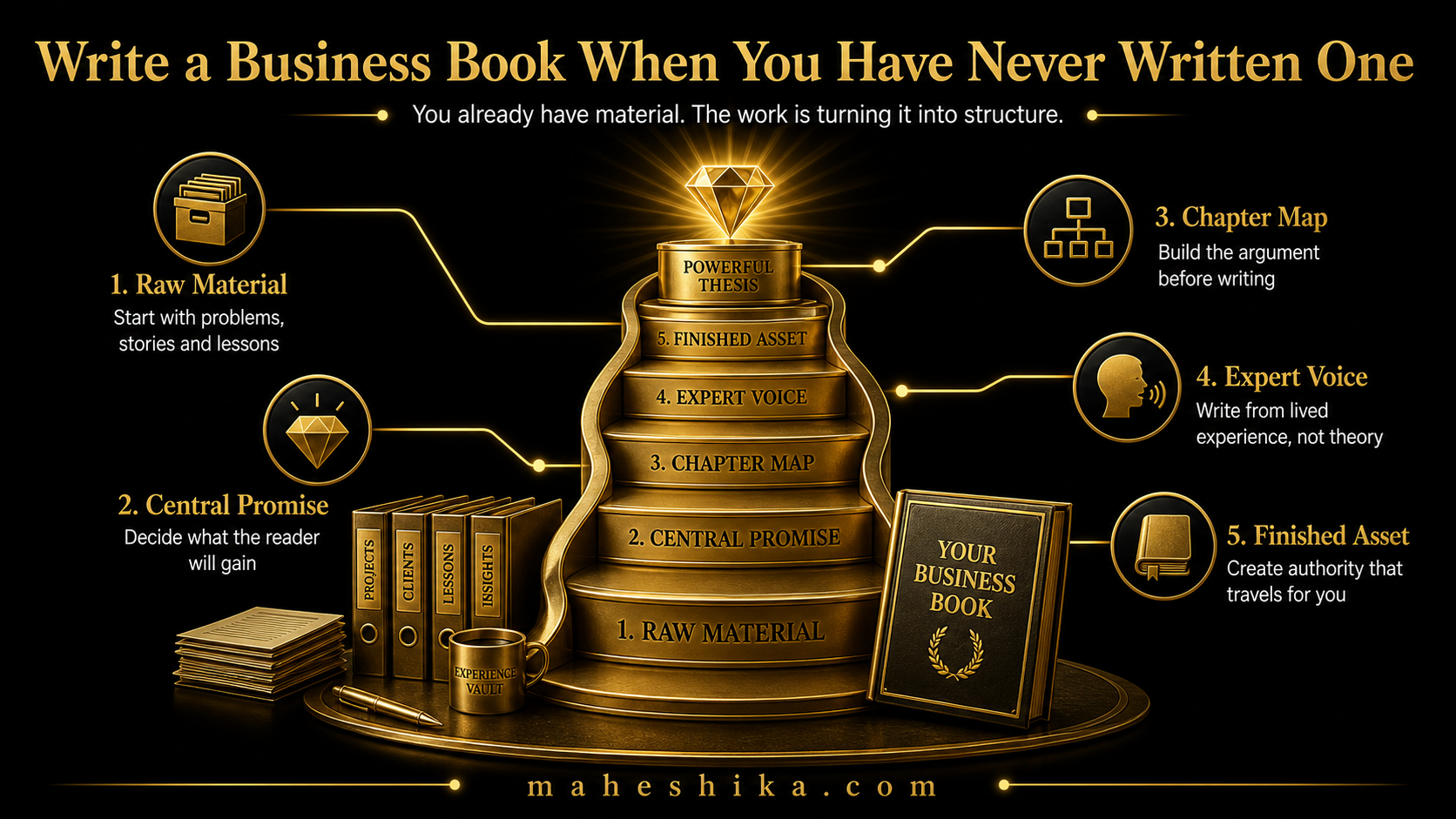
Most experienced professionals who want to write a book do not lack ideas. They lack a starting point. The prospect of writing 50,000 or 60,000 words from scratch is so large that it produces paralysis rather than progress. The cursor blinks. Nothing happens.
Here is the reality: a business book is not written in one sitting, one month, or even one draft. It is assembled in layers, built from a structure you design first and fill in second. Once you understand how a business book is actually constructed, the task becomes manageable. Not easy, but manageable.
Start with the reader's problem, not your story
The most common mistake first-time business book authors make is beginning with themselves: their career, their journey, their transformation. Readers do not pick up a business book to hear your story. They pick it up because they have a problem, and they want to know if you can help them solve it.
Your central question before writing a single word is this: what is the specific, painful problem my reader has, and what is my unique answer to it? Your story and experience matter enormously, but only as evidence that your answer works. The frame is the reader's problem. Everything else is in service of that.
Once you have articulated the problem and your answer with precision, you have the spine of the book. Every chapter should be a step in the reader's journey from the problem to the solution. If a chapter does not serve that journey, it should not be in the book.
Build your structure before you write a word of prose
A business book typically follows one of three structural patterns: a framework book (here is my model and its components), a journey book (here is a transformation with stages), or a case study book (here is the evidence across multiple examples). Most strong business books blend two of these, usually a framework carried by case studies.
Your structure is your table of contents, written in detail. Before you draft the introduction, write out every chapter with three things: a working title, the central argument of the chapter in one sentence, and three to five sub-points you will cover. This turns a terrifyingly blank document into a fillable template. You are no longer writing a book. You are writing one section of chapter four. That is a far smaller task.
Spend two to three weeks on structure before you write any prose. Adjust it, challenge it, show it to one trusted reader. A strong structure makes the writing faster and the editing easier. A weak structure produces a manuscript that requires structural rebuilding after you are already emotionally attached to the sentences.
Write first drafts badly on purpose
The internal editor kills more business books than anything else. First-time authors write a paragraph, decide it is not good enough, delete it, and restart. Three months later, they have chapter one in fourteen different versions and chapters two through twelve are still blank.
The discipline that produces finished manuscripts is the separation of generating from refining. Write your first draft as quickly as you can, accepting that it will be rough. Write to the chapter outline, not to a quality standard. Get the ideas on the page. The prose can be improved in the second pass. But you cannot improve a blank page.
A practical daily target for a professional writing around work commitments is 400 to 600 words. At 500 words per day, five days a week, you have a 60,000-word first draft in 24 weeks. That is six months for a complete manuscript, alongside a full professional schedule.
Related Reading
Free Tool
Start free: where do you actually stand?
Two free tools give you an honest answer in minutes. The AI Risk Score shows how exposed your role is. The Expertise Ownership Score shows how findable and owned your expertise is.
AI Risk Score Expertise Ownership ScoreUse your professional experience as your primary material
You do not need to conduct new research to write a compelling business book. You have spent years accumulating observations, case studies, lessons, and hard-won insight. That material is already yours. The work of writing the book is largely the work of retrieving, organising, and contextualising what you already know.
Keep a running document as you work on the manuscript: every story from your career that illustrates a principle, every mistake that taught you something, every client situation that changed how you think. These become the connective tissue of your chapters. The principles and frameworks you articulate are the intellectual architecture. The stories are what make them stick.
Be specific with your stories. Vague anecdotes about "a client I once worked with" carry little weight. Specific, contextual stories, with enough detail to make the situation recognisable and the lesson clear, are what readers remember. Specificity is the mark of a writer who has genuinely lived what they are describing.
Editing is where the book becomes good
The first draft is not the book. It is the raw material from which the book is made. Give yourself at least six weeks between completing the first draft and beginning the editing pass. Distance is essential. You need to read the manuscript as a reader, not as a writer who knows what they were trying to say.
Edit for structure first, prose second. Read each chapter and ask: does this do what it was supposed to do? Does it advance the reader's journey? Is there anything here that could be cut without losing something essential? Only once the structure is sound should you refine the sentences.
A professional editor is worth the investment, particularly for a first book. Not because your writing is inadequate, but because a good editor will see structural problems, logical gaps, and unclear passages that you have become too close to notice. The editorial fee is small relative to the commercial value of a well-executed book.
The Book Is Not the Finish Line
So the answer is this: you write a business book by refusing to face it as one giant task. Build the structure first, write badly on purpose in daily sections, mine the experience you already have instead of hunting for new material, and give the manuscript real distance before you edit it. Followed properly, that process turns "I have never written a book" into a finished manuscript in well under a year. The block was never talent. It was always the absence of a process.
But finishing the manuscript is not where the value sits. A book proves you can think clearly and finish what you start. It does not, on its own, secure your place. Publish it and the book lives on someone else's shelf, someone else's algorithm, someone else's platform, and every day AI writes paragraphs in a voice that sounds just like an expert's. The professionals who turn a finished manuscript into lasting authority are the ones who give it a permanent home under their own name, not a listing that can be buried by the next release.
That home is a personal website. Somewhere your framework lives in full, your case studies are shown in your own words, and the book becomes the front door to everything else you know, not the whole of it. Owned outright, findable in a search, impossible to mistake for anyone else's answer. That is what turns "I wrote a book" into "I am the person to call", and it is the one asset that keeps working for you long after the launch week is over.
You have already done the hard part by reading this far. If you would rather build that home properly, with someone who has walked exactly this path, let us talk.