The most common reason experienced professionals do not write their book is not that they lack ideas, knowledge, or the ability to write. It is that they cannot see where the time comes from. Senior roles consume enormous bandwidth. Evenings fill with family, recovery, or the overflow of the day. Weekends are precious. The book keeps getting deferred.
Writing a book while working full time is not comfortable. But it is completely achievable, and many of the most useful business books have been written precisely this way: in the margins of a demanding career, by people who cared enough about the idea to protect the time for it. Here is how to make it work structurally.
Treat the manuscript as a second job with fixed hours
The single most important decision in writing a book alongside full-time work is to assign it a fixed, non-negotiable time slot rather than trying to fit it in when other things allow. If you wait for a window of unscheduled time, you will wait indefinitely. A senior professional's calendar does not produce spare hours spontaneously.
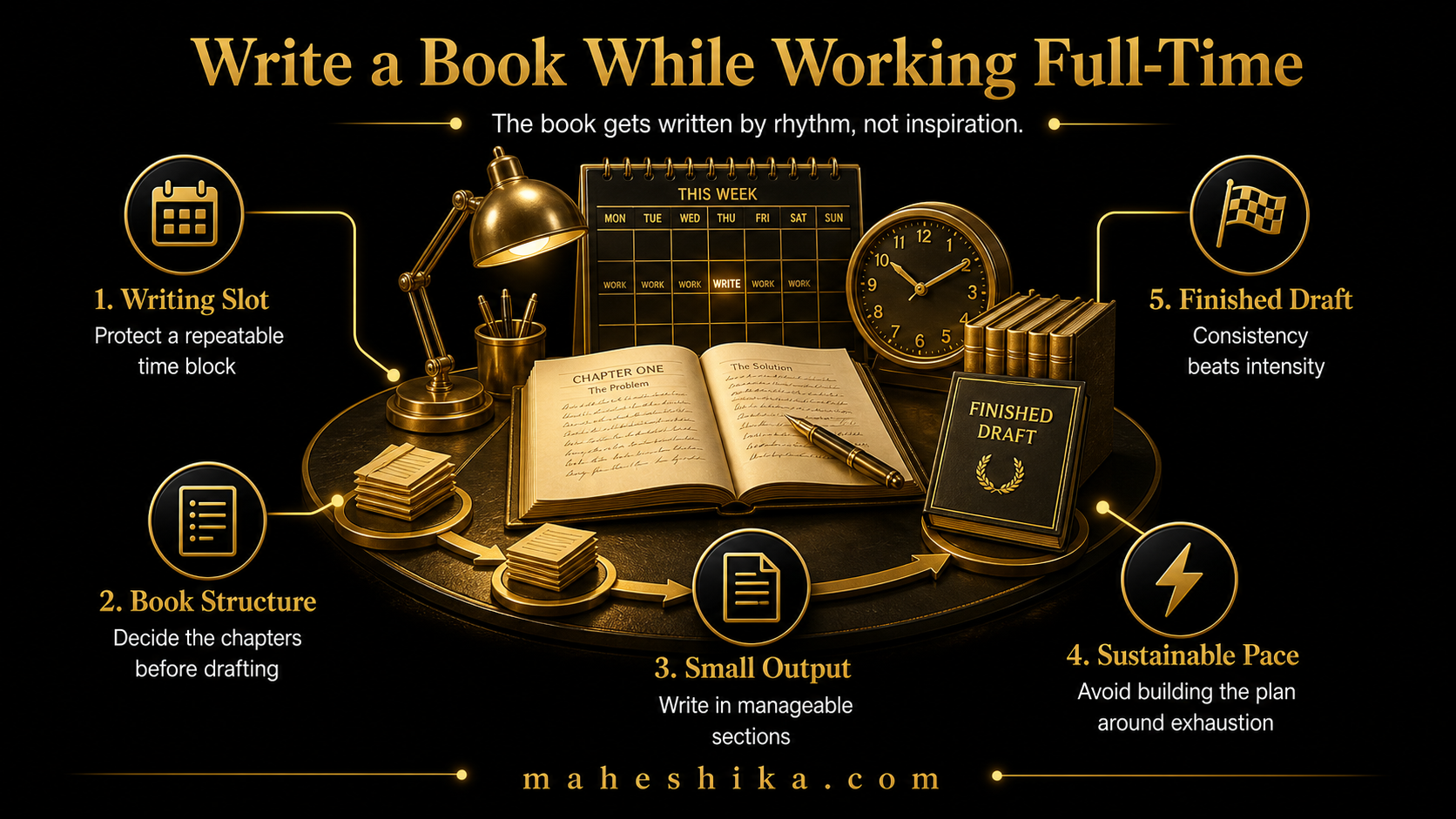
Choose one hour per day, five days per week, at a time that is consistently available to you. For most people in demanding roles, this means early morning: before email opens, before the demands of the day arrive, before the cognitive load of work depletes the mental resource that good writing requires. An hour from 6 to 7am, five days a week, gives you five hours of protected writing time. At 500 words per hour, that is a 60,000-word first draft in 24 weeks.
The time slot needs to be protected rather than optimised. It does not need to be the most convenient time. It needs to be the most reliable time. Reliability is what produces a finished manuscript.
Reduce friction at the start of each session
One of the hidden enemies of progress is the time spent at the beginning of each writing session working out what to write next. If you sit down to a blank screen with only a chapter heading to guide you, the first 20 minutes are often spent in orientation rather than writing. That is a third of your available hour.
End each writing session by writing three sentences about what you will write in the next session. Not a plan, just a direction: "Next session I will describe the moment in 2015 when the commercial strategy failed and what that taught me about assumption testing." When you sit down the following morning, you begin in motion rather than standing still.
Also keep your manuscript document open on your desktop rather than buried in a folder. Micro-frictions matter. Reducing the distance between sitting down and starting to write by even 30 seconds has a meaningful effect on consistency over months.
Related Reading
Use weekends for structure, weekdays for content
A useful division of labour is to use your weekday writing sessions for forward progress: drafting chapters, filling in sections, generating words. Use weekend sessions, or even 30-minute Saturday morning slots, for structural review: reading what you wrote during the week, checking that it connects properly, adjusting the outline, and identifying where next week's sessions should go.
This separation of generation from organisation prevents the pattern of constant tinkering that keeps writers rewriting the same chapter for weeks without moving forward. Weekday sessions are not for editing. They are for producing. Weekends are for perspective. Keep these functions separate and you will maintain both momentum and quality simultaneously.
Free Tool
Start free: where do you actually stand?
Two free tools give you an honest answer in minutes. The AI Risk Score shows how exposed your role is. The Expertise Ownership Score shows how findable and owned your expertise is.
AI Risk Score Expertise Ownership ScoreTell the people around you
A book written in secret is surprisingly fragile. The people in your household do not know to protect the hour. Colleagues do not know why you are not available at 6:30am. Without external acknowledgement of the project, it is easy to sacrifice the writing session to the first competing demand that appears.
Tell your partner or family that you are writing a book and that you need a specific hour protected each day. Tell one or two trusted colleagues that you are working on a manuscript. This is not performance. It is accountability. The social commitment to a project that other people know about is a meaningful protection against the drift that kills most manuscripts.
Consider also finding one accountability partner: someone also working on a creative or intellectual project who will check in with you weekly on progress. The structure does not need to be formal. A message on Friday saying "I hit 2,300 words this week" creates enough external expectation to keep you writing on the days when internal motivation alone is insufficient.
Protect the energy, not just the time
Writing quality degrades significantly when you are exhausted. If your designated writing hour is at 6am but you consistently get to bed after midnight, the hour will produce poor work and you will lose confidence in the project. The writing schedule requires a corresponding sleep and recovery schedule.
This is not idealism. It is pragmatics. A 45-minute writing session at your best cognitive state produces more useful material than two hours of writing while depleted. The book deserves the best hour of your day, and protecting that requires the same discipline you would apply to any high-priority professional commitment. Write the book in your best hour. Make everything else accommodate around it.
The Hour Gets You the Manuscript. This Gets You the Rest.
So the book is not waiting for a quieter season, because there will not be a quieter season. It gets written the way every useful business book gets written under a full-time role: a fixed hour, a low-friction start, weekdays for words and weekends for structure, people who know to protect the time, and enough sleep to make the hour count. Follow that and the manuscript gets finished.
But finishing the manuscript is not the same as finishing the work. A book launches onto someone else's shelf. Amazon controls the listing. LinkedIn controls whether the post about it is even seen. All those early mornings you protected can be buried by an algorithm update you never see coming, and the thinking you spent a year committing to the page ends up with nowhere permanent to live.
That is the part almost nobody plans for. AI can now generate a plausible answer to any question in your field in seconds, in a voice that sounds like every other expert. A book proves you did the thinking first. But proof that lives only on rented platforms is easy to lose in the noise. What actually secures your place is a home of your own: a personal website under your own name, where the book, the thinking behind it, and your work all live together. Owned outright, findable in a search, impossible to mistake for anyone else.
You do not have to build that home alone, and you do not have to leave it for "someday" the way the book almost was. If you want it done properly, by someone who has protected those early mornings herself, let us talk.