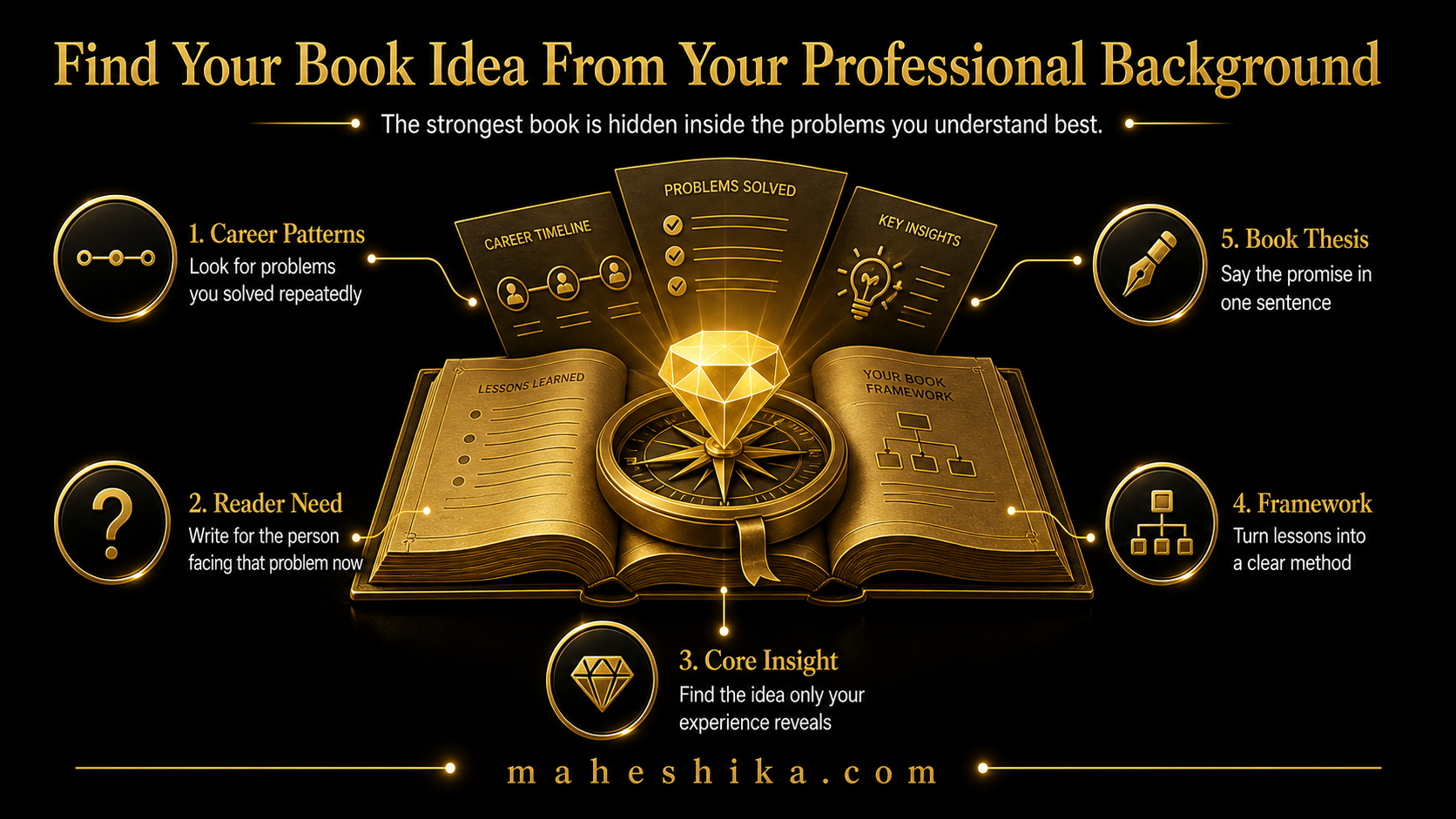
Most experienced professionals who want to write a book do not suffer from a shortage of ideas. They suffer from an excess of them, combined with uncertainty about which one is worth the commitment a full-length book requires. Others are convinced they have nothing distinctive to say because they are too close to their own knowledge to see how unusual it actually is.
Finding your book idea is not a creative exercise. It is a diagnostic one. The idea is almost always already there. The work is learning how to surface it and evaluate it clearly.
Start with the question you are most often asked
The most reliable source of a book idea is the question your peers, junior colleagues, and clients ask you repeatedly. If you have spent 20 years in a field, the people around you will have noticed your particular competence and will come to you with variations of the same question, year after year.
Pay attention to the questions that feel almost too obvious to you but clearly puzzle other smart people. That gap between what feels obvious to you and what confuses others is the location of your book. Your expertise has made certain things feel simple that are genuinely complex. Your book is the explanation of how you made them simple, made accessible to everyone who has not yet had your experience.
Write down the five questions you are most frequently asked by people who respect your judgement. The book idea that serves the greatest number of these questions with a coherent framework is likely your strongest option.
Identify your signature framework or method
After years of practice, most senior professionals have developed a way of approaching problems in their domain that is distinct from how their peers approach the same problems. It is not necessarily named or formally articulated, but it exists. They see certain things first. They ask certain questions before others. They organise complexity in a particular way.
This is your signature framework, and it is almost always the core of a book. To find it, look at the last ten to fifteen major problems you have solved or projects you have led. What did you do first that others did not? What did you look for that others missed? What questions did you ask at the outset that proved decisive later? The pattern across these examples, not any individual one, is the framework your book should articulate.
Once you can name your framework and describe its three to five core components, you have a book architecture. Each component becomes one or two chapters. The introduction frames the problem the framework solves. The conclusion demonstrates what changes when professionals apply it. This is a complete and compelling book.
Related Reading
Test the idea before you commit to it
Before you invest months in writing a manuscript, spend two weeks testing the idea with your network. Not by asking "would you read a book about X?", which is a question people answer politely rather than honestly. Instead, describe the core premise in two or three sentences and ask: "Does this reflect a real problem you encounter? Would someone in your organisation pay to solve it?"
You can also test the idea through shorter-form content. Write a LinkedIn article or a blog post on the central thesis of the book. The response, particularly the questions and objections it generates, tells you whether the idea is resonating and which parts need further development. A book idea that generates strong response in a 1,000-word article is almost certainly strong enough to sustain a full-length treatment.
Free Tool
Start free: where do you actually stand?
Two free tools give you an honest answer in minutes. The AI Risk Score shows how exposed your role is. The Expertise Ownership Score shows how findable and owned your expertise is.
AI Risk Score Expertise Ownership ScoreLook for the idea at the intersection of your experience and current relevance
The best business books are timely without being trendy. They address a perennial problem, but they address it through a lens that is particularly relevant to the moment in which they are published. Your book idea is strongest when it sits at the intersection of your deep experience and something that is genuinely urgent in the current professional landscape.
In the current environment, that often means anything connected to AI transformation, organisational resilience, the future of leadership in distributed teams, or the economics of expertise in a world where information is commoditised. If your experience intersects with any of these themes, the book idea almost writes itself. You have lived through something that the current generation of leaders needs to understand, and you have the perspective of someone who has seen both what came before and what is emerging now.
The simplest test of a strong book idea
After all the exercises and the testing and the frameworks, the simplest test remains this: when you describe the book idea to someone whose judgement you respect, do they lean forward? Does their response shift from polite interest to genuine curiosity? Do they ask follow-up questions?
A book idea that produces that response, consistently, across different people with different backgrounds, is worth writing. The leaning forward is not about your status or your storytelling. It is about the idea itself: the recognition that here is something that matters, articulated clearly by someone who genuinely knows it. That is the combination a book needs. And for a senior professional with two decades of real experience, it is closer than it usually feels.
The One Place Your Book Idea Needs to Live
So the book idea you have been circling was never missing. It was sitting under years of expertise that felt too obvious to name. Write down what you are asked most often, name the framework behind how you solve problems, and watch what happens when you describe it to someone whose judgement you trust. If they lean forward, you have found it. The idea does not need inventing. It needs surfacing, then testing until you trust it too.
But naming your framework clearly enough to write a book about it hands you something else as well: proof of an expertise that AI can now imitate in seconds, in a voice that sounds like everyone else's. Ask any AI system the five questions you are asked most and it will answer confidently, generically, with no memory of the twenty years you spent earning that answer. The knowledge you have just learned to name is exactly the knowledge that gets flattened first.
What does not flatten is a place with your name on it. A personal website where your framework lives in your own words, where the questions you keep being asked have answers only you could give, and where your signature, not a chatbot's approximation of it, is unmistakable. Owned outright. Findable in a search. The book proves the idea exists in you. The website is where it stays visibly, permanently, yours.
You do not have to choose between writing the book and building the place that holds it, and you do not have to work out where to start on your own. If you want help turning what you already know into something the world can find, let us talk.