You have spent 15, perhaps 20 years becoming genuinely excellent at something. You have solved problems that most people cannot even articulate correctly. You have sat in rooms with boards and executives and guided decisions worth millions. And yet, right now, you are trading all of that for a salary that someone else decided was fair.
This guide is for you. Not the 25-year-old with a side hustle. Not the influencer building a personal brand for vanity. This is for the experienced professional who has accumulated real, hard-won expertise and wants to know, concretely, how to build a business around it.
I have been through this transition myself. Eighteen years building enterprise commercial ecosystems across EMEA. A PhD, an Executive MBA, and a deep suspicion that my market value was significantly higher than any employer was willing to admit. What I found on the other side was not just financial freedom. It was clarity: about what I actually know, who I can genuinely help, and how to build a business that grows because of my expertise, not despite my constraints.
In This Guide
What the Expert Economy Actually Is
The expert economy is not a trend. It is a structural shift in how value is created and captured in professional services. For most of the 20th century, expertise was bundled inside organisations. If you wanted access to the knowledge of a great commercial strategist, you hired the consultancy that employed them. The knowledge was not portable: it was locked behind a letterhead.
That has changed. Platforms, AI tools, and a growing buyer sophistication mean that organisations can now hire the expert directly, often at a fraction of the consultancy rate, and get faster, more relevant results. The intermediary has become optional. And that means the senior professional who has spent 20 years accumulating specialised knowledge is, for the first time, in a position to capture the full value of what they know.
The expert economy rewards specificity. The generalist with broad experience is useful inside a corporation but invisible in the market. The expert with a sharp point of view on a specific problem, backed by a track record of solving it, can command premium rates and build a sustainable independent practice. The shift is not about working harder. It is about positioning differently.
Why 2026 Is the Right Moment
Three forces have converged to make this the most favourable environment in history for experienced professionals to go independent.
First, organisations are pulling back on permanent headcount while simultaneously facing more complex strategic challenges. The demand for senior expertise has not gone down. The appetite for senior salaries has. That gap is being filled by independent consultants and advisors, and the organisations paying for them are relieved to do so because they get what they need without the overhead.
Second, AI has dramatically reduced the operational cost of running a solo or small expert business. What previously required a team of eight, including a researcher, a content creator, a client-services person, and an admin, can now be handled by one person with the right AI stack. I build things daily with Claude and Claude Code that would have taken a full agency six months five years ago. The leverage available to a solo expert today is genuinely unprecedented.
Third, buyers have become more sophisticated. The decision-maker who is evaluating whether to hire you does not need you to be the biggest firm in the room. They need you to demonstrably understand their problem better than anyone else. A well-built personal brand and a clear track record will beat a polished corporate pitch deck almost every time, because the buyer knows they are getting the actual expert, not the person who sold the project.
How to Identify What You Know That Others Will Pay For
This is where most people get stuck. Not because they lack expertise, but because they are too close to it. What feels ordinary to you, because you have done it a thousand times, is genuinely rare and valuable to someone who has not.
Start with problems, not skills. Do not begin by listing your competencies. Begin by listing the problems you have solved repeatedly, at a level of complexity that most people cannot navigate. The more specific the problem, the more valuable your expertise. "I know how to structure a commercial partnership" is a skill. "I know how to build a distribution ecosystem from scratch in a regulated market where the incumbent players do not want you there" is a problem you can charge serious money to solve.
Then ask: who else has this problem? If the answer is "every mid-sized pharmaceutical company expanding into new markets," you have a market. If the answer is vague, narrow it further until it becomes specific. Specificity is not limiting. It is what makes you findable, credible, and referable.
Finally, look at where you have been trusted. The problems organisations trusted you to own, at the most senior level, are the problems they will pay an independent to solve. Your track record is your curriculum vitae for the market, and it is more persuasive than any certificate.
Free Tool
Start free: where do you actually stand?
Two free tools give you an honest answer in minutes. The AI Risk Score shows how exposed your role is. The Expertise Ownership Score shows how findable and owned your expertise is.
AI Risk Score Expertise Ownership ScoreThe Three Components of an Expert Business
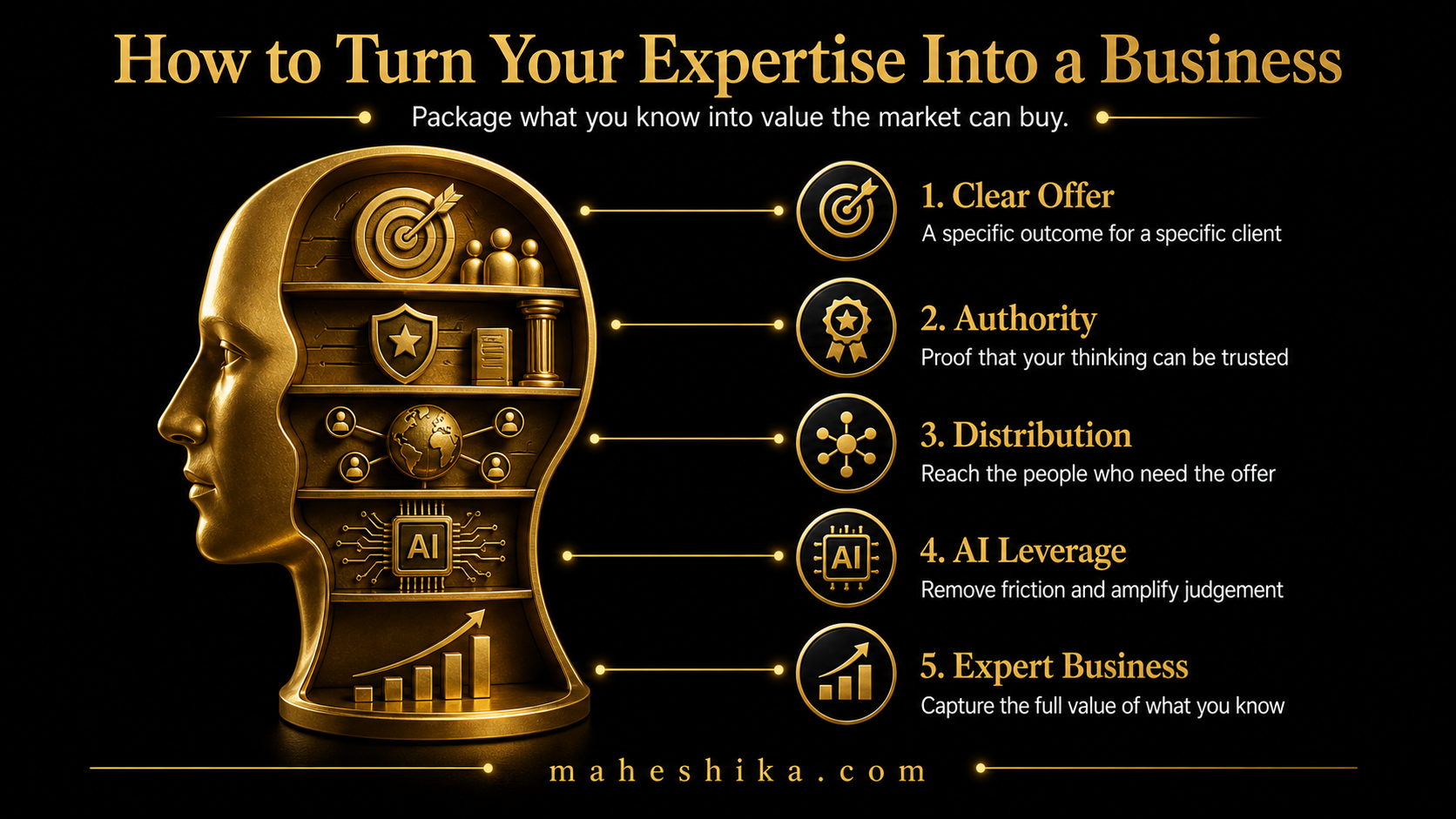
Every successful expert business, regardless of the industry or the individual, is built on the same three foundations: a clear offer, demonstrated authority, and a distribution system. When all three are working, the business grows. When one is missing, it stalls. Most people who struggle have two of the three and are missing the third.
The Offer. Your offer is not your CV, and it is not a list of services. It is a specific outcome you deliver to a specific type of client in a specific situation. The clearest offers are structured as: I help [type of person or organisation] do [specific thing] so that [specific result]. The more precisely you can name the client, the problem, and the outcome, the more your offer will resonate with the right people. A well-structured offer also has layers: a high-touch engagement at the top, a more accessible entry point below, and possibly a self-serve resource at the base. This is called an offer stack, and it allows you to serve clients at multiple levels without multiplying your time.
The Authority. Authority is the evidence that you can do what you say you can do. It comes in two forms: demonstrated and borrowed. Demonstrated authority is built through your own content: articles, frameworks, talks, books, and documented case studies. Borrowed authority comes from the recognition of others, whether that is a publisher, an award, a media feature, or a prestigious speaking slot. Both matter, but demonstrated authority is the one you control and the one that compounds over time. Publishing your thinking, naming your frameworks, and sharing your perspective on the problems your ideal clients face is not self-promotion. It is the primary mechanism by which the right clients find you.
The Distribution. Distribution is how your authority reaches the people who need your offer. For most expert businesses, this means a combination of a personal brand platform (LinkedIn, a website, occasional video), referral networks from your corporate career, and strategic partnerships. The mistake most experts make is assuming that doing excellent work is enough. It is necessary but not sufficient. The clients who would most benefit from your expertise will not find you unless you have a deliberate system for being visible to them. Distribution does not need to be loud or constant. It needs to be consistent and targeted.
The Role of AI in Building Faster
I am a daily practitioner of AI tools, and I want to be specific about what AI actually does for an expert business, rather than repeating the generic claims.
AI does not replace your expertise. It amplifies your ability to express and distribute it. The thinking, the frameworks, the judgement, the relationships: these remain entirely human. What AI removes is the operational friction that previously made it expensive and slow to run a high-quality expert business alone. You can now produce well-researched, well-written content at a pace that would previously have required a team. You can build client-facing tools, calculators, and resources that add genuine value and generate leads. You can automate the administrative work of running a business so that your time is concentrated on the work that only you can do.
The experts who are building fastest in 2026 are not the ones who know the most about AI in the abstract. They are the ones using specific AI tools, daily, in their actual work. The learning curve is real but short. The leverage is immediate. And the competitive advantage of being fluent in AI while your peers are still hesitating is significant and narrowing by the month.
The Complete Series: 10 Articles on Turning Expertise Into a Business
This guide is the foundation. The articles below go deeper on each component of building your expert business. Read them in order or jump to the question most pressing for you right now.
All Articles in This Series
- What Is the Expert Economy and Why Your Knowledge Is Worth More Than Your Salary
- How to Identify Your Niche as an Independent Expert
- How to Stop Trading Time for Money and Build an Expertise-Based Income
- What Is a Consulting Offer Stack and How to Build One
- What Is a Signature Framework and How to Create One From Your Experience
- How to Validate Your Consulting Offer Before You Quit Your Job
- The Difference Between Consulting, Coaching, and Advisory Work
- How to Build Recurring Revenue as an Independent Expert
- The 5 Most Profitable Ways to Monetize 20 Years of Corporate Experience
- What Is Knowledge Monetization and How Has It Changed in 2026
The One Asset Every Expert Business Needs
So building a business from your expertise is not one decision. It is three foundations working together: an offer specific enough to be undeniable, authority you demonstrate rather than claim, and distribution that puts both in front of the right people, built faster because you are using AI as leverage rather than waiting for permission to start.
But there is a layer beneath all three, and it decides whether the whole structure holds. Your offer, your authority, your distribution: none of it is truly yours if it only lives inside a corporate profile, a platform's algorithm, or a client's memory. The moment you step away from the employer, or the moment AI starts answering your prospective client's question in a voice indistinguishable from every other consultant's, whatever you have not claimed as unmistakably yours simply disappears from view.
A personal website under your own name is the one asset that does not disappear. It is where your frameworks live, where your track record is shown in full, where your signature on the work is impossible to mistake for anyone else's. Owned outright, findable in a search, standing on its own long after any single engagement ends. That is not a marketing nice-to-have. It is the foundation the other three components are built on.
You do not have to build that foundation alone, and you do not have to wait until the rest of the business is finished to start. If you want it done properly, by someone who has built her own from the same starting point, let us talk.