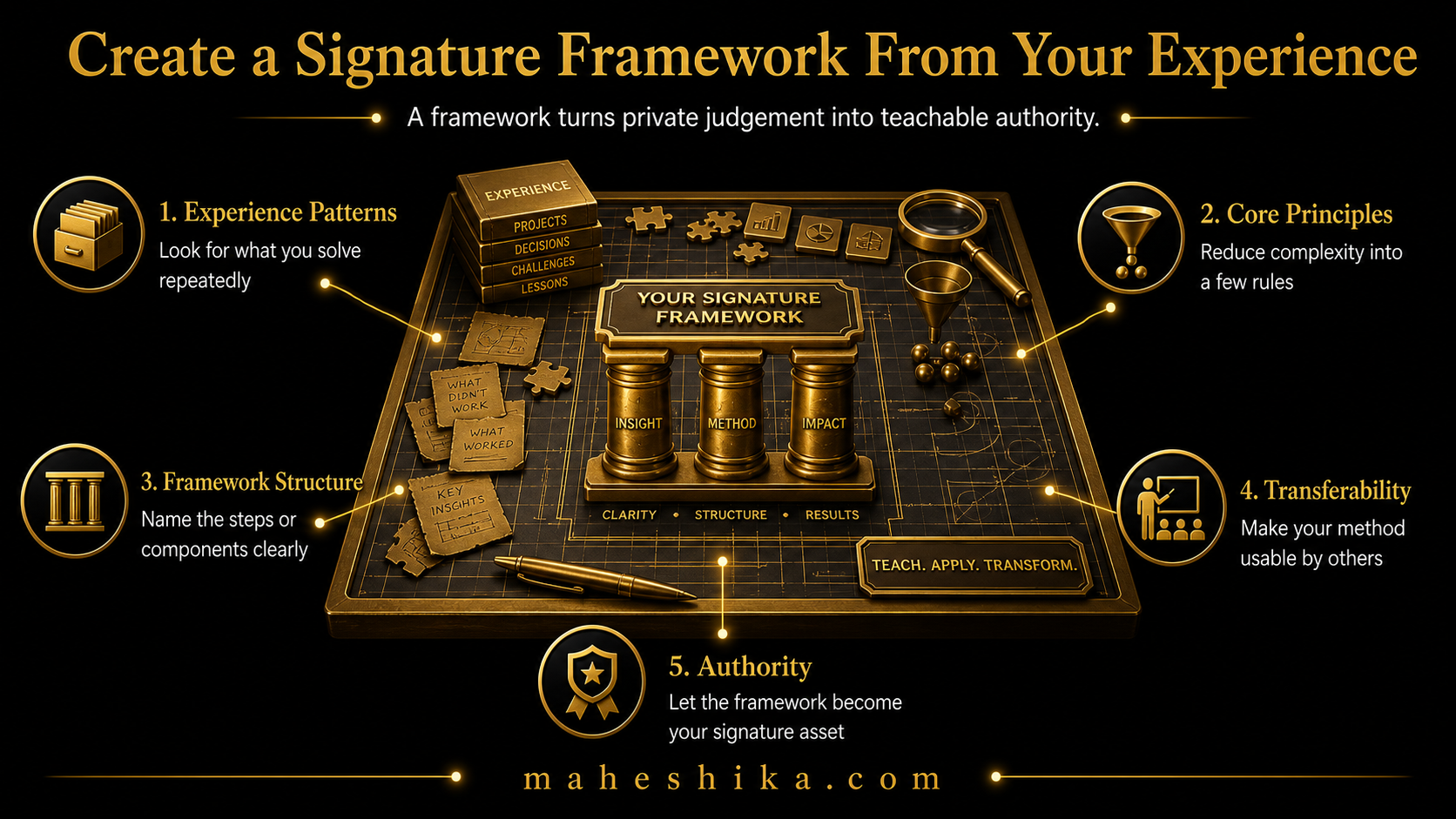
A signature framework is the single most powerful thing you can build as an independent expert. Not because frameworks are fashionable, but because they do something that experience alone cannot: they make your thinking visible. When a prospective client can see how you approach a problem, what steps you take, and why, they can evaluate whether your method fits their situation before they commit to working with you. That reduces the friction of buying significantly. It also separates you from every other expert in your space who is simply offering "20 years of experience."
What a Signature Framework Actually Is
A signature framework is a named, structured representation of how you solve a particular type of problem. It takes the implicit, intuitive approach you have developed over years and makes it explicit, repeatable, and communicable. It can be a sequence of steps, a set of dimensions to evaluate, a diagnostic model, or a decision-making structure. The form matters less than the clarity.
What it is not: a generic framework borrowed from a business school textbook, a vague process that could apply to anything, or a list of competencies dressed up as a methodology. A genuine signature framework is specific to how you, specifically, have solved a specific class of problem. It carries the mark of your particular insights and experience. No one else would have arrived at exactly the same structure, because no one else has had exactly the same experience.
The business value of a well-built framework is significant. It becomes the backbone of your consulting engagements. It becomes the curriculum of your workshops and courses. It becomes the structure of your book. It becomes the intellectual property that makes your personal brand distinctive. A single well-named framework, consistently applied and publicly shared, can become the thing you are known for.
How to Extract a Framework From Your Experience
The raw material is already there. You have been applying a framework implicitly for years. The task is extraction and articulation, not invention.
Start by identifying the type of problem you have solved most consistently and most successfully. Not the full breadth of your work, but the specific territory where you have repeatedly delivered outcomes that others found difficult to achieve. Then ask: when I approach this problem, what do I always do first? What do I assess or establish before anything else can move forward? What are the stages or dimensions that I navigate in some consistent order?
Write these out without editing. You will likely have five to ten things. Then look for the underlying logic. Is there a sequence that must be followed? Are there distinct categories that all need to be addressed? Is there a diagnostic before the prescriptive? The structure of your framework emerges from the logic of how the problem actually works, not from how it looks when you present it. Start with the logic. The presentation comes second.
Related Reading
Naming Your Framework
The name matters. A well-named framework is memorable, distinctive, and communicates the essence of what it does. The name becomes a shortcut that your clients and audience use when they refer to your work. When someone says "we used the [Your Name] method" in a conversation with a peer, the name does the marketing for you.
Good framework names tend to fall into a few categories. An acronym where each letter represents a key component: these are easy to remember and teach. A metaphor that captures the essence of the approach: useful when the concept is novel and needs a familiar anchor. A number plus a noun, such as "the four stages of..." or "the five forces of...": immediately communicates scope and gives the listener a handle for the structure. A proprietary term that you coin specifically for the concept: this takes longer to establish but creates the strongest distinctiveness when it lands.
Whatever name you choose, use it consistently. In your writing, in your speaking, in your client proposals. The name becomes a brand asset over time, and that compounding effect only happens through consistent repetition.
Free Tool
Start free: where do you actually stand?
Two free tools give you an honest answer in minutes. The AI Risk Score shows how exposed your role is. The Expertise Ownership Score shows how findable and owned your expertise is.
AI Risk Score Expertise Ownership ScorePublishing Your Framework to Build Authority
A framework that lives only in your head or in your private client work is doing a fraction of its potential work. Publishing your framework, through articles, talks, LinkedIn posts, and eventually a book or course, is how it becomes a market asset rather than just a personal tool.
The common fear is: if I publish my framework, someone will copy it and I will lose my advantage. This gets the economics of expertise backwards. The framework is not valuable because it is secret. It is valuable because you are the person who created it, understands it most deeply, and can apply it with the greatest skill. Publishing it widely does not give that away. It demonstrates the depth of your thinking to everyone who reads it, and it creates the associations in the market between the framework and you, not between the framework and whoever might attempt to copy it.
The experts who guard their methods and never share their thinking in public are the ones who remain invisible. The ones who publish generously, teach their frameworks openly, and make their thinking freely available are the ones who build the kind of authority that attracts clients before any pitch or proposal is involved.
The One Move That Makes Your Framework Count
So a signature framework is not a slogan or a slide. It is the extraction of a method you already carry, given a name, a shape, and a home in public view. Building it is not a one-day exercise. Let it emerge across several sessions, test it with trusted colleagues or existing clients, refine it against what resonates. The first version will not be the final one. What matters is starting, because a framework that stays in your head is worth nothing to the market.
But naming the framework is only half the work, and it is the half almost everyone stops at. A method with no fixed address still depends on whoever is hosting the conversation: the platform, the publication, the client call. Say it once on a call and it is gone by the next meeting. Post it on a platform you do not own and an algorithm decides who sees it, or an AI answer folds it into a summary with your name nowhere near it. Everything you built to distinguish your thinking quietly loses its shape.
A personal website under your own name is where a framework stops being a good idea you once had and becomes an asset. Somewhere it lives permanently, gets named once and referenced forever, and is found in a search with your name attached, not absorbed into a generic answer. Owned outright. That is what turns extraction into authority.
You do not have to build that home alone, and you do not have to build it later. If you want it done properly, by someone who has walked exactly this path, let us talk.