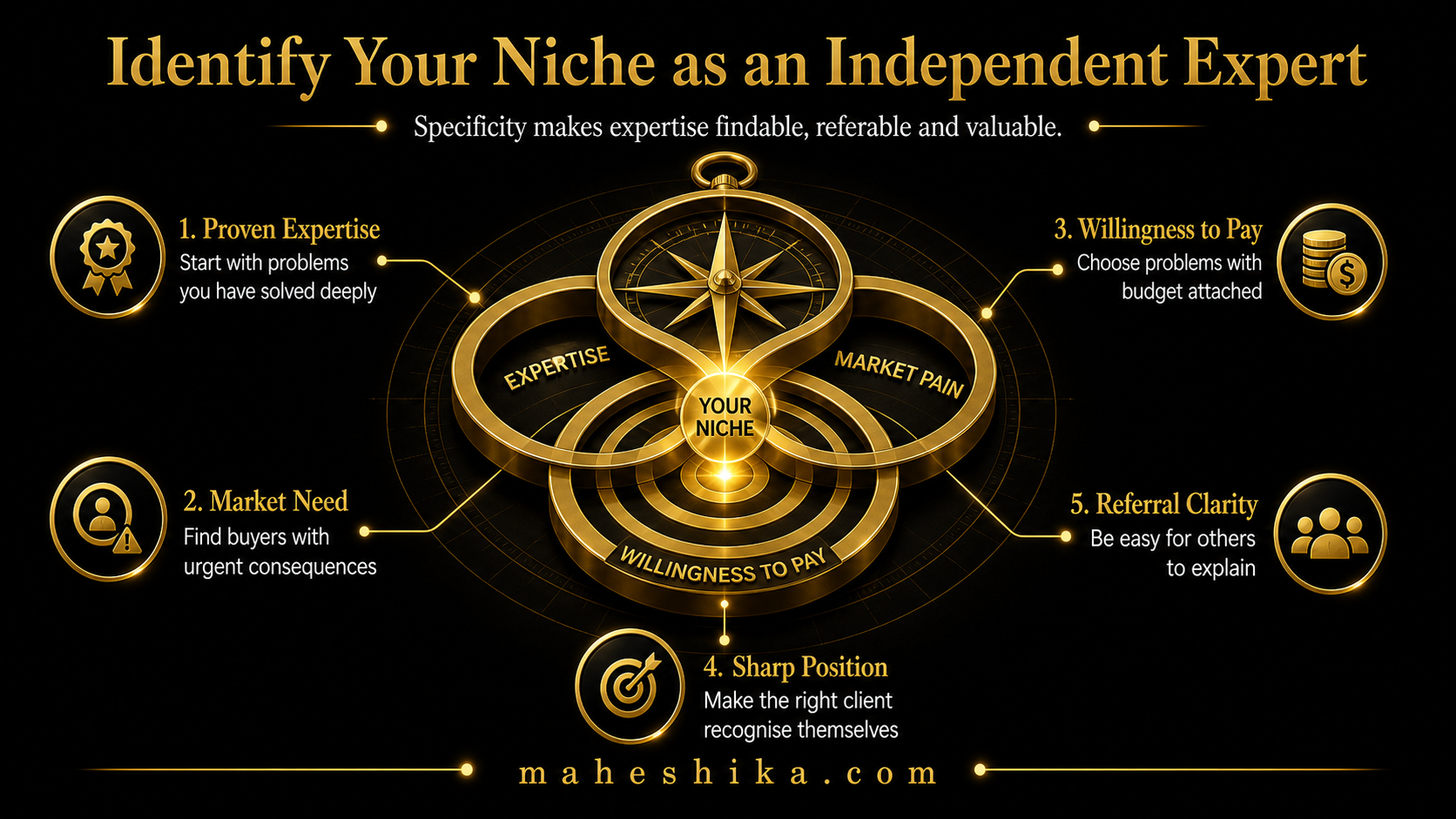
The niche question is where most experienced professionals get stuck. Not because they lack expertise, but because they have too much of it. After 15 or 20 years in complex organisations, you have developed real competence across a broad range of domains. Choosing one feels like discarding the rest. It is not. It is the decision that makes you findable, hirable, and genuinely valuable to the clients who need you most.
Why Choosing a Niche Feels Difficult
The resistance to niching is almost universal among senior professionals making the transition to independence. It comes from a reasonable place. Inside a corporation, being the person who can handle anything is an asset. It makes you versatile, deployable, and resilient to organisational change. The broader your apparent capability, the safer your position.
The market works in exactly the opposite way. Buyers with a specific problem do not search for a generalist. They search for the person who has solved their specific problem before. When your positioning is broad, you appear in no one's search. When it is sharp and specific, you appear at the top of the relevant search, both literally and in the minds of the people who can refer you.
Niching is not about limiting what you can do. It is about choosing what you lead with. You can expand later. You cannot build authority in a space you have not committed to occupying.
The Three Questions That Reveal Your Niche
Rather than trying to think your way to a niche in the abstract, work through these three questions systematically. The answers will almost always point to the same territory.
What problems have you been called in to solve at the most senior level? Not the problems you managed day-to-day, but the ones that required your particular judgement, relationship, or expertise. The problems that others escalated to you. These are the problems your market will pay for, because they are the problems where the cost of getting it wrong is high and the supply of people who can reliably solve them is low.
Where have you had disproportionate impact relative to effort? There are almost always areas in your career where you created unusual results without unusual effort, because the work aligned with how your mind naturally works. That alignment is a strong signal of genuine expertise. It is also the territory where you are likely to enjoy your work as an independent, which matters enormously for sustainability.
Who would pay to have this problem solved? This is the market-validation test. Genuine expertise in solving a problem is only commercially viable if the people who have the problem have both the means and the motivation to pay for its solution. Senior professionals with deep expertise in operational or strategic challenges almost always pass this test, because the problems they have solved have always been expensive problems.
Related Reading
How Specific Is Specific Enough
The fear with niching is always: what if I go too narrow? In practice, almost every experienced professional who approaches this for the first time errs in the opposite direction. They stay far too broad because each additional constraint feels like a reduction in potential clients.
A useful test: can you describe your ideal client and their problem in a single sentence that would make that client immediately recognise themselves? "I help senior finance executives in PE-backed businesses manage the first 18 months after a buyout" is specific. "I help organisations with their finance function" is not. The first sentence will resonate deeply with the 50 people in the world who are that person right now. The second will resonate with no one in particular.
The market size question resolves itself when you consider that expert business economics do not require thousands of clients. A consulting practice of 10 to 20 engaged clients per year, each paying at appropriate rates for genuinely valuable work, is a very healthy business. You do not need a mass audience. You need the right audience.
Free Tool
Start free: where do you actually stand?
Two free tools give you an honest answer in minutes. The AI Risk Score shows how exposed your role is. The Expertise Ownership Score shows how findable and owned your expertise is.
AI Risk Score Expertise Ownership ScoreValidating Your Niche Before Committing to It
You do not need certainty before you begin. You need a working hypothesis that is specific enough to test. The way to test it is not market research in the abstract. It is having real conversations with the people you believe are your ideal clients.
Reach out to five to ten people who fit your target profile. Not to pitch your services: to understand their world. Ask them what their most pressing challenge is right now. Ask what is keeping them stuck. Ask what they have already tried. Listen for the language they use to describe their problem, because that language is also the language of your positioning. If the problem you solve appears consistently in those conversations, your hypothesis is sound. If it does not, adjust.
This validation process also has a useful side effect: it surfaces the first relationships that might become clients. People remember the person who took the time to understand their situation, and they are far more likely to hire that person when the moment is right than someone who sent them a cold pitch about their services.
Your Niche Will Evolve
The niche you start with is not the niche you will have in three years. As you work with clients in your chosen space, you will develop even sharper insight into the specific sub-problems that matter most, the specific types of organisations you work best with, and the specific outcomes you reliably deliver. Your positioning will become more precise over time, not less. The goal right now is not to find the permanent answer. It is to find an answer specific enough to start.
Many of the professionals I work with discover that their most valuable niche is something they initially dismissed as too obvious, because it was simply what they had done for most of their career. The obvious, for you, is rare for most others. Start there.
The One Move That Secures Your Niche
So the answer to the niche question is not a personality test or a month of soul-searching. It is three honest questions about the work you have already done: what problems you were trusted to solve, where you had outsized impact for the effort, and who would pay to have that problem handled. Answer those with specificity, and your niche stops being a mystery. It becomes the obvious next sentence.
But naming your niche is only half the job, and it is the half almost everyone stops at. A sharp niche you carry only in your head, or scattered across old job titles and a LinkedIn headline, is still invisible to the people who need it. When a prospective client searches for the exact problem you solve, or asks an AI tool who handles it, they need somewhere to land that is unmistakably yours, not a folder of case studies buried inside a former employer's website that you no longer have access to.
That is the quiet risk in staying niche-clear but homeless. Your positioning can be perfect and still lose you the client, simply because nothing owned by you shows up when it matters. A personal website under your own name closes that gap. It is where your niche, your proof, and your point of view live together, permanently findable, impossible to mistake for a generic answer or a competitor's page.
You do not have to build that alone, and you do not have to wait until the niche feels perfectly settled to start. If you want it done properly, by someone who has walked this exact path, let us talk.
Identifying your niche is the foundation of everything else in an expert business. It determines who you build authority with, what content you create, how you write your offer, and who you network with. The next step is understanding how to turn your niche expertise into a signature framework that makes your thinking visible and sellable.