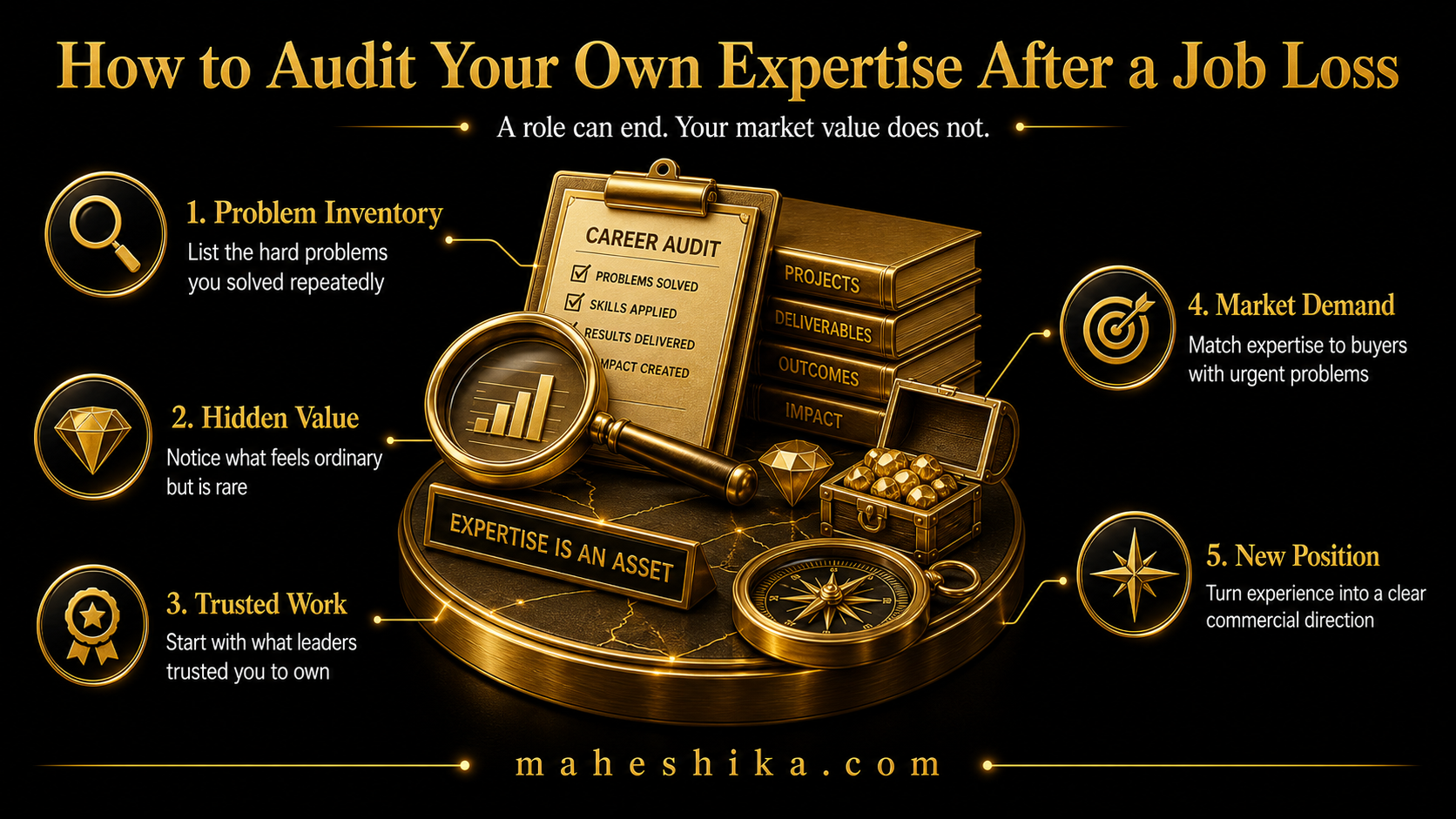
Most people who lose a job in their 40s or 50s have spent two decades deploying their expertise inside organisations without ever having to articulate its commercial value. The organisation provided the context, the mandate, the clients, and the pricing. You provided the expertise. Now the organisation is gone, and you need to understand what you actually have, in terms the independent market can recognise and pay for.
A professional expertise audit is the process of making that translation. It is not a CV review. It is a structured excavation of the knowledge, judgement, and methods you have built across your career, expressed in terms of the problems you solve and the outcomes you produce.
Why the Audit Is the Most Important Work You Will Do
Every subsequent decision about your professional direction, whether you are building a consulting practice, writing a book, positioning yourself for employment, or building a business, rests on the clarity you gain from this audit. Professionals who skip it, who jump straight to updating their LinkedIn or calling contacts, end up either positioning themselves too broadly ("I can help with strategy and leadership and change management") or too narrowly ("I can only do the specific thing I just did in the specific sector I just left").
Both of those positions leave significant opportunity on the table. The audit gives you the complete picture of your transferable value and allows you to make intelligent, strategic choices about how to deploy it.
The Four Categories of Expert Knowledge
Professional expertise operates across four distinct categories, and a complete audit covers all of them.
Technical expertise: the domain-specific knowledge and skills that are specific to your field. What specific things can you do that most professionals in your sector cannot? What methodologies, frameworks, or approaches have you developed or mastered?
Commercial expertise: your understanding of how value is created and captured in your sector. How businesses grow, where revenue comes from, how commercial relationships work, how deals get done. This is often the most underestimated form of senior professional expertise.
Organisational expertise: your understanding of how large organisations work at the political, structural, and cultural levels. How to get things done inside complex systems. How decisions actually get made versus how they are supposed to be made. This knowledge is extraordinarily valuable to clients who are trying to navigate or influence those systems.
Network expertise: the relationships, access, and trust you have built with specific individuals, organisations, and communities. This is often the most directly monetisable form of expertise in the short term, because it allows you to produce results for clients that would take others years of relationship-building to replicate.
The Audit Questions
Work through these questions in writing. Give each one real attention. The quality of your answers will directly determine the quality of your positioning.
- What have people repeatedly asked me to help with across my career, regardless of my official role?
- What are the specific problems I have solved that produced measurable, demonstrable results?
- What would not have happened, or would have happened much more slowly or poorly, without my specific involvement?
- What do people in my professional network come to me for advice on?
- What knowledge do I have that took me ten or more years to build and cannot be quickly researched or learned?
- What have colleagues or clients said about me that surprised me, in terms of what they valued about my contribution?
- What kinds of problems energise me versus drain me?
- Which of my skills are most transferable across sectors, and which are specific to my industry?
Related Reading
Translating the Audit Into a Commercial Position
Once you have completed the audit, the next step is to identify the intersection of three things: what you are genuinely excellent at, what the market will pay for, and what you want to spend your time doing. The professional who positions at that intersection has a powerful, durable foundation for the next chapter of their career.
In practice, this usually means identifying one or two specific problems that you are uniquely well-positioned to solve, for a specific type of client, with a specific kind of outcome. The more precise that positioning, the more effective your outreach will be and the more clearly clients will understand why you, specifically, are the right person for the work.
Generalist positioning is comfortable because it feels safe. "I can help lots of different organisations with lots of different things" avoids the vulnerability of claiming specific territory. But it also fails to attract clients who have a specific problem and are looking for the person who solves it best.
Free Tool
Start free: where do you actually stand?
Two free tools give you an honest answer in minutes. The AI Risk Score shows how exposed your role is. The Expertise Ownership Score shows how findable and owned your expertise is.
AI Risk Score Expertise Ownership ScoreTesting Your Audit in the Market
No audit is complete until it has been tested in conversation. Take your clearest, most confident claim from the audit exercise, the problem you believe you are best at solving, and use it as the opening of five or ten conversations with people who know your work. See how they respond. Do they nod immediately? Do they push back? Do they suggest a different framing? The market's reaction to your positioning tells you as much as the internal work does.
The professionals who move fastest and most effectively after redundancy are those who complete the audit quickly and then immediately test it in conversation, rather than spending weeks perfecting it in isolation. The refinement comes from dialogue, not from solitary deliberation.
Where the Value You Just Found Needs to Live
So the answer to auditing your own expertise is not a personality test or a values exercise. It is a structured excavation of your technical, commercial, organisational, and network knowledge, tested against real conversations until it holds. Do the eight questions honestly, in writing, and you will end that process with something you did not have before: a precise, defensible account of exactly what you are worth and to whom.
But here is what the audit does not solve on its own. That clarity now lives in a document on your laptop, or in your own head, and nowhere the market can find it. The organisation that used to broadcast your expertise for you is gone. And in a market where AI can answer almost any question in a voice that sounds like everyone else's, the professionals who get overlooked are not the ones without expertise. They are the ones whose expertise has nowhere to be seen.
A personal website under your own name is where that audit becomes visible and permanent. Somewhere your thinking lives, your specific positioning is stated in your own words, and your name is what a search returns. Owned outright, not rented from a platform or dependent on a title. That is what turns a private audit into a public, un-replaceable position.
You have done the hardest part already. If you want help turning what you just found into the site that carries it, let us talk.