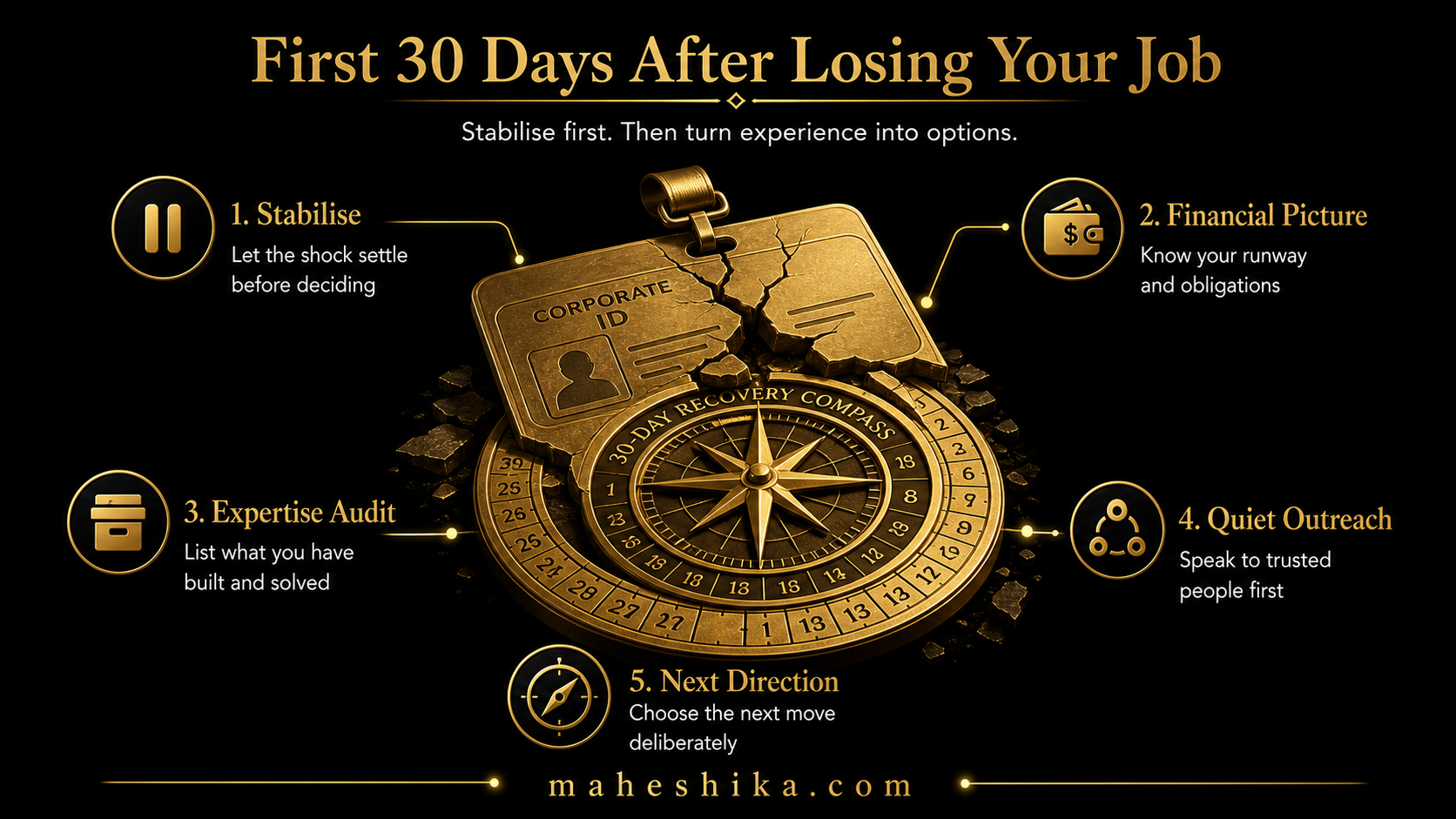
The first 30 days after losing a job are the most important and the most wasted. Important because the decisions and habits you establish in this period shape the entire trajectory of your transition. Wasted because most people spend them in a mixture of shock, reactive job searching, and paralysis. This article gives you a concrete, week-by-week plan for what to actually do instead.
Days 1 to 3: Absorb, Do Not Act
The first advice I give to anyone who has just been made redundant is counterintuitive: do not do anything professionally significant for the first 72 hours. Not on LinkedIn, not with your CV, not in terms of reaching out to contacts. The emotional state of those first days, a mixture of shock, anger, anxiety, and sometimes relief, produces decisions and communications that do not serve you.
In those first three days, focus on four things only. Review your redundancy agreement and understand what you have signed or are being asked to sign. Calculate your financial runway precisely. Tell the people closest to you. And sleep.
The professional world will be there in 72 hours. The clarity you will have after that brief pause is worth more than any head start gained by acting immediately.
Week One: Financial and Legal Foundations
Before you can make good strategic decisions about what comes next, you need a clear picture of your financial position and a clean understanding of any legal constraints.
- Review any settlement agreement with an employment lawyer. Most employers provide a contribution to legal fees for this purpose. Use it.
- Map your outgoings against your incoming redundancy payment, notice period pay, and any savings. Set a realistic monthly budget for the transition period.
- Check whether you are entitled to any state support, tax rebates, or pension-related payments based on your circumstances.
- Review any restrictive covenants in your employment contract. Understand what, if any, restrictions apply to whom you can contact and when.
With your financial position clear, you will likely find you have more runway than the panic of the first few days suggested. Most senior professionals have between three and nine months of genuine financial cushion. Knowing the actual number removes a significant amount of the anxiety-driven decision-making that leads to poor choices.
Week Two: The Expertise Audit
This is the most important week of your 30-day plan, and it is the one most people skip because it does not feel like action. It feels like reflection. But this work is the foundation of everything that follows.
Spend week two doing a structured audit of your professional expertise. The goal is to translate your career history from a list of roles and responsibilities into a commercial inventory of the specific problems you solve, the outcomes you produce, and the knowledge you have that others would pay to access.
Work through these questions in writing, not just in your head. What problems have I been brought in to solve, repeatedly, across different roles? What results have I produced that are measurable and demonstrable? What would have not happened, or happened much more slowly, without my specific involvement? What do senior people in my field ask me for advice on? What do I know that took me ten years to learn and that cannot be quickly acquired?
The output of this exercise is the raw material for your positioning, your offer, and your outreach, regardless of whether you are returning to employment or building an independent practice.
Related Reading
Week Three: Conversations and Direction Setting
With your financial picture clear and your expertise audit complete, week three is about testing what you have learned in conversations with your network.
Reach out to ten to fifteen people who know your work well: former colleagues, clients, mentors, industry contacts. The purpose of these conversations is not to ask for a job or a referral. It is to test your thinking about where your expertise could be most valuable and to understand what problems people in your sector are currently trying to solve.
Ask questions like: What do you think I am genuinely best at? Where are you seeing demand for the kind of expertise I have? Who do you know who is dealing with [specific problem you solve]? These conversations do three things simultaneously. They sharpen your thinking, they warm up your network, and they frequently produce the first genuine lead.
By the end of week three, you should have a clear sense of whether you are moving toward a new employment role, toward independent consulting, or toward building something more substantial. This does not need to be a final decision, but you need enough clarity to know which direction to lean in with your efforts.
Free Tool
Start free: where do you actually stand?
Two free tools give you an honest answer in minutes. The AI Risk Score shows how exposed your role is. The Expertise Ownership Score shows how findable and owned your expertise is.
AI Risk Score Expertise Ownership ScoreWeek Four: Build the Foundation, Commit to a Direction
By week four, you have the information and the clarity to make a genuine strategic decision. This week, commit to one. Not irrevocably, but with enough conviction to put genuine energy behind it for the next 90 days.
If you are moving toward independent consulting: write your positioning statement, identify your one core offer, update your LinkedIn with language that speaks to clients rather than employers, and schedule three to five follow-up conversations from week three's outreach. If you are moving toward employment: update your CV and LinkedIn in line with the clarity from your expertise audit, identify your target organisations and roles, and begin the outreach process from a position of confidence rather than desperation.
By the end of 30 days, you should have a clear direction, a realistic financial picture, a network that knows you are in motion, and an early pipeline of either conversations or applications. That is a stronger position than most people find themselves in at this stage, and it sets the tone for everything that follows.
The Move That Makes the Next 30 Days Compound
So the answer to those first 30 days is not one dramatic decision, it is a sequence: absorb before you act, get your financial picture exact, audit your expertise properly, test it in real conversations, then commit to a direction with real energy behind it. Follow that order and you finish the month with something most people never manage: genuine clarity, real momentum, and a plan that is actually yours.
But there is a deeper truth sitting underneath all of it. Redundancy did not only cost you an income, it cost you your visibility. Whatever authority you had, the title on your email signature, the seat at the table, the years of expertise people trusted you for, all of it lived inside someone else's structure. The moment you left, so did the platform that made you findable.
That is the real risk in this moment, and it grows quieter, not louder, as the weeks pass. In a market where AI can answer almost any question in a voice that sounds like everyone else, the professionals who keep their place are the ones who own a space of their own: a personal website under their own name, where their thinking lives, their work is shown, and their signature is unmistakable. Findable in a search, owned outright, impossible to reduce to a generic answer.
That is the one asset from these 30 days that keeps compounding long after the redundancy is behind you. You do not have to build it alone, and you do not have to wait until you feel ready. If you want it done properly, by someone who has walked exactly this path, let us talk.