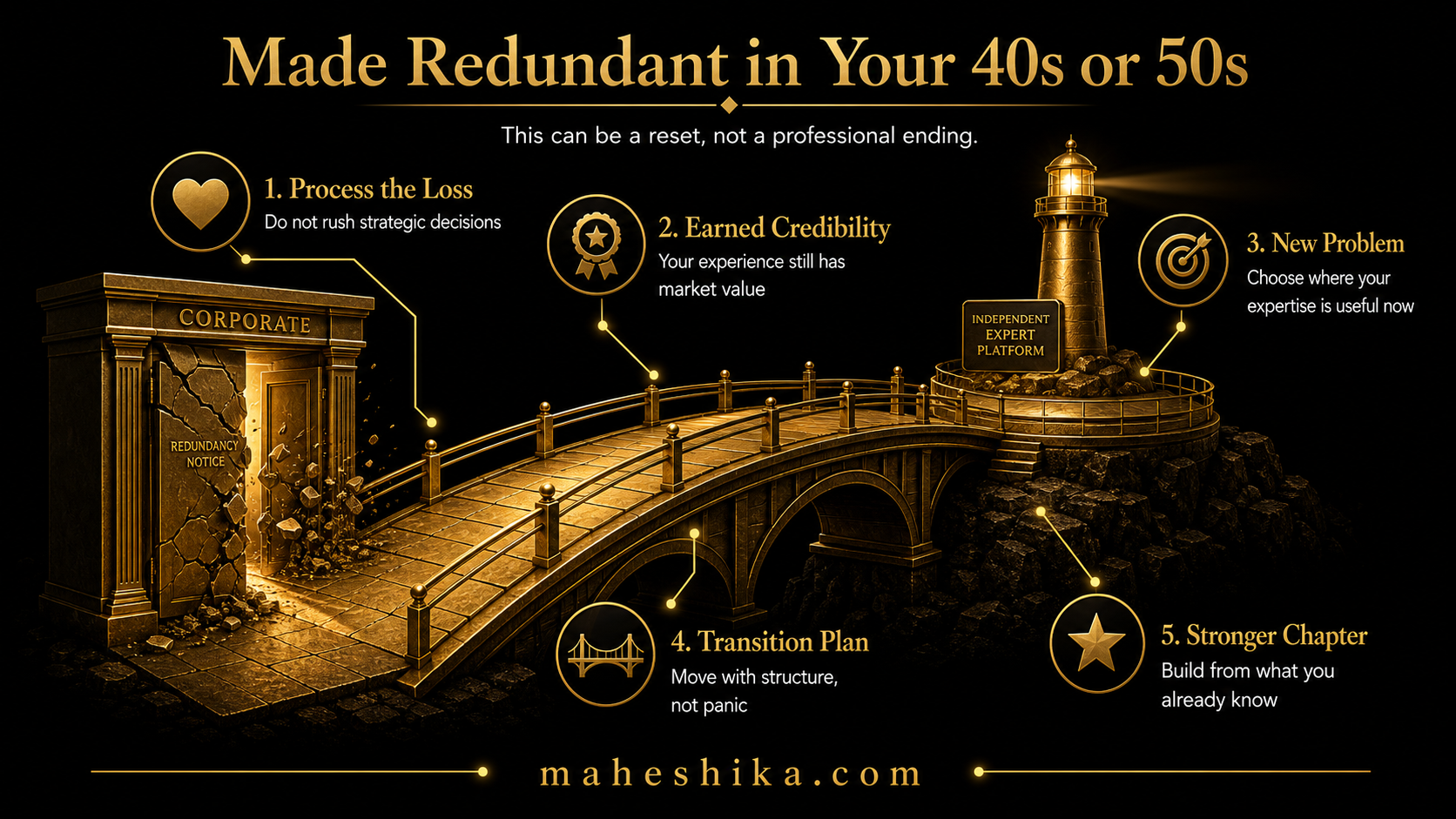
Redundancy arrives with a particular kind of shock when it happens in your 40s or 50s. Not just because of the immediate practical concerns, though those are real, but because of what it does to the identity you have been building for two decades. One day you are a senior professional with a title, a team, a budget, and a defined place in an organisation. The next day, the structure is gone. What you do in the weeks that follow will have a significant bearing on what comes next.
This article gives you the honest, practical picture of what to do, in what order, and why. No platitudes about doors closing and windows opening. Just the actual steps.
Before You Do Anything Else: Take 72 Hours
The first instinct for most people is to act immediately. Update the LinkedIn profile, call every contact you have, start sending applications. I understand the impulse. When the ground shifts beneath you, movement feels like control. But premature action in the first days after redundancy tends to produce outcomes you later need to undo.
Give yourself 72 hours before making any significant professional move. Use that time to process the immediate shock, to review your redundancy agreement carefully (and seek legal advice if anything is unclear), to understand your exact financial position including notice period, statutory pay, any enhanced package, and the timeline of your outgoings. None of this is avoidance. It is preparation. The professionals who navigate redundancy well are the ones who start from a clear picture rather than a panicked one.
Also: tell the people you trust. Do not try to manage this alone. The isolation that comes with sudden job loss is one of the most corrosive parts of the experience, and you do not need to earn support before you accept it.
Understand Your Legal and Financial Position
This is not the exciting part, but it is the part that protects you. Before you make any decisions about what comes next, you need to know exactly what you have to work with and for how long.
- Review your redundancy package carefully. What is included. What conditions are attached. Are there any restrictive covenants that limit where you can work or who you can contact. If the package requires you to sign a settlement agreement, you have the right to independent legal advice, and in most cases the employer covers the cost.
- Calculate your financial runway. Add up your redundancy payment, notice period pay, any remaining holiday pay, and your savings. Divide by your monthly outgoings. That number is your runway in months. Knowing it clearly removes a significant amount of the anxiety that drives bad decisions.
- Check your entitlements. Depending on your jurisdiction, you may be entitled to unemployment benefits, tax rebates, or pension contributions that affect your net position. Do not assume you know what you are owed.
Once you know your financial runway, you can make decisions with a realistic time horizon rather than from a position of imagined urgency.
Resist the Reflex to Go Straight Back Into the Same Thing
The default response to redundancy at mid-career is to immediately start searching for the same kind of role you just left. This is understandable. It is what you know, it is where your CV naturally points, and the corporate job market feels like familiar territory. But it is worth pausing before you activate that default.
The corporate employment market for senior professionals in their late 40s and 50s has structural biases that work against you. Salary expectations are high. Organisations often default to younger, cheaper candidates for senior roles. The process can be slow, demoralising, and disconnected from the actual value you bring. Many professionals who go back into the same kind of role find themselves in a worse position than before: lower salary, less seniority, and the same structural vulnerabilities that led to this redundancy.
This does not mean you should not pursue employment if that is the right choice for your circumstances. It means you should make that choice consciously, with a clear understanding of the alternatives. The independent market, where your expertise is priced by the value it produces rather than by an HR band, often pays significantly more and offers significantly more autonomy. More on that in the expertise to business guide.
Related Reading
Do Your Expertise Audit Before You Update Anything
Before you change your LinkedIn headline, before you update your CV, before you reach out to your network, spend two to three days doing a genuine audit of your expertise. This is not a list of job responsibilities. It is a structured exploration of the problems you have solved, the results you have produced, and the knowledge you have built that others in your field have not.
Ask yourself: What do people consistently come to me for? What have I built or fixed or transformed that would not have happened without me? What does it take 10 years to understand in my domain, that I now understand deeply? What would organisations pay to access if they could buy it directly?
The answers to these questions are the foundation of everything that follows, whether you go back into employment, build a consulting practice, or create something entirely new. You cannot position yourself effectively without knowing what you are positioning.
Activate Your Network Deliberately, Not Desperately
Your professional network is your most immediate asset, but how you activate it matters enormously. There is a significant difference between reaching out from a position of clarity ("I am exploring a transition into independent consulting and I would value a conversation") and reaching out from a position of desperation ("I have just been made redundant and I need help").
The first invites a peer conversation. The second invites sympathy but rarely produces useful outcomes. Before you contact anyone, get clear on what you are actually asking for: information about a specific domain, an introduction to a specific type of client, a perspective on whether your expertise has commercial application in a new area. Specific asks produce better results than general ones.
Start with your warmest contacts: people who know your work well and who respect what you have built. Those conversations will sharpen your thinking and often produce the first real opportunity before you have done any formal marketing at all.
Free Tool
Start free: where do you actually stand?
Two free tools give you an honest answer in minutes. The AI Risk Score shows how exposed your role is. The Expertise Ownership Score shows how findable and owned your expertise is.
AI Risk Score Expertise Ownership ScoreSet a Decision Deadline
One of the most damaging patterns after redundancy is what I call the open-ended drift: a period of exploration that never closes into a decision because making a decision feels risky. Exploration is valuable. Indefinite exploration is corrosive. It depletes your runway, your confidence, and your momentum simultaneously.
Give yourself a defined exploration period, typically four to six weeks for most people, at the end of which you commit to a direction. Not forever. Not irrevocably. But a direction that you pursue with genuine commitment for the next 90 days, after which you can reassess. Having a deadline transforms exploration from anxiety into enquiry.
The One Move That Secures Your Place
So what do you do when you are made redundant in your 40s or 50s. You take the 72 hours. You get precise about your legal and financial position. You resist the reflex to chase the same role at the same kind of company. You audit your expertise properly before you touch your CV. You activate your network deliberately, not desperately. And you set yourself a decision deadline so exploration does not quietly become drift. That sequence, done in order, is what turns a redundancy into a genuine reinvention rather than a lesser version of what you had.
But underneath that sequence sits something worth naming plainly. The title, the team, the budget, the org chart, all of it made you visible to the market without you having to do anything. The moment it disappears, twenty years of hard-won expertise suddenly lives nowhere anyone can find it. And in a market where AI now answers most questions in a voice that sounds like everyone else's, the professionals who keep their place are the ones who have a place of their own to stand on.
That place is a personal website under your own name. Somewhere your thinking lives, your work is shown, and your signature is unmistakable. Owned outright, findable in a search, impossible to flatten into a generic answer. It is not a nice extra for later. It is the asset that keeps working for you the day after redundancy and every day after that, whether or not you are in the room.
You do not have to work out what that looks like on your own. If you want to talk through what it would take to build yours, let us talk.