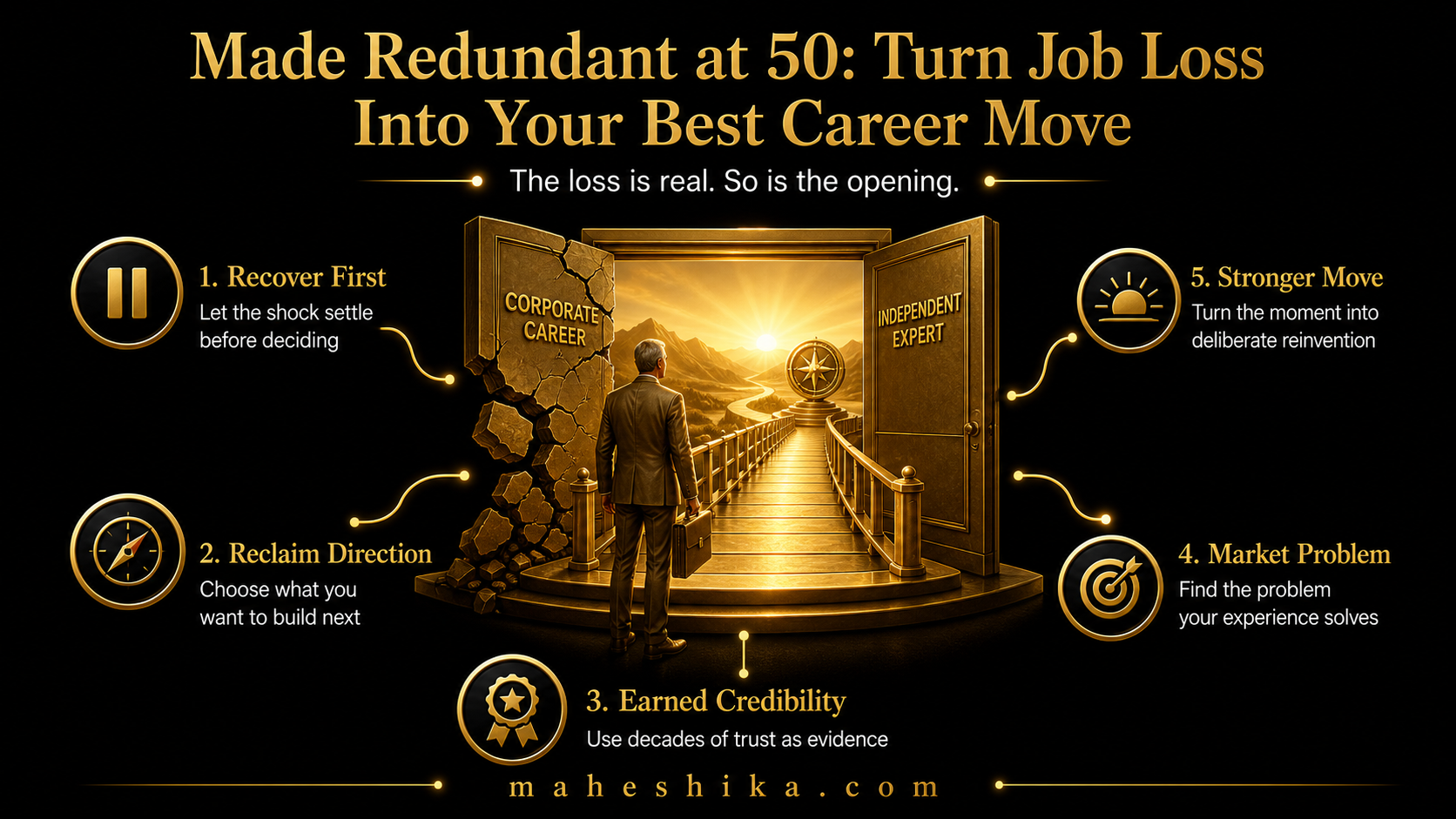
Being made redundant at 50 carries a particular weight. The years you have invested in building your career, the seniority you have earned, the salary level you have reached: all of it feels suddenly precarious. The corporate job market can make you feel like your experience is a liability rather than an asset. And yet, for the professionals who approach this moment correctly, redundancy at 50 is frequently the catalyst for the most commercially successful and personally satisfying phase of their entire working life.
This article is direct about why, and about what you actually need to do to make that true for you.
The Honest Reality of the Corporate Job Market at 50
Before anything else, it is worth naming something that rarely gets said openly: the corporate employment market for senior professionals over 50 is structurally difficult. Not impossible, but difficult in ways that are worth understanding clearly rather than discovering gradually through a demoralising job search.
Organisations restructuring at the senior level tend to replace expensive, experienced roles with cheaper, more generalist ones. Hiring managers, who are often younger than you, may have unconscious assumptions about adaptability, energy, or cultural fit. The interview process for senior corporate roles can take months and may never result in an offer even for highly qualified candidates.
None of this means you cannot find an excellent employed role. Some professionals at 50 move straight into better positions than the ones they left. But the base rate for that outcome is lower than most people expect, and the alternative, building your own independent practice, has a higher base rate of success for people at your level than it does for anyone younger.
What You Actually Have at 50
Strip away the title, the team, and the corporate infrastructure, and what remains is substantial. At 50, you have assets that no amount of academic qualification or early career hustle can produce.
- Domain depth. You understand your field at a level that takes 15 to 20 years to reach. You have seen patterns, failures, and successes that cannot be learned from books. This is the rarest and most valuable form of professional knowledge.
- A professional network. The contacts you have built over two decades are not just social relationships. They are a commercial infrastructure. Many of your next clients, referrers, and collaborators are already in your network.
- Credibility. People who have worked with you know what you can do. That reputation, built over years, does not disappear when the job does. It follows you into whatever comes next.
- Pattern recognition. You have seen what works and what does not in complex organisations, at a level of nuance that cannot be replicated by someone 20 years younger. That judgement is exactly what the most valuable consulting and advisory work requires.
The corporate employment market does not price these assets well. The independent market does.
The Four Moves That Make Redundancy a Career Upgrade
The professionals I have seen turn redundancy at 50 into their best career move all follow a similar pattern. It is not about talent or luck. It is about a specific sequence of decisions.
Move One: Resist the urgency to replicate what you had. The financial pressure to replace your income quickly is real, but making decisions from that pressure usually produces worse outcomes than taking four to six weeks to think clearly. You are likely to have more financial runway than you realise. Use it.
Move Two: Conduct an honest expertise audit. Identify the specific problems you have solved, for whom, with what results. Articulate your expertise in commercial terms: not "I have 20 years in commercial leadership" but "I help organisations entering new markets build the commercial infrastructure and partnership ecosystems that produce revenue in year one." The specificity is where the value lives.
Move Three: Test demand before you build anything. Before you create a website, write a proposal, or define an offering in detail, have five to ten conversations with people who might hire you or know people who would. Those conversations will tell you more about the market for your expertise than any amount of planning.
Move Four: Price from value, not from anxiety. The most common mistake independent professionals make at the start is underpricing out of fear. If you have 20 years of domain expertise and a track record of board-level results, your day rate should reflect that. Underpricing signals insecurity, not affordability.
Related Reading
The Timeline That Works
Many professionals expect the transition to independence to take much longer than it does, or much shorter. The realistic timeline for building a functioning consulting practice from scratch is typically three to six months to your first paid engagement, and nine to eighteen months to a consistent, full income replacement. That timeline shortens significantly if you have warm contacts who know your work, if you have a clear niche, and if you price your work at the right level from the start.
The first client almost always comes from your existing network, not from inbound marketing. This is why the quality of your positioning matters more in the early stages than the quality of your website. You are not trying to attract strangers. You are trying to make it easy for people who already know you to hire you.
What AI Changes About This Transition
The infrastructure required to operate as an independent professional in 2026 is a fraction of what it was five years ago. Websites, content, proposals, research, administrative systems: all of these can be built and maintained by one person using AI tools that did not exist at scale until very recently. The practical barrier to going independent has fallen dramatically.
More importantly for you specifically: AI cannot replicate the expertise, judgement, and network you have built over 20 years. It amplifies what you have. It cannot substitute for it. This is a structural advantage for experienced professionals in a way it simply is not for those with less career capital to draw on.
Free Tool
Start free: where do you actually stand?
Two free tools give you an honest answer in minutes. The AI Risk Score shows how exposed your role is. The Expertise Ownership Score shows how findable and owned your expertise is.
AI Risk Score Expertise Ownership ScoreThe Asset That Survives the Next Redundancy
So the answer to redundancy at 50 is this: it is not a setback to recover from, it is the moment you finally price yourself for what you are actually worth. The professionals who make it their best career move are not waiting for the next job title to validate them. They take the domain depth, the network and the credibility a role never fully captured, and they build something of their own around it.
But there is a deeper truth underneath the four moves above, and redundancy makes it impossible to ignore. That title on your email signature was never yours. It belonged to the organisation, and the day the org chart changed, it disappeared with the job. Twenty years of judgement, pattern recognition and client trust suddenly had nowhere of its own to live. And in a market where AI can answer almost any question in a voice that sounds like everyone else, the professionals who stay visible are the ones with a place the market cannot take from them.
A personal website under your own name. Somewhere your expertise lives permanently, your track record is shown in full, and your name, not a former employer's, is what people find when they search. Owned outright, findable in a search, impossible to reduce to a generic answer. That is not a nice extra for later. It is the one asset that would still have been working for you the day the redundancy letter arrived, and the one that protects you from ever being left exposed like that again.
You do not have to work out how to build that alone, and you do not have to wait until you feel ready. If you want to turn this moment into the asset that secures your next chapter, properly, let us talk.