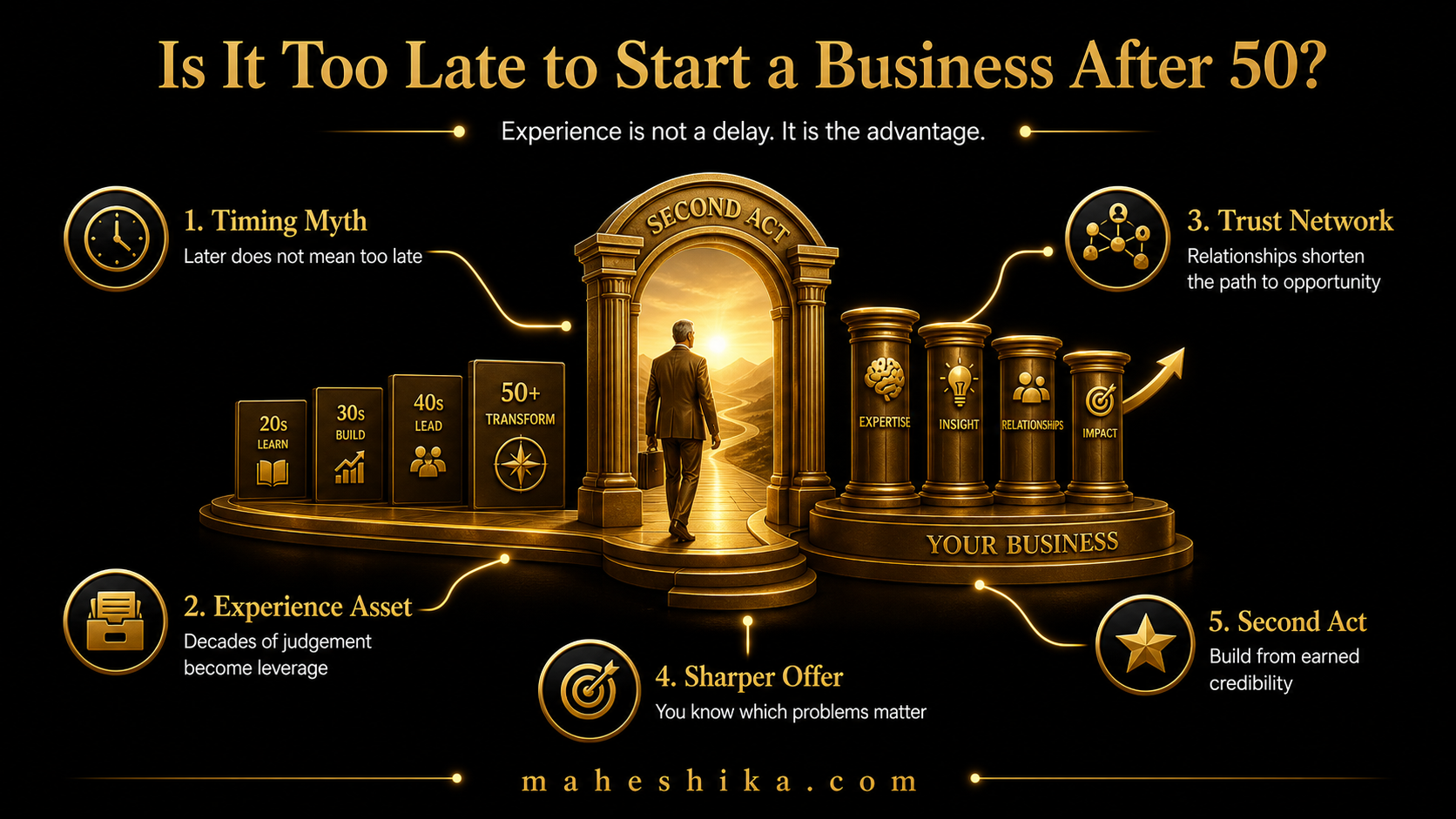
No. But let me give you a better answer than that, because the question deserves a proper response rather than cheerleading. The myth of the young founder has been one of the most damaging narratives in business culture: the idea that entrepreneurship is a young person's game, that you need to start young to be successful, and that reaching 50 without having built a business means you have somehow missed the window.
The evidence does not support that narrative, and neither does my experience working with senior professionals who build their first independent practices in their 50s and watch them outperform anything they could have built 20 years earlier.
What the Research Actually Shows
Studies looking at successful business formation consistently find that founders in their 40s and 50s have higher success rates than founders in their 20s and 30s. The reasons are not mysterious: more domain knowledge, more business acumen, more financial discipline, more realistic expectations, and a larger professional network from which to acquire clients, partners, and advisors.
Research from MIT and Northwestern University, examining millions of companies, found that the average age of successful founders was higher than commonly assumed, with founders in their late 40s showing some of the highest success rates of any age group. This aligns with what most people who work with mid-career founders directly observe: experience creates a structural advantage that enthusiasm cannot substitute for.
The types of businesses that most 50-year-olds build also differ from the high-growth, venture-funded startups that dominate the cultural narrative around entrepreneurship. Expert-based businesses, consulting practices, advisory firms, professional service organisations, these are often built on client relationships, reputation, and deep domain knowledge. All of which favour older founders.
The Specific Advantages You Have at 50
Starting a business at 50 is not just "not too late." In several important respects, it is better than starting at 30.
You already have clients, or people who will become clients. Your professional network is full of people who have worked with you, trust your judgement, and are in positions of decision-making authority. Getting your first client at 50 is almost always easier than getting your first client at 30, because the relationships are already there.
Your expertise is at its most valuable. The specific knowledge and judgement you have accumulated over 20 years of professional practice is at its peak. You understand not just what to do but why, not just the tactics but the strategic context, not just the playbook but the exceptions to it. That depth is what clients pay premium rates for.
You understand how businesses work. You have seen organisations from the inside, at senior level, across multiple business cycles. You understand commercial reality in a way that cannot be learned from courses or books. That understanding makes you a better founder in practical terms.
You are more resilient. You have navigated difficult situations, managed uncertainty, and kept going when things were hard. You know that setbacks are not signals to stop. That psychological durability is a genuine business asset.
The Honest Challenges
It would be dishonest to make the case for starting after 50 without acknowledging the real challenges.
Financial commitments are typically higher at 50 than at 30. Mortgages, dependent children or parents, lifestyle costs built on a senior salary: these create real pressure that makes the early stages of building a business more stressful than they would be for someone with fewer obligations.
The identity shift is more significant. You have spent more years in a professional structure that provided status, colleagues, and a clear definition of your value. Leaving that structure behind is psychologically harder when it has been your context for longer.
The tech learning curve is real for some people, though far less steep than it used to be. AI tools, in particular, have made the operational infrastructure of running an independent business more accessible than at any previous point.
None of these challenges are insurmountable. They are real, and they are worth accounting for in your planning rather than dismissing.
Related Reading
Free Tool
Start free: where do you actually stand?
Two free tools give you an honest answer in minutes. The AI Risk Score shows how exposed your role is. The Expertise Ownership Score shows how findable and owned your expertise is.
AI Risk Score Expertise Ownership ScoreWhat Kind of Business Works at 50
Not all business models suit every founder at every age. At 50, with a deep professional background, the models that work best are those that leverage expertise and relationships rather than those that require scale, venture funding, or a decade of product development.
Consulting, advisory, fractional executive work, training, speaking, online courses, and book-based businesses all fit this profile well. They can be built with low capital requirements, started quickly, and grown through reputation and referral rather than advertising spend. They generate revenue early because they are based on direct relationships rather than scalable products that require mass adoption.
The question is not "is it too late?" The question is "what kind of business fits the assets I have right now?" For most professionals at 50, the answer to that question leads somewhere compelling.
The One Move That Makes the Timing Work
So no, it is not too late. The data says founders your age outperform, your clients are already in your network, and your expertise has never been worth more. The honest answer is not permission to wait for certainty. It is a case for starting with what you already have.
But starting is not the same as being found. You can be exactly the right person to build this business, with two decades of proof behind you, and still be invisible the moment someone searches your name. When you leave the company that gave you a title and an email signature, you lose the platform that made you findable. And in a market where AI can generate an answer that sounds like anyone, the professionals who keep their place are the ones who have a place nobody else can claim.
A personal website under your own name. Somewhere your expertise lives in your own words, your track record is laid out plainly, and your name is the first result when a client looks you up. Owned outright, not rented from an employer or a platform, impossible to mistake for a generic answer. That is not a website. It is the foundation the rest of the business stands on.
You do not have to figure out the site alone, and you do not have to wait until the business is further along to build it. If you want it done properly, by someone who understands exactly what this stage looks like, let us talk.