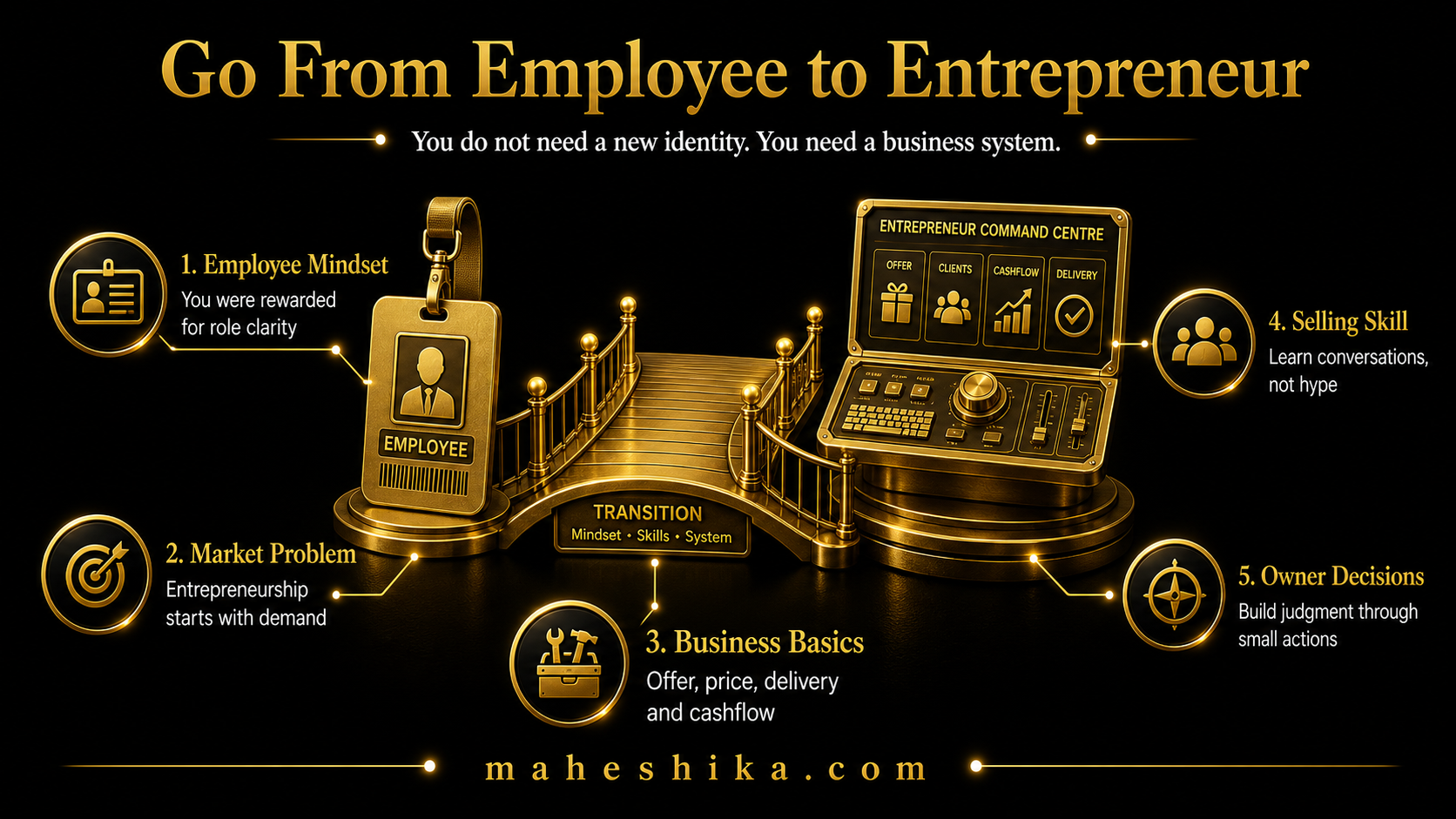
The phrase "I have never run a business" is one of the most common reasons senior professionals give for not making the transition to independence. It sounds like a sensible caution. It is actually a misunderstanding of what running an expert business at the senior level actually requires, and what skills you already have.
If you have managed a P&L, you understand the basics of business economics. If you have built a team, you understand the principles of organisation and people management. If you have won commercial agreements, managed client relationships, or navigated organisational politics to get things done, you already have most of the skills that an independent professional business requires. What is new is narrower than you think.
The Skills You Already Have
Let me be specific about this, because the "I have never run a business" story often gets conflated with "I do not know how to do anything commercial." If you have reached a senior level in a large organisation, you almost certainly have all of the following.
Commercial judgement. You understand how businesses make money, where value is created and captured, how to evaluate commercial risk. This is one of the most important skills for running an independent practice, and it takes years to develop.
Client management. Whether your clients were external customers or internal stakeholders, you have experience of managing complex relationships, understanding needs, delivering against expectations, and navigating the inevitable moments when things do not go to plan.
Negotiation. You have negotiated contracts, resources, priorities, and agreements throughout your career. Independent professional work requires exactly this kind of negotiation, in a simpler, more direct form.
Structured problem-solving. The ability to diagnose a complex situation, identify the relevant factors, and develop a course of action is the core intellectual skill of consulting. If you have done this in a corporate context for 15 years, you can do it in an independent one.
Communication and presentation. Winning and retaining consulting clients requires the ability to communicate clearly, present compellingly, and build trust through conversation. Senior corporate professionals have typically developed these skills to a high level.
What Is Actually New
The genuinely new skills required to run an independent business are narrower than most people expect. They fall into three categories.
Sales and business development. In a corporate role, the business development function, finding new clients, winning new work, was typically shared across a team or handled by dedicated commercial functions. As an independent, you are responsible for your own pipeline. This is the area that most corporate professionals underestimate, and it is the area where the learning curve is steepest. The good news is that for senior professionals with deep networks, the early pipeline almost always comes from relationships rather than from systematic sales processes, which reduces the initial learning required.
Pricing and positioning. Deciding what to charge for your work, and how to position yourself to attract the clients who will pay it, is a different skill from managing costs and revenues inside an organisation. The principles are the same, but the application is different. The most common error is underpricing, driven by the discomfort of selling yourself rather than by a realistic assessment of the value you deliver.
Operations and administration. The infrastructure behind an independent practice, legal structure, accounting, invoicing, contracts, tax compliance, is genuinely new for most corporate professionals. The good news is that it is also genuinely simple, particularly in 2026 when most of it can be handled by affordable professional services and basic software.
The Mental Shift That Actually Matters
The most significant transition from employee to entrepreneur is not about skills. It is about mindset, specifically the shift from executing within a structure to creating the structure itself.
As an employee, even a very senior one, there is always an organisation providing the context: the mandate, the clients, the resources, the performance framework. As an entrepreneur, you create all of that. There is no one to set the direction, no team to execute the plan, no HR to handle the difficult conversations, no finance function to manage the cash. The freedom is genuine and the responsibility is absolute.
Most professionals find this simultaneously liberating and disorienting, particularly in the early months. The disorientation is normal and temporary. The liberation, once you have established your own rhythm and structure, tends to be permanent. The professionals who navigate the mental shift most effectively are those who replace the missing corporate structure with their own: clear working hours, defined priorities, regular accountability mechanisms, and a peer community of other independents who understand what they are navigating.
Related Reading
The Practical Starting Sequence
For a senior professional making the transition from employee to entrepreneur for the first time, the practical starting sequence looks like this.
- Week one to two: Complete your expertise audit. Understand clearly what specific problems you solve, for whom, with what outcomes.
- Week two to three: Have ten conversations with your warmest professional contacts. Test your positioning, look for early leads, build momentum.
- Week three to four: Define your core offer. One primary service with a clear scope, delivery structure, and price. Keep it simple.
- Month two: Set up the basic infrastructure. Company structure, professional liability insurance, basic accounting software, a simple contract template.
- Month two to three: Build your online presence. LinkedIn updated, simple website live, professional biography written.
- Month one to three in parallel: Keep the outreach and conversations going every week. Your first client will almost certainly come from your network, not from inbound marketing.
This sequence is deliberately simple because simplicity is what produces momentum in the early stages. Complex business plans, elaborate marketing funnels, and sophisticated positioning frameworks all come later. First, get a client. Everything else follows from there.
Free Tool
Start free: where do you actually stand?
Two free tools give you an honest answer in minutes. The AI Risk Score shows how exposed your role is. The Expertise Ownership Score shows how findable and owned your expertise is.
AI Risk Score Expertise Ownership ScoreThe Space Nobody Can Take From You
So no, you do not need to have run a business before to become an entrepreneur. What you need, you already have: commercial judgement, client relationships, negotiation, and the discipline to solve hard problems under pressure. The genuinely new ground is narrow, finding clients, pricing yourself honestly, and putting simple infrastructure in place, and none of it takes as long to learn as the fear suggests. Follow the sequence, have the conversations, get your first client. Everything else follows from there.
But here is the part that decides how this chapter actually goes. For 15 or 20 years, your credibility travelled on someone else's letterhead: the organisation's brand, the title on your card, the team standing behind you. The day you leave, that borrowed credibility disappears with it, and for a while it can feel like the expertise went too. It did not. What you built is yours. What you know is yours. What you have done is yours. But if nowhere carries your name, nobody can find it, and in a market where AI can produce a competent-sounding answer to almost anything, competent and generic is exactly what gets ignored.
The professionals who make this transition well are not the ones with the boldest business plan. They are the ones who give their expertise a home before they need it: a personal website under their own name, where their thinking lives, their work is shown, and their signature is unmistakable. Owned outright, findable in a search, impossible to mistake for anyone else. That is not a marketing extra. It is the asset that keeps working, and keeps you visible, long after the employer's brand has stopped doing it for you.
You do not have to work this out alone, and you do not have to wait until the business feels fully formed to build it. If you want that space built properly, by someone who has made this exact transition herself, let us talk.