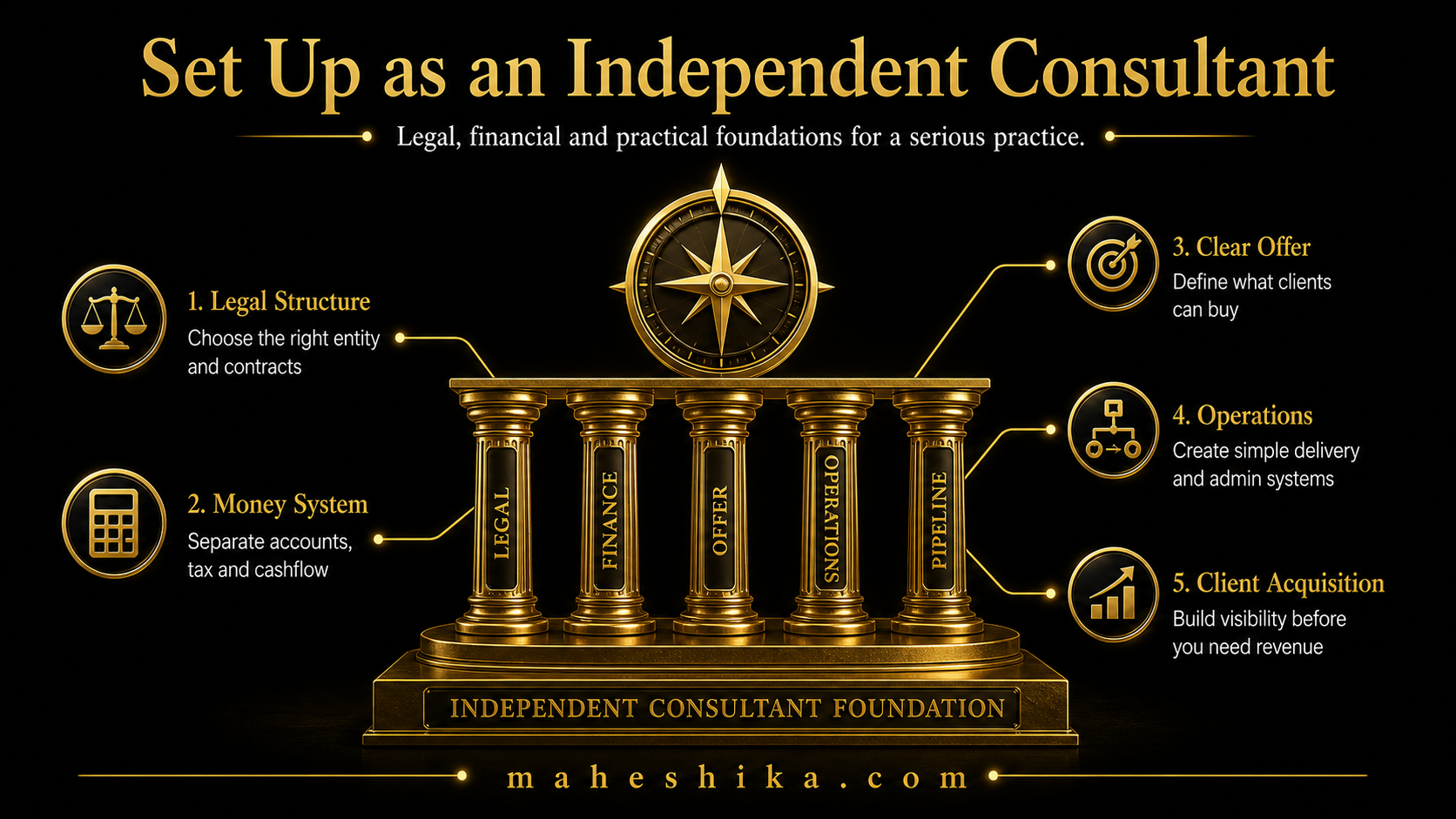
The operational setup of an independent consulting business is not complicated, but it does have a specific sequence, and doing things out of order creates problems that are annoying to unpick later. This is the sequence that works, with enough detail to act on without requiring you to read three other guides first.
Note: this article covers the UK context. If you are based elsewhere, the structural principles apply, but the specific legal and tax frameworks will differ. In all cases, and at every stage in this article, the advice to consult a qualified accountant and solicitor is not a disclaimer. It is practical guidance that will save you money and headaches.
Step One: Sole Trader or Limited Company?
The first structural decision is whether to operate as a sole trader or through a limited company. Both are legitimate options. The right choice depends on your circumstances, your tax position, and the nature of your expected client base.
Sole trader is the simplest structure. You register with HMRC for self-assessment, you invoice clients in your own name, and you pay income tax and National Insurance on your profits. There is no separation between you and your business legally, which means your personal assets are exposed if your business incurs a liability. The administrative burden is low.
Limited company is more complex to administer but offers several advantages for most senior consultants. The company is a separate legal entity, which limits your personal liability. It creates a more professional presentation to corporate clients, many of whom prefer or require contracting with a company rather than an individual. It can be more tax-efficient, particularly at higher income levels, through the combination of a salary and dividends. It is also the structure that most relevant to IR35 considerations.
For most senior independents in the UK who expect to work with corporate clients and who have an annual revenue above approximately forty thousand pounds, a limited company is worth setting up. The tax efficiencies typically outweigh the additional administrative cost of running the company. But the optimal structure for your specific situation depends on your income level, your personal circumstances, and how your engagements are structured, which is exactly the conversation to have with an accountant who specialises in contractor and consultant structures.
IR35: What It Is and Why It Matters
IR35 is UK tax legislation designed to identify workers who are, in effect, employees of their clients but are working through a personal service company in order to pay less tax. If HMRC determines that your engagement falls inside IR35, your income from that engagement is taxed as employment income rather than company income, which removes most of the tax advantages of operating through a company.
Since 2021, for engagements with medium and large private sector clients, the responsibility for determining IR35 status sits with the client organisation. This means your corporate clients will make their own assessment of whether your engagement is inside or outside IR35, and that assessment has direct implications for how they structure the contract with you.
The factors that point towards outside IR35: you can send a substitute to do the work, you are not integrated into the client's organisation, you control how and when the work is done, you have multiple clients, you carry your own financial risk. The factors that point towards inside IR35 are largely the opposite: you work exclusively with one client, you are given a desk and equipment, you work set hours, the client controls the how and when of your work.
This is genuinely complex, the legislation has been litigated extensively, and the right approach for your specific situation requires professional advice. Do not ignore it, and do not assume your engagement is obviously outside IR35 without having an accountant review the specifics. The consequences of getting it wrong are significant.
Related Reading
Insurance: What You Actually Need
Professional indemnity insurance is non-negotiable for most independent consultants. It covers you if a client claims that your advice caused them financial loss. The vast majority of corporate clients will ask for evidence of PI cover before signing any engagement agreement, and they are right to do so. Standard cover levels for senior consultants range from one million to five million pounds depending on the size and nature of the engagements you take on.
Public liability insurance is less commonly required for consultants who work in office environments rather than physical spaces, but it is worth checking whether your typical client environments require it. Some large corporates include it in their supplier requirements.
If you have a limited company, directors' and officers' insurance can also be relevant, particularly if you take on board advisory roles. Discuss with your insurance broker.
Get quotes from specialist contractor and consultant insurance providers. Premiums for professional indemnity at appropriate cover levels are typically in the range of a few hundred pounds annually, which represents a trivial fraction of your consulting revenue for protection that is genuinely important.
Free Tool
Start free: where do you actually stand?
Two free tools give you an honest answer in minutes. The AI Risk Score shows how exposed your role is. The Expertise Ownership Score shows how findable and owned your expertise is.
AI Risk Score Expertise Ownership ScoreBanking, Accounting, and Contracts
Business bank account. Open one before you invoice your first client. Mixing personal and business finances is administratively messy and creates complications at tax time. Most of the major banks offer business accounts, as do several digital-first providers that are better suited to the low transaction volumes typical of consulting businesses. The account should be in the name of your company if you have incorporated.
Accounting software. Set this up from day one. The leading options for small UK businesses are well-suited to the invoicing, expense tracking, and VAT management needs of a consulting practice. Good software makes the annual accounts process significantly less painful and provides the financial visibility you need to make sensible decisions throughout the year. If your revenue is likely to exceed the VAT registration threshold (currently eighty-five thousand pounds), register for VAT early rather than retrospectively.
Your contract template. Before you take on your first engagement, have a standard consulting agreement reviewed by a solicitor and ready to use. The contract should cover: scope of work, deliverables, timeline, fee and payment terms, intellectual property ownership, confidentiality obligations, limitation of liability, and termination provisions. Many clients will want to use their own contract. That is fine. Review it carefully and understand what you are agreeing to before signing. Pay particular attention to IP ownership and exclusivity clauses.
The Setup Checklist in Order
- Decide on structure (sole trader or limited company) with accountant advice
- Incorporate the company at Companies House if going the limited company route
- Register for self-assessment or corporation tax as appropriate
- Open a business bank account
- Set up accounting software and connect it to the bank account
- Obtain professional indemnity insurance
- Have a standard consulting contract template prepared by a solicitor
- Register for VAT if appropriate to your expected revenue
- Set up a simple expense tracking process from day one
None of these steps is difficult. Each has a cost, mostly modest. The combined effect is a business that operates professionally from the first day, which matters both for how clients experience working with you and for your own sense of operating with credibility and confidence.
The Paperwork Protects You. It Does Not Make You Findable.
So that is the answer: a sole trader or a limited company, IR35 clarity, proper insurance, a real contract, and a bank account and accounting system that keep the numbers honest. Nine steps, done in order, and you are trading legitimately from day one. That part is genuinely not complicated.
But notice what none of it does. Your company registration does not put you in front of a client. Your insurance certificate does not explain why you, specifically, are worth hiring. Companies House gives you a number, not a reputation. All of that structure protects the business you are building, but it says nothing about who you are, and it will not be the thing a prospective client finds when they search your name at eleven at night before deciding whether to take the call.
That is the gap most new independents leave open, and it is a costly one. The moment you stepped outside the corporate structure, you lost the platform that used to make you visible: the title, the intranet profile, the logo that did the introducing for you. Now your name has to do that work alone, in a market where AI can answer almost any question in a voice that sounds like everyone else. The consultants who get chosen are the ones with a place of their own: a personal website, under their own name, where the thinking, the track record, and the signature are unmistakably theirs. Owned outright. Findable in a search. Impossible to mistake for a generic answer.
You have set the business up correctly. Now let us make sure the market can actually find it. If you want to talk through what that looks like for you, let us talk.