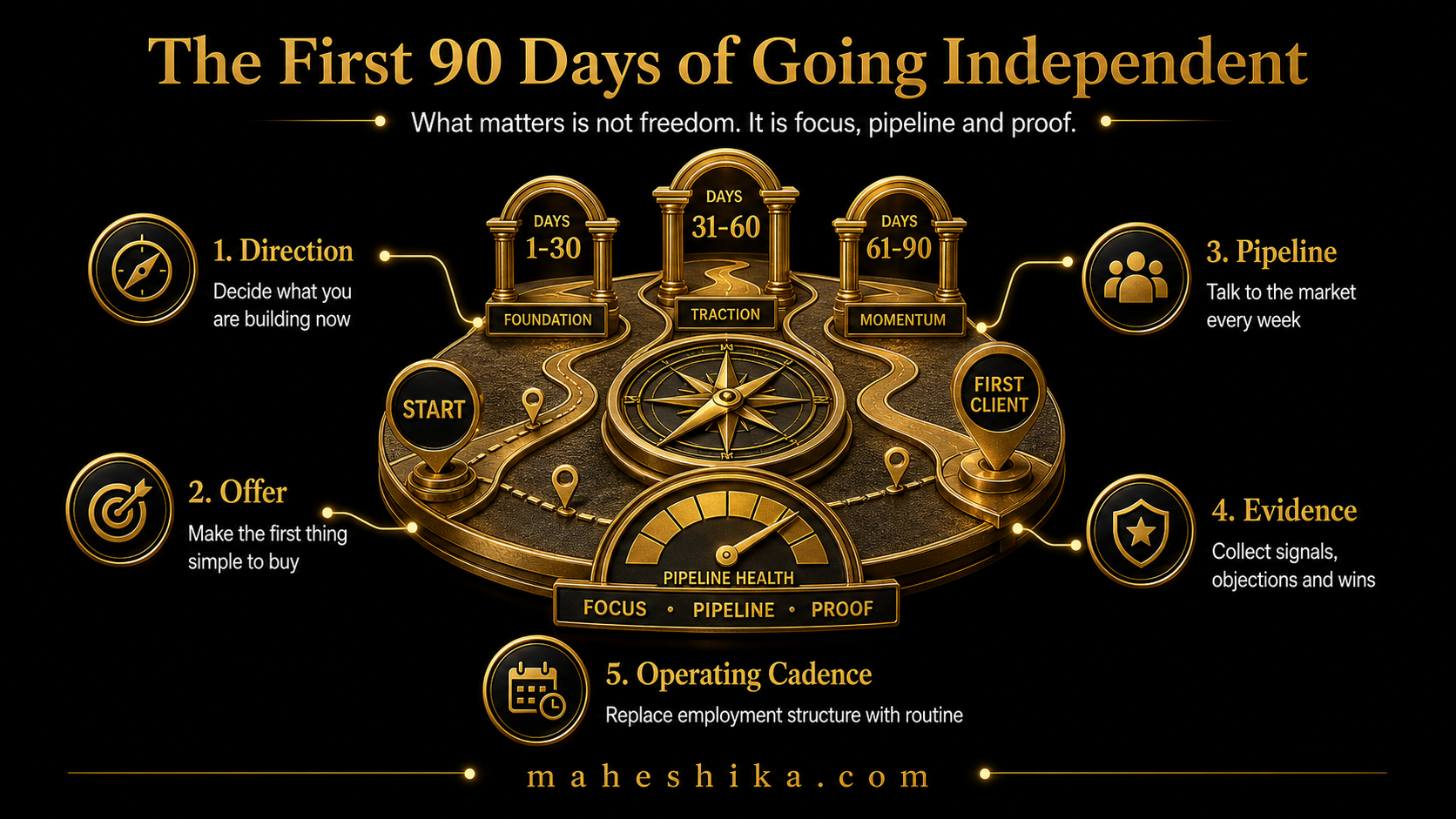
Everyone talks about the freedom. The flexibility, the autonomy, the relief of not having your working life shaped by someone else's agenda. What fewer people talk about is the specific strangeness of the first ninety days: the disorientation, the unexpected loneliness, the moments of doubt that arrive alongside the genuine excitement. And the practical reality that the choices you make in those first three months have an outsized effect on the year that follows.
This is what I wish someone had told me before I started, and what I tell every senior professional I work with who is making the transition.
The First Two Weeks Are About Identity, Not Operations
Most new independents spend the first two weeks doing the things that feel productive but are largely displacement activity: setting up email systems, debating company names, designing logos, arranging office furniture. None of this is bad. Some of it is genuinely necessary. But it is almost always prioritised over the things that are actually urgent, because those things are scarier.
What is actually urgent in the first two weeks: getting in front of five people who might hire you or refer you, and having honest conversations about what you are doing and what kinds of problems you are positioned to solve. That is it. Five conversations. Everything else can wait.
The identity shift is the deeper work happening underneath the operational busyness. You have spent years with a title, a team, an organisation behind your name. Now your name is the thing. The shift from "I work at X" to "I help organisations do Y" is not just a phrasing change. It is a reconfiguring of how you introduce yourself, how you think about your value, and what you choose to spend your time on. Give yourself permission to find it disorienting. Most people do.
What the First Month Actually Looks Like
In the first month, you will likely experience a pattern that I call the feast and the void. On some days, the pipeline looks full, conversations are happening, and you feel certain this was the right decision. On other days, nothing moves and the silence feels like failure. Both experiences are normal, and neither is a reliable signal of how things are actually going.
The first month priorities in order of importance: client conversations first, administrative setup second, brand and marketing third. Most new independents reverse this order. They spend three weeks on a website and two days having conversations. The website will not generate your first client. A conversation will.
If you have a first engagement already in place, the first month is about delivering it brilliantly and using it as the foundation for everything that follows. The case study, the referral, the testimonial, the next opportunity. Every first engagement should be treated as a proof of concept for the whole business, because that is effectively what it is.
Related Reading
Month Two: The Trough and How to Navigate It
Month two is where many new independents have their first genuine crisis of confidence. The initial burst of activity from the transition has subsided. Conversations that seemed warm in month one have gone quiet. The work that was there at the start may be nearing its end without a clear replacement in sight.
This is not a sign that you made the wrong decision. It is the normal pattern of pipeline development when you are new to the market. Consulting pipelines take time to mature, and the conversations you had in month one are beginning to convert, but on the client's timeline, not yours.
The practical response to the trough: do not slow down your outreach when the pipeline looks thin. Accelerate it. The temptation is to wait for existing conversations to conclude before starting new ones. That creates a permanent boom and bust cycle. The antidote is a constant, consistent level of outreach regardless of how full the pipeline currently looks.
Month two is also when most new independents discover that they need to refine their offer description. The first version of how you describe what you do rarely survives contact with real client conversations. Pay attention to which descriptions land and which create confused silences. Adjust accordingly.
Free Tool
Start free: where do you actually stand?
Two free tools give you an honest answer in minutes. The AI Risk Score shows how exposed your role is. The Expertise Ownership Score shows how findable and owned your expertise is.
AI Risk Score Expertise Ownership ScoreMonth Three: Building the Foundations That Last
By month three, the early chaos has settled. You have had enough conversations to understand which client types are genuinely interested in what you offer. You have delivered some work, or at least have projects in flight. The shape of your business is becoming clearer, even if the edges are still forming.
Month three is the right time to do the structural work you were too busy for in months one and two. Formalise your offer. Document your process. Set up the tracking systems that will let you understand your pipeline. Start building your visible authority: a LinkedIn profile that reflects the clarity you now have, the beginnings of written content that demonstrates your thinking.
It is also the time to make honest decisions about what is working and what is not. Some potential clients who seemed interested in month one will have gone quiet permanently. Some sectors you hoped would engage have not. Some niches you did not anticipate have shown strong interest. At ninety days, you have enough evidence to start shaping your focus based on what you have actually learned, rather than what you assumed before you started.
The One Foundation That Makes the First 90 Days Compound
So here is the honest answer to what no one tells you: the first ninety days are not about avoiding the discomfort, they are about building the habits that let the discomfort work for you. Five real conversations before you touch a logo. Deliver the first engagement so well it becomes proof, not just income. Accelerate your outreach exactly when the trough makes you want to slow down. Do those three things and by day ninety you are working from evidence, not the assumptions you started with.
But there is a shift underneath all of it that most people only feel and never name. For years, a title, a team, and an organisation's name sat in front of yours and did the work of making you visible. The moment you go independent, that scaffolding is gone, and twenty years of expertise suddenly has nowhere obvious to live. In a market where AI can answer almost any question in a voice that sounds like everyone else's, the professionals who hold their ground are the ones who own a space no algorithm can absorb.
A personal website under your own name. Somewhere your thinking, your track record, and your actual signature live in one place, owned outright, findable the moment someone searches for exactly what you do. That is not a task to leave for month four once things settle. It is the asset that makes months one through three easier, because every one of those five conversations lands on solid ground instead of a blank space.
You do not have to work this out alone, and you do not have to wait until the trough forces the question. If you want to build the foundation properly, with someone who has been through exactly this transition, let us talk.