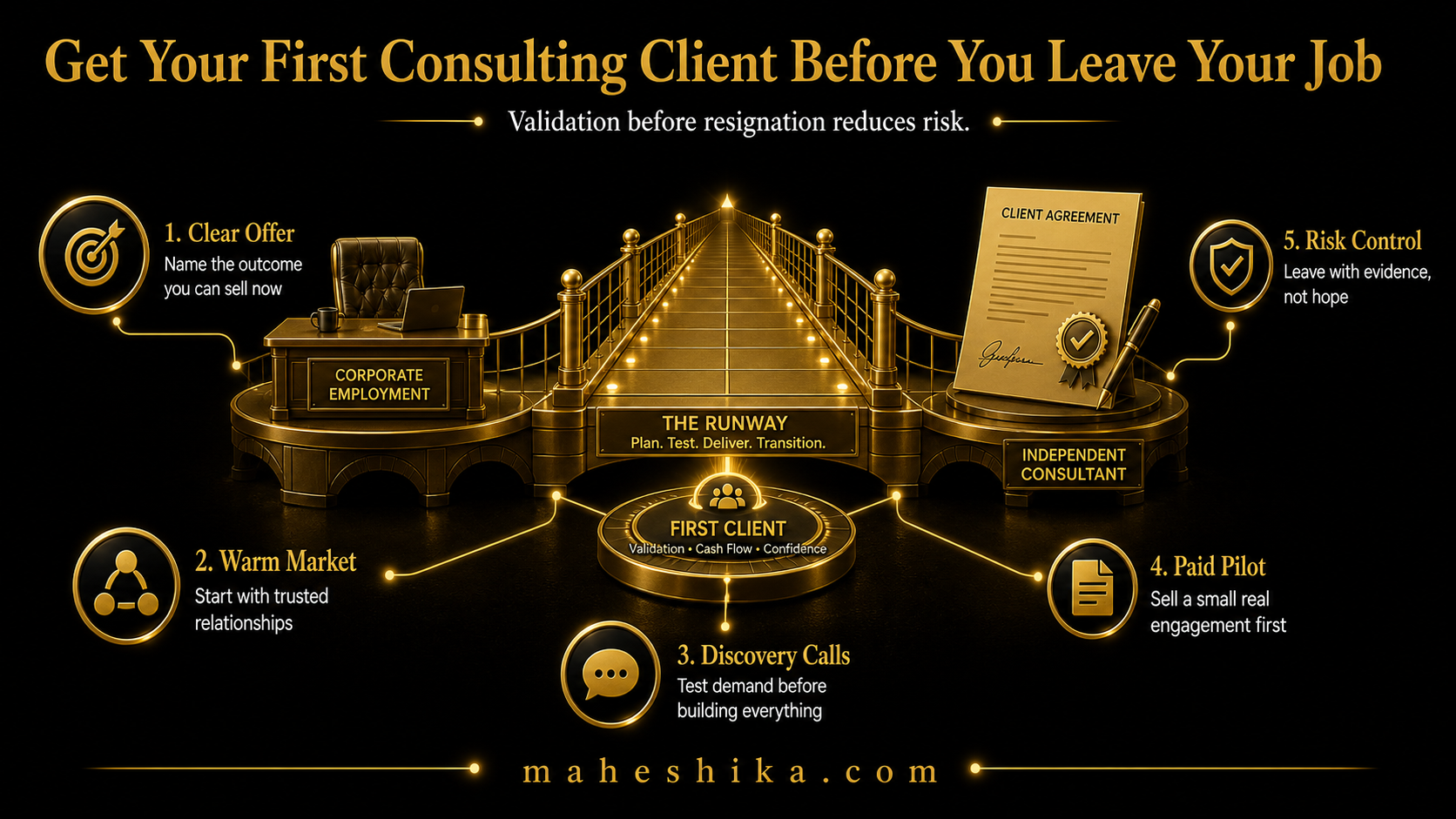
The single biggest variable in whether a corporate to consulting transition goes well or badly is whether you have a first client secured before you leave. Not a warm lead. Not a promising conversation. A secured engagement, or a commitment clear enough that you can treat it as one. Everything else, the structure, the branding, the website, becomes substantially less stressful when you have that first piece of work in place.
Getting there before you leave requires preparation, but it does not require anything dishonest or disloyal to your current employer. It requires clarity about what you are going to offer, and the willingness to have direct conversations with people who already know and respect your work.
Why Your First Client Almost Always Already Knows You
Cold outreach to strangers rarely generates a first consulting engagement. The conversion rates are low, the trust is not there yet, and the process takes far longer than most people planning a transition can afford.
Your first client is almost certainly in your existing network. They might be a former employer who knows what you can do and has a project that needs that capability. They might be a peer in your industry who is now in a role where your expertise is directly relevant to their challenges. They might be a client or supplier from your corporate career who would benefit from ongoing access to your thinking.
The reason they have not already hired you is not that they do not see the value. It is that they do not know you are available, or they have not thought of you in the context of a consulting engagement rather than as a colleague or counterpart. Your job is to change that, clearly and specifically.
The List: Who to Talk to and in What Order
Before you have a single conversation, make a list. This is not a networking list in the vague sense. It is a specific list of people who have seen your work, who understand its quality, and who are in positions where your expertise is commercially relevant to problems they are currently facing.
Aim for twenty to thirty names. For each person, note what you know about their current situation: what organisation they are in, what challenges that organisation is likely facing, and specifically how your expertise might address those challenges. This level of preparation before a conversation is what separates people who convert quickly from people who have many conversations and land no work.
Prioritise the list. At the top: people you have worked with directly and who have expressed appreciation for your work. Second tier: people who know your reputation but have not worked alongside you directly. Third tier: people who are adjacent to your target market and might know someone who needs you.
Work through the list methodically. Not all at once. A handful of high-quality, well-prepared conversations a week is far more effective than a mass reconnection effort that feels transactional to the people on the receiving end.
Related Reading
What to Say: The Conversation That Opens Doors
The conversation you are having before you leave is not a pitch. It is a genuine reconnection with a clear, honest description of what you are planning. The distinction matters: a pitch puts the other person in a position of being sold to. A conversation puts them in a position of being informed by someone they trust.
A script that works, adapted to your own voice: "I wanted to reach out because I have made the decision to go independent later this year. I will be focusing on [specific area], specifically helping [type of organisation] with [specific problem]. I am having conversations with people in my network whose judgement I trust, partly to sense-check that I am describing it clearly, and partly because I suspect some of them know organisations that might benefit. Is this something you are seeing in your world?"
Notice what this does. It is not asking for a job. It is not pitching. It is sharing a clear plan, signalling expertise, and opening a question about whether the other person sees relevance in their world. Most people, when asked that question by someone they respect, will either say "actually, we have exactly that problem" or "you should talk to X". Both are exactly what you are looking for.
Free Tool
Start free: where do you actually stand?
Two free tools give you an honest answer in minutes. The AI Risk Score shows how exposed your role is. The Expertise Ownership Score shows how findable and owned your expertise is.
AI Risk Score Expertise Ownership ScoreThe Constraints to Respect and How to Work Within Them
Most employment contracts include restrictions on competitive activity, use of confidential information, and in some cases non-solicitation clauses that limit your ability to approach former clients or colleagues. These are real and should be respected.
The good news is that almost all of the activity described in this article, having conversations, describing what you plan to offer, asking whether people know relevant opportunities, falls well within what is permissible in virtually all employment contracts. You are not poaching clients. You are not misusing confidential information. You are a professional who is making a career transition and having conversations about it.
If your employment contract is unusually restrictive, review it with a solicitor before you begin any outreach. That is a two-hour investment that can save significant complications later. Most senior professionals find that their actual constraints are narrower than they fear.
Equally, be scrupulously honest in every conversation about your timeline. If you are leaving in six months, say so. If you are still deciding on exact timing, say that. People appreciate clarity and it builds the trust that converts conversations into engagements. The goal is to leave employment with work already beginning, not with promises that feel contingent.
The One Move That Secures Your Place
So the answer to landing your first client before you leave is not a leap of faith. It is a list, a series of honest conversations, and the discipline to have them while you still hold a title that opens doors. Do that well and you will not walk out into the unknown. You will walk out with work already in motion.
But notice what those conversations rest on right now: a badge on your email signature, a job title that still means something to the person you are calling. The day you hand in your notice, that badge disappears. Your track record, the very thing you built your reputation on, still has to live somewhere the next client can find it, verify it, and trust it before you ever pick up the phone. Without that, every future conversation starts from zero again.
A personal website under your own name solves that permanently. Somewhere your case studies, your thinking, and your track record live whether you are employed, between engagements, or three clients deep into independence. Owned outright, findable in a search, impossible to mistake for anyone else's work. That is not a nice extra for later. It is the asset that makes every one of those first-client conversations easier, and keeps working long after this transition is behind you.
You do not have to build it alone, and you do not have to wait until you have left to start. If you want it done properly, by someone who has made this exact transition, let us talk.