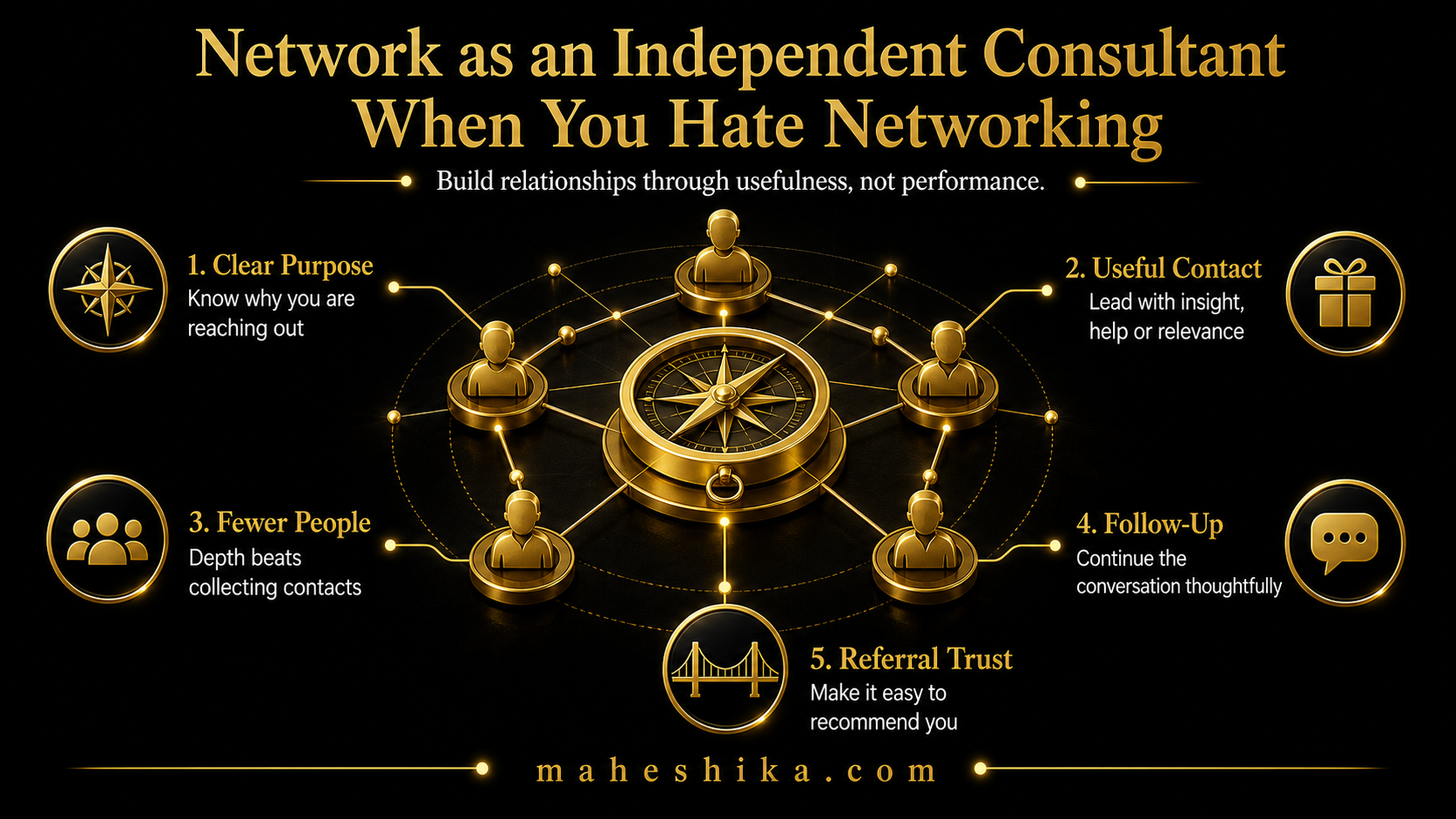
Most advice about networking for consultants assumes you enjoy it. It talks about working rooms, collecting business cards, following up with people you have never met, and building relationships from scratch at industry events. For a significant proportion of senior professionals, that model is both exhausting and ineffective.
The good news is that it is not the only model, and for experienced consultants with deep professional histories, it is not even the best model. The most reliable consulting pipelines I have seen are built through relationships that already exist, deepened and activated rather than created from nothing.
The Difference Between Networking and Relationship Building
Traditional networking is largely about volume: meeting as many people as possible in the hope that some percentage will eventually be relevant. Relationship building is about depth: maintaining a smaller set of genuine connections with people who know and trust your work.
For senior consultants, the relationship-building model produces better results for two reasons. First, the decision to commission a senior consultant almost always involves trust, and trust cannot be manufactured at a networking event. It accumulates through shared experience, demonstrated competence, and time. Second, the clients most likely to hire a senior independent consultant are themselves senior people with well-developed networks and well-developed nonsense detectors. They can tell the difference between someone who is genuinely interested and someone who is working a room.
The practical implication: invest more time in fewer, deeper connections. A coffee with someone who knows your work and respects your thinking will generate more consulting leads than attending twelve networking events per year.
Your Existing Network Is Larger Than You Think
Spend an hour mapping your professional network properly, and most senior professionals discover it is substantially larger than their everyday sense of it. Think beyond the people you are in regular contact with. Think about everyone across your entire career, the colleagues, managers, clients, suppliers, peers, and counterparts who have seen you work.
For someone with fifteen or twenty years in senior roles, that network might include several hundred people who know your name and would take a call if you reached out. A fraction of those will be in positions where your expertise is currently relevant to their challenges. A fraction of those will have both the need and the authority to commission the kind of work you do. That fraction, across a network of several hundred, is a meaningful pipeline.
The activation work is straightforward. Reconnect with people you have not spoken to in a while. Not with a pitch. With genuine interest in what they are working on. Ask what they are finding challenging. Share what you are doing. Let the conversation go where it naturally goes. Most people are pleased to hear from professional contacts who reach out with genuine interest rather than an agenda.
Related Reading
Content as Passive Networking
The most scalable form of networking for people who dislike traditional networking is content. When you publish useful, specific thinking on LinkedIn or on your own website, your network sees it. People who had forgotten you existed remember you. People who were not thinking about the problem you solve start thinking about it in the context of your expertise. Inbound conversations begin that you never initiated.
This is not a quick mechanism. A LinkedIn article or a blog post published today will not generate an enquiry tomorrow. But over twelve to eighteen months of consistent, specific, genuinely useful content, the cumulative effect becomes significant. I have had consulting conversations begin with "I have been following your writing for a while and we have a situation where I think what you do is exactly what we need". That conversation starts from a much stronger position than one that begins with a cold introduction at an industry event.
The content does not need to be voluminous. It needs to be specific enough to be useful to a particular type of reader with a particular type of challenge, and consistent enough that people who follow you know what to expect. Two well-considered posts per month, for a year, produced with genuine expertise and honest perspective, will generate more relevant inbound attention than most consultants create through active networking.
Free Tool
Start free: where do you actually stand?
Two free tools give you an honest answer in minutes. The AI Risk Score shows how exposed your role is. The Expertise Ownership Score shows how findable and owned your expertise is.
AI Risk Score Expertise Ownership ScoreThe One Networking Activity Worth Doing Even If You Hate Networking
If there is one form of active networking worth doing even for those who find it draining, it is one-to-one conversations with people who are adjacent to your target clients. Not necessarily clients themselves, but people whose work brings them into contact with the kind of organisations and decision-makers you are trying to reach.
In practice, this means building relationships with a handful of complementary consultants and advisers who serve the same clients from different angles. A management consultant who focuses on operations might refer clients needing commercial strategy. An executive coach who works with senior leaders might encounter organisations that need the kind of structural work you do. A law firm that advises on corporate transactions might need an independent expert for a specific workstream. These relationships generate referrals that are warm, trusted, and high-conversion.
Build five to ten of these relationships over the course of your first year, and maintain them with the same genuine interest and consistency you bring to client relationships. These are long-term investments, not transactional arrangements. The referrals they generate become a significant and self-sustaining source of new business, without a networking event in sight.
The One Move That Makes You Findable
So the answer to networking when you hate it is not to force yourself into rooms you cannot stand. It is to trade volume for depth: activate the relationships you already have, invest in a handful of referral partnerships that compound for years, and let specific, consistent content do the introductions you would rather not make yourself. The consultants who build durable pipelines are not the best networkers in the room. They are the ones who make themselves easy to find and easy to trust, from a distance.
But here is the part that changes where that content should actually live. Every post you publish on LinkedIn is borrowed space. The platform decides who sees it, the algorithm decides how long it survives, and the day you stop posting, your visibility resets to zero. Meanwhile AI search is starting to answer the exact questions your prospective clients are typing, in a voice that sounds like everyone else's advice, with no name attached and no way to trace it back to you.
The professionals who keep their place in that world are not the ones posting the most. They are the ones with a home the algorithm cannot take away from them: a personal website under their own name, where the thinking that started those coffee conversations and those referral relationships actually lives, permanently, findable in a search, unmistakably theirs. It turns a scattered trail of posts and warm introductions into a body of work someone can find at eleven at night when they are searching for exactly what you do.
That is the piece worth building before the next reconnection email goes out, not after. You do not have to work out the technical side of it yourself, and you do not have to wait until you feel ready. If you would like help building the home your network keeps referring people back to, let us talk.