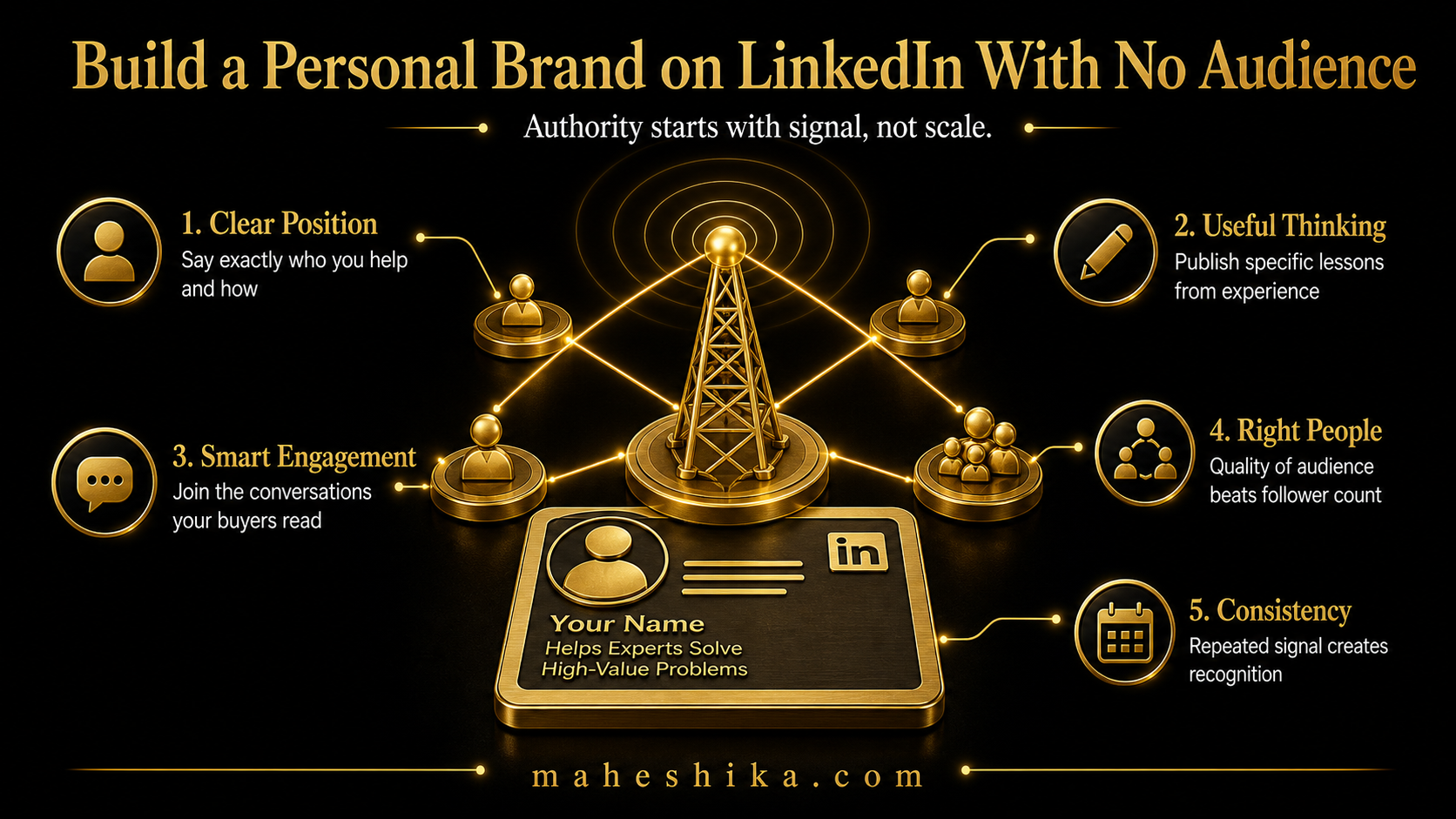
Zero followers is not a problem. It is a starting point. The experts who wait until they have an audience to start building one are waiting for something that does not work that way. Audiences form around people who are already showing up. Here is exactly how to begin, even if your current profile is a decade-old headshot and a job title no one outside your former employer understands.
Fix Your Profile Before You Post Anything
Your LinkedIn profile is a landing page for your expertise. Before a single person reads your content, they will land on your profile to decide whether you are worth following. A weak profile kills the momentum of even the best post.
Start with your headline. The default LinkedIn headline is your job title. That is useless for an independent expert. Instead, use this structure: what you do, who you do it for, and the outcome you deliver. "I help mid-market manufacturers build channel partnerships that generate eight-figure indirect revenue" is a headline. "Director of Sales, EMEA" is a filing system entry.
Your About section should open with the problem you solve, not with where you went to university. Write it in first person. Make it direct. End it with a clear statement of what you offer and how to contact you. Three to five short paragraphs is enough. Read it aloud: if it sounds like a brochure, rewrite it until it sounds like you.
Your banner image should reflect your area of expertise, not the default blue gradient. Use Canva, spend twenty minutes, and create something that communicates your positioning visually. First impressions form fast.
Build Your Connection Base Strategically
Your network is your initial distribution. When you post, LinkedIn shows that content to a fraction of your connections first. If your connections are irrelevant to your work, your content reaches the wrong people and the algorithm suppresses it. So before you start posting, spend a week connecting with intention.
Connect with former colleagues at the seniority level of your target clients. Connect with people in the industries you serve. Connect with event organisers, editors, podcast hosts, and journalists who cover your domain. Connect with other independent consultants who serve the same client base but offer different services: they are referral partners, not competitors.
Send a short, personal note with every request. Not a pitch. Just a genuine line about why you are connecting: "We overlapped at [company] and I have been following your work on [topic]," or "I read your article on [subject] and wanted to stay connected." Connection acceptance rates drop sharply when the message reads like a template.
Aim for three hundred relevant connections before you start worrying about posting frequency. Quality matters far more than speed here.
Related Reading
Your First Ten Posts: What to Write
The most common reason experts do not start is that they cannot decide what to say. Here is a framework that removes the guesswork. Your first ten posts should each be drawn from one of these categories.
One story of a problem you solved. Not a case study with client names, but a narrative of a specific challenge, the decision you made, and what happened. "I once inherited a commercial team in three markets with no CRM, no playbook, and six months to make the numbers. Here is what I did first." These posts build immediate credibility because they are specific and real.
One opinion on something your industry gets wrong. Pick a widely held assumption in your field and push back on it, with your reasoning. This signals independent thought, which is exactly what clients hire consultants for.
One lesson from a mistake. Vulnerability, handled with professional composure, builds trust faster than polished success stories. Write about a decision you got wrong and what you would do differently. It makes you human and it makes your lessons more credible.
One practical framework or process. Break down how you think about a problem your target clients face. Number it. Make it genuinely useful. These posts get saved and shared far more than opinion pieces.
One response to an industry development. When relevant news breaks in your domain, your analysis of it demonstrates active thinking in your field. Keep it short and pointed.
Post once a week. Engage with ten other people's posts every day. The commenting is often more important than the posting when you are starting out, because it puts your name and perspective in front of audiences you do not yet have.
Free Tool
Start free: where do you actually stand?
Two free tools give you an honest answer in minutes. The AI Risk Score shows how exposed your role is. The Expertise Ownership Score shows how findable and owned your expertise is.
AI Risk Score Expertise Ownership ScoreHow to Get Your First Hundred Followers Without Advertising
There is no shortcut. There is, however, an accelerator: genuine engagement. Find the ten most active voices in your area of expertise on LinkedIn. Read their posts carefully. Leave thoughtful, substantive comments that add to the conversation rather than just agree with it. Not "great post" but "this mirrors what I saw in the pharmaceutical sector: when you remove the intermediary, you often also remove the accountability layer, and that creates a different problem downstream."
When you leave comments like that consistently, people follow you. Not because you promoted yourself, but because you demonstrated that following you would add something to their thinking.
Also: when you post your own content, reply to every single comment for the first twelve months. Every one. This signals to the algorithm that your content generates conversation, which extends its reach. It also tells the people who commented that you are actually present, not broadcasting and ignoring.
The first hundred followers are the hardest. After that, the network effect begins to compound, and new connections start arriving without effort on your part. Hold to the process until you get there.
The Mindset Shift That Changes Everything
Most people approach LinkedIn like a stage: they perform for an audience, worry about how many people are watching, and feel exposed when a post lands quietly. That is the wrong frame entirely.
Think of LinkedIn as a long-form conversation with your professional community. You are not performing. You are thinking out loud, in public, about things that matter in your field. Some of those thoughts will resonate widely. Most will reach a small number of the right people. Both are valuable.
The consultant who landed her first three clients from LinkedIn told me she had not thought about the audience at all. She had just written what she would have said in a room full of people she respected, posted it, and moved on. After six months of that, the phone started ringing.
Start small. Start honest. Show up consistently. The audience follows the person, not the follower count.
The Ground You Do Not Actually Own
So that is the real answer: you do not wait for an audience, you build one, deliberately, from a fixed profile, a strategic connection base, and a small set of post types you repeat with discipline. Followers come from consistency, not luck. Hold to the process in this article for six months and the compounding starts to feel obvious in hindsight.
But there is something worth naming honestly. Every post you write, every comment you leave, every follower you earn lives inside someone else's platform. LinkedIn decides what the algorithm rewards, what the feed shows, and what stays visible tomorrow. You can do everything right and still watch reach change overnight because a policy shifted somewhere you were never consulted.
That matters more now than it ever has. AI can answer almost any question in a voice that sounds like everyone else's, and a platform, like a title or an employer, can be reshaped without asking you first. The professionals who keep their place in that world are the ones who also have somewhere of their own: a personal website under their own name, where their thinking lives, their work is shown, and their signature is unmistakable. Owned outright, findable in a search, impossible to reduce to a generic answer.
Build the LinkedIn audience. Just make sure it has somewhere permanent to send people. If you want that place built properly, by someone who has walked this exact path, let us talk.