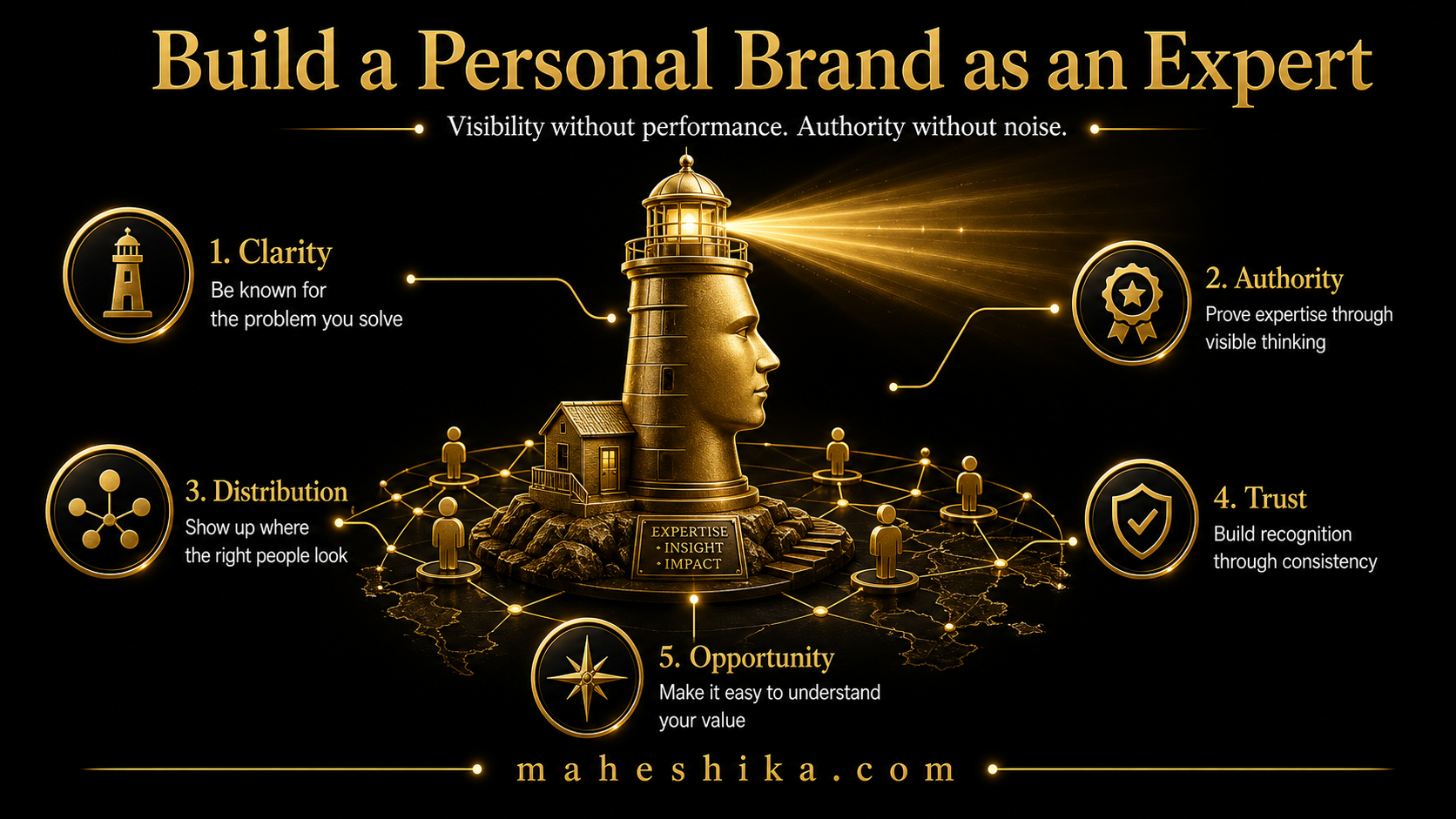
You have spent years, possibly decades, building genuine expertise. You have solved hard problems, led complex organisations, and developed a perspective that very few people hold. And yet, when the right opportunity appears, the wrong person gets it. Not because they are better. Because they are known.
That is the gap a personal brand closes. Not by making you louder, but by making you visible to the people who need exactly what you offer. This guide covers how to build that brand deliberately, without performing, without chasing vanity metrics, and without pretending to be someone you are not.
In This Guide
- How to Build a Personal Brand on LinkedIn When You Have No Audience
- The LinkedIn Content Strategy That Builds Authority in 90 Days
- How to Position Yourself as a Thought Leader in Your Industry
- What to Post on LinkedIn When You Are Just Starting Out as an Independent Expert
- How to Write a LinkedIn Profile That Attracts Consulting Clients
- How to Get Speaking Engagements Using LinkedIn and Your Personal Brand
- Why Your Personal Brand Is Your Most Important Business Asset in 2026
- How to Build a Personal Website That Positions You as an Expert
- The 5 Mistakes Experts Make With Their Personal Brand
- How to Grow a YouTube Channel Around Your Professional Expertise
- How to Turn Your LinkedIn Audience Into Paying Clients
- What Is a Personal Brand Platform and Do You Need One?
What a Personal Brand Actually Is (and What It Is Not)
A personal brand is not a logo. It is not a colour palette, a headshot strategy, or a posting schedule. Those are tools. The brand itself is something simpler and more durable: it is the clear, consistent answer to the question "what does this person stand for, and what can they help me with?"
When someone hears your name and immediately thinks of a specific problem you solve, a specific quality you bring, or a specific outcome you deliver, that is a personal brand working properly. When they hear your name and think "I'm not quite sure what she does," the brand is absent, regardless of how many followers you have.
This matters because people buy from people they understand. A client who cannot clearly explain to their colleague why they hired you will hesitate before hiring you again. A conference organiser who cannot articulate your exact angle will not book you. Clarity is not a marketing trick. It is the foundation of trust.
What a personal brand is not: it is not performance. You do not need to pretend your life is more exciting than it is, manufacture controversy for engagement, or post content you find embarrassing. The most effective personal brands I have seen are built on honesty. The expert who says precisely what they believe, in plain language, consistently, over time. That is it.
Why Experts Need a Personal Brand in 2026
The market for independent expertise has never been more competitive, and simultaneously never been more valuable. Organisations are bringing in more fractional, consulting, and advisory relationships than at any previous point. The budget exists. The demand is real. But the allocation of that budget is overwhelmingly driven by reputation and visibility.
Consider how a buying decision actually happens. A CFO needs a specialist to lead a commercial transformation. She thinks of two or three names. Those names come from people she trusts, from content she has seen over the past year, from speakers she heard at a conference. The expert who is not in that mental shortlist does not get a phone call, regardless of their credentials.
AI has accelerated this dynamic. When anyone can generate competent-sounding content in minutes, the genuine expert with a clear point of view and a track record of real results becomes more valuable, not less. But that value is only accessible to the market if the market knows it exists. Invisibility is no longer neutral. It is a business cost.
The Three Platforms That Matter Most
You do not need to be everywhere. You need to be findable in the places where your clients actually look. For most independent experts, that means three platforms, each serving a different function.
LinkedIn is your primary professional surface. It is where your existing network discovers what you are doing now, where inbound referrals land, and where the social proof of your career accumulates. A well-written profile, a consistent content presence, and active engagement with others' work will do more for your consulting pipeline than almost any other single activity. The key is that your profile must read like a business case, not a CV. Hiring managers read CVs. Clients read LinkedIn to decide whether to trust you with a real problem.
Your website is your owned asset. LinkedIn can change its algorithm tomorrow. Your website cannot be taken from you. It should be a single, clear destination that tells the right visitor, within about eight seconds, exactly what you do, who you do it for, and what to do next. Most expert websites fail because they are either too vague ("helping leaders unlock potential") or too biographical. A website that converts visitors into enquiries is specific: it names the problem, names the outcome, and gives evidence that you can bridge the two.
Content, whether written or video, is how you demonstrate expertise at scale. One client conversation reaches one person. One article reaches everyone who searches for that question for the next three years. YouTube compounds similarly over time. The goal is not to produce high-volume content but to produce content that is genuinely useful to the specific people you want to work with. Quantity is a distant second priority to precision.
Related Reading
How to Build Authority Without Chasing Vanity Metrics
Follower count is not authority. I have seen experts with 400 followers close five-figure consulting engagements because their content was so specific and so credible that the right person read it and immediately knew they needed to call. I have also seen people with 40,000 followers who cannot convert a single inbound enquiry because their brand is too diffuse to communicate what they actually offer.
Authority comes from specificity and consistency. Specificity means you are not writing about leadership in general. You are writing about the specific commercial dynamic that mid-market SaaS businesses face when they try to move upmarket, or the specific failure mode in EMEA distribution partnerships that most boards do not spot until year three. The more specific your subject matter, the smaller your audience will be, and the higher the quality of that audience.
Consistency means you show up in the same area, with the same voice, week after week. Not because an algorithm rewards you for it, though it may, but because trust is built through repeated exposure to someone's thinking. When a prospective client has read fifteen of your articles, they already know how you think. The first conversation skips the credibility stage entirely and goes straight to the work.
The practical steps: define one primary problem you solve. Write about that problem from every angle. Share your perspective on relevant news and industry developments. Tell stories from your career, with lessons attached. Engage genuinely with the thinking of others in your field. Do this every week for twelve months and you will have built a body of work that speaks for you long after you have moved on to the next project.
The Five Most Common Mistakes
I see the same errors repeatedly, not from inexperienced people but from very accomplished ones who have never had to market themselves before.
Positioning too broadly. "I help senior leaders perform at their best" describes almost no one and attracts almost no one. The fear of narrowing your market is understandable. The reality is that specific positioning attracts more clients, not fewer, because those clients recognise themselves immediately.
Waiting until everything is perfect. The LinkedIn profile that never gets published because the headline is not quite right. The website that has been in development for nine months. The content strategy that is being planned instead of executed. Your brand is built by doing, not by preparing to do.
Separating the brand from the business. A personal brand without a clear commercial offer is a hobby. You need to know what you are selling, to whom, at what price, and with what outcome. The brand builds demand. The offer converts it.
Posting to impress peers rather than to attract clients. If your content would only be understood or appreciated by people at the same level as you, it is not doing commercial work. Write for the person one or two levels below the problem, who is experiencing it and searching for a way through.
Disappearing after a good month. Personal brands are not campaigns. They do not have a start and end date. The professionals who build real visibility are the ones who treat content and presence as a permanent function of their business, not a project they run when revenue dips.
For a deeper look at each of these, read The 5 Mistakes Experts Make With Their Personal Brand.
Free Tool
Start free: where do you actually stand?
Two free tools give you an honest answer in minutes. The AI Risk Score shows how exposed your role is. The Expertise Ownership Score shows how findable and owned your expertise is.
AI Risk Score Expertise Ownership ScoreBuilding Your Brand When You Are Starting from Zero
Most experts who come to this work have more assets than they realise. They have a career full of stories, decisions, failures, and hard-won lessons. They have opinions shaped by years of working through real problems. They have a network built over a decade or more. None of that disappears because you have not been active on LinkedIn.
Start with the basics. Rewrite your LinkedIn headline so it states the outcome you create, not your job title. Rewrite your About section so it tells a client-facing story: the problem you solve, the approach you take, the results you have achieved. Make it human. Make it specific. Then post once a week, even if your audience is forty connections.
Your first thirty posts are practice. You are developing a voice, finding which ideas resonate, learning how to explain complex thinking in plain language. Do not judge yourself against people who have been doing this for three years. Compare yourself to where you were ninety days ago.
For a structured plan, read How to Build a Personal Brand on LinkedIn When You Have No Audience and The LinkedIn Content Strategy That Builds Authority in 90 Days.
Converting Your Brand into Clients
A brand that never generates revenue is just a profile. The conversion happens when two things are true simultaneously: the right person is paying attention to your content, and there is a clear path from their attention to an engagement with you.
The clear path means a website with a specific offer and a simple way to enquire. It means a LinkedIn profile that ends with an invitation to connect, book a call, or download something useful. It means you mention, occasionally and without apology, the work you do and who it is for. Experts often find this uncomfortable. They post for months without once mentioning that they can be hired. Their audience has no idea they are available.
The mechanism is simple. Valuable content builds trust and visibility. Trust converts to enquiries when there is a clear, relevant offer visible to the reader. A call-to-action at the end of a post, a link to a calculator or free resource, a short note saying "if this resonates and you want to explore working together, my details are below." These are not pushy. They are useful.
For the specific tactics, read How to Turn Your LinkedIn Audience Into Paying Clients.
The Foundation Underneath the Whole Strategy
So the answer to building a personal brand is not one platform or one tactic. It is specificity over reach, consistency over intensity, and an offer that turns attention into work. Do that for ninety days and the shortlist starts to include your name. Keep doing it for two years and the compound effect takes over: your reputation starts doing work you are not in the room for, and opportunities appear that you did not create.
But underneath LinkedIn, the content, the speaking invitations, sits a question most experts never ask: where does all of this actually live? LinkedIn can change its algorithm overnight, restrict your reach, or simply stop being the right platform for your next chapter. AI can now generate a competent-sounding answer to almost any question in a voice that sounds like everyone else's. A job title can disappear in a single reorganisation. In a market like that, the professionals who keep their place are the ones who have somewhere of their own to stand.
A personal website under your own name. Somewhere your thinking lives permanently, your work is shown in full, and your signature is unmistakable: owned outright, findable in a search, impossible to reduce to a generic AI answer. That is not a nice extra once the brand is built. It is the one asset that makes everything else you build durable, because it is the one thing no platform, algorithm, or employer can take away from you.
You do not have to build it alone, and you do not have to wait until the brand feels finished first. If you want it done properly, by someone who has built her own from nothing, let us talk.