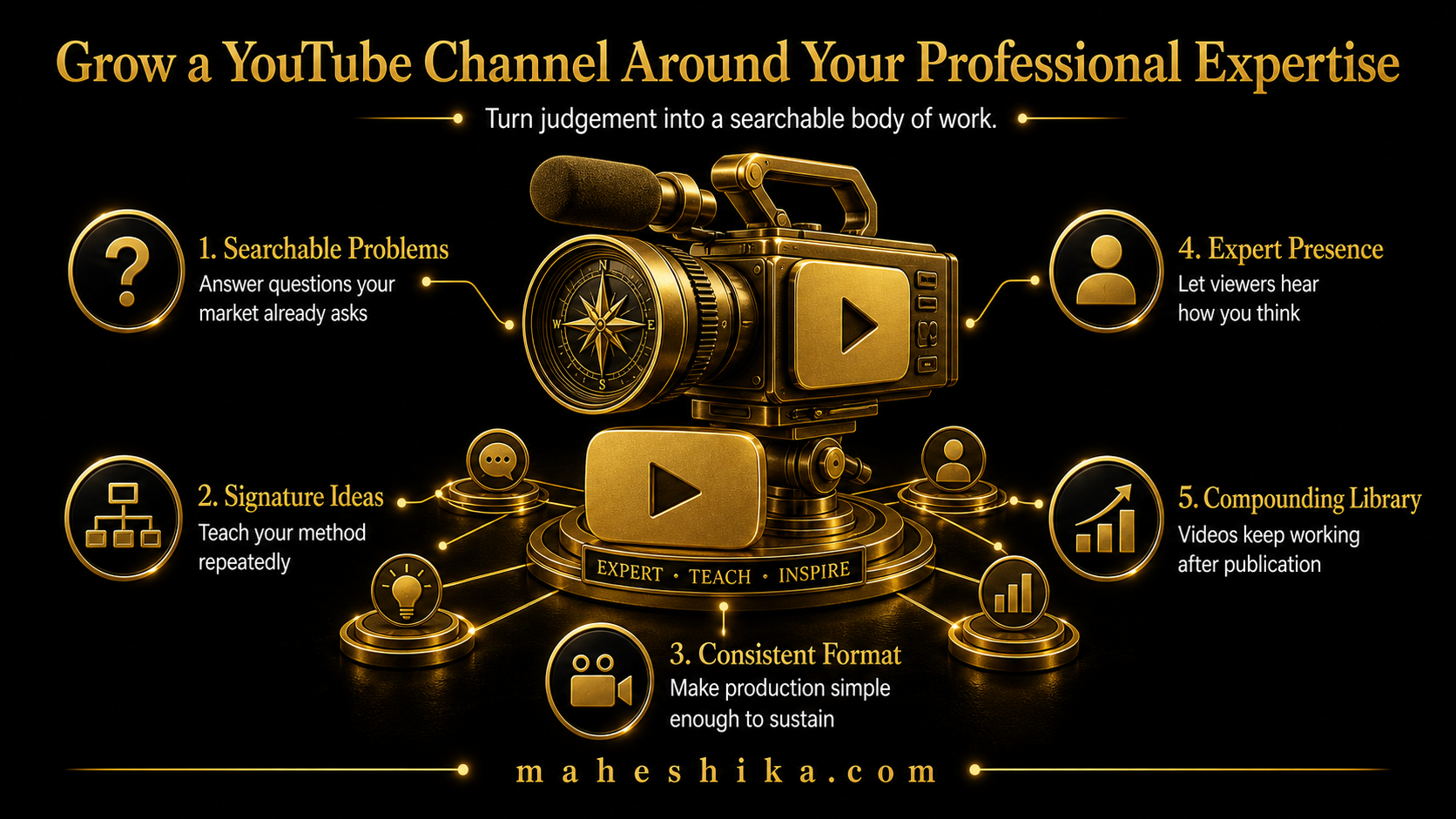
YouTube is the most underused channel by independent experts, and for understandable reasons. It requires more setup than a LinkedIn post, more comfort on camera, and more patience before it produces results. But those barriers are also why it is valuable: most of your competitors have not bothered. A consistent YouTube presence in a specialist professional domain is genuinely rare, and rare translates directly to visibility.
Why YouTube Works Differently From LinkedIn
LinkedIn content has a shelf life of roughly 48 to 72 hours. A post reaches its audience in that window and then largely disappears from feeds. YouTube is the opposite. A video published today will still be receiving views in two years, because YouTube functions as a search engine. People search for answers to specific professional questions, and a well-titled, substantive video appears in those results indefinitely.
This compound dynamic means that YouTube rewards patience in a way that LinkedIn does not. The first twenty videos may generate very modest viewership. By video fifty, the cumulative search traffic from all previous videos creates a base of consistent monthly views that requires no new activity to maintain. That is the fundamental economics of YouTube as a brand-building tool: slow to start, self-sustaining over time.
For an independent expert, the implications are clear. A library of fifty substantive videos on your area of expertise is a permanent asset that works around the clock, introducing new prospective clients to your thinking whether or not you are posting anything else that week.
The Right Video Topics for Expert Authority
Professional expertise channels work best when they answer specific questions that practitioners in your field are genuinely searching for. Not high-level thought leadership pieces (those rarely rank in search), but answers to the concrete questions your clients type into YouTube at 10pm when they are stuck on a problem.
"How to restructure a channel partner programme without losing your top distributors." "The three questions to ask before entering a new European market." "Why indirect sales teams consistently miss forecast and what to do about it." These titles reflect real search intent. They bring in viewers who are experiencing the problem you are describing, which means they are pre-qualified for the kind of work you do.
Build your initial video list by collecting the questions your clients ask most often in discovery calls, the questions your LinkedIn posts generate in the comments, and the questions you find yourself answering repeatedly in professional conversations. Those are your first twenty videos. You will not run out of material.
Related Reading
Production: What You Need and What You Do Not
You do not need a studio, a production team, or an editing suite. The quality threshold for professional expertise content is clear audio, stable image, and adequate light. A decent microphone (around £80 to £100 for a USB condenser), a window as your light source, and a clean or blurred background behind you: that is sufficient for professional-grade content.
What you do need to invest in is preparation and delivery. Know what you are going to say before you record it. Not a word-for-word script (that tends to produce stilted delivery), but a clear outline with the key points and the order in which you will make them. Practice until you can speak without reading. The difference between a hesitant, searching delivery and a confident, clear one is not natural talent. It is preparation and repetition.
Keep videos between eight and eighteen minutes for in-depth expertise content. Shorter than that and the topic rarely reaches sufficient depth to be genuinely useful. Longer than that and completion rates drop sharply, which suppresses distribution in the algorithm. The ideal length is however long the topic genuinely requires, up to about eighteen minutes.
Free Tool
Start free: where do you actually stand?
Two free tools give you an honest answer in minutes. The AI Risk Score shows how exposed your role is. The Expertise Ownership Score shows how findable and owned your expertise is.
AI Risk Score Expertise Ownership ScoreOptimising for Search Without Becoming Formulaic
YouTube is a search engine. That means your title, description, and thumbnail determine whether anyone finds your video, regardless of how good the content is. Take the title seriously. Include the specific phrase your target viewer would search for. Use natural language, not SEO jargon: write the title as if you were answering a colleague's question, not gaming a system.
Your description should include a plain-language summary of what the video covers, the specific questions it answers, and relevant terms that a searching viewer might use. Write two to three paragraphs. Include a link to your website and any relevant resources in the description.
Thumbnails matter more than most people expect. A clear, readable thumbnail with your face visible, and text that communicates the specific value of the video in a few words, dramatically outperforms a generic or cluttered one. You do not need professional design skills: a clean template in Canva, applied consistently across all videos, is sufficient.
The Channel Is Not the Home
So the growth strategy is not a secret. Answer the specific questions your field is asking at 10pm, show up on a fortnightly rhythm, keep the production simple, and let two years of consistency do what no single viral video ever could. A library of fifty videos becomes a search asset that works while you sleep, quietly introducing you to people you will never meet any other way. That is the whole game.
But notice what you actually own when that library exists. Every video sits on a platform you do not control, under an algorithm you cannot see, subject to rules that change without asking you first. A channel can be demonetised, a video can be de-ranked, an account can be suspended over a dispute you never got to argue. None of that is likely on any given Tuesday. All of it is possible, and years of hard-won expertise would vanish from view the moment it happened, through no fault of the work itself.
That is the quiet risk underneath every platform strategy, and it points to something bigger. In a market where AI can answer almost any question in a voice that sounds like everyone else, the professionals who keep their place are the ones with a place of their own: a personal website under their own name, where every video, every idea, every piece of proof lives permanently, independent of any platform's mood. YouTube brings people to you. Only a home you own keeps them, and keeps your name attached to the work no matter what an algorithm decides tomorrow.
That home is worth building properly, and you do not have to wait until the channel takes off, or work it out alone. If you want it built now, by someone who has walked this exact path, let us talk.