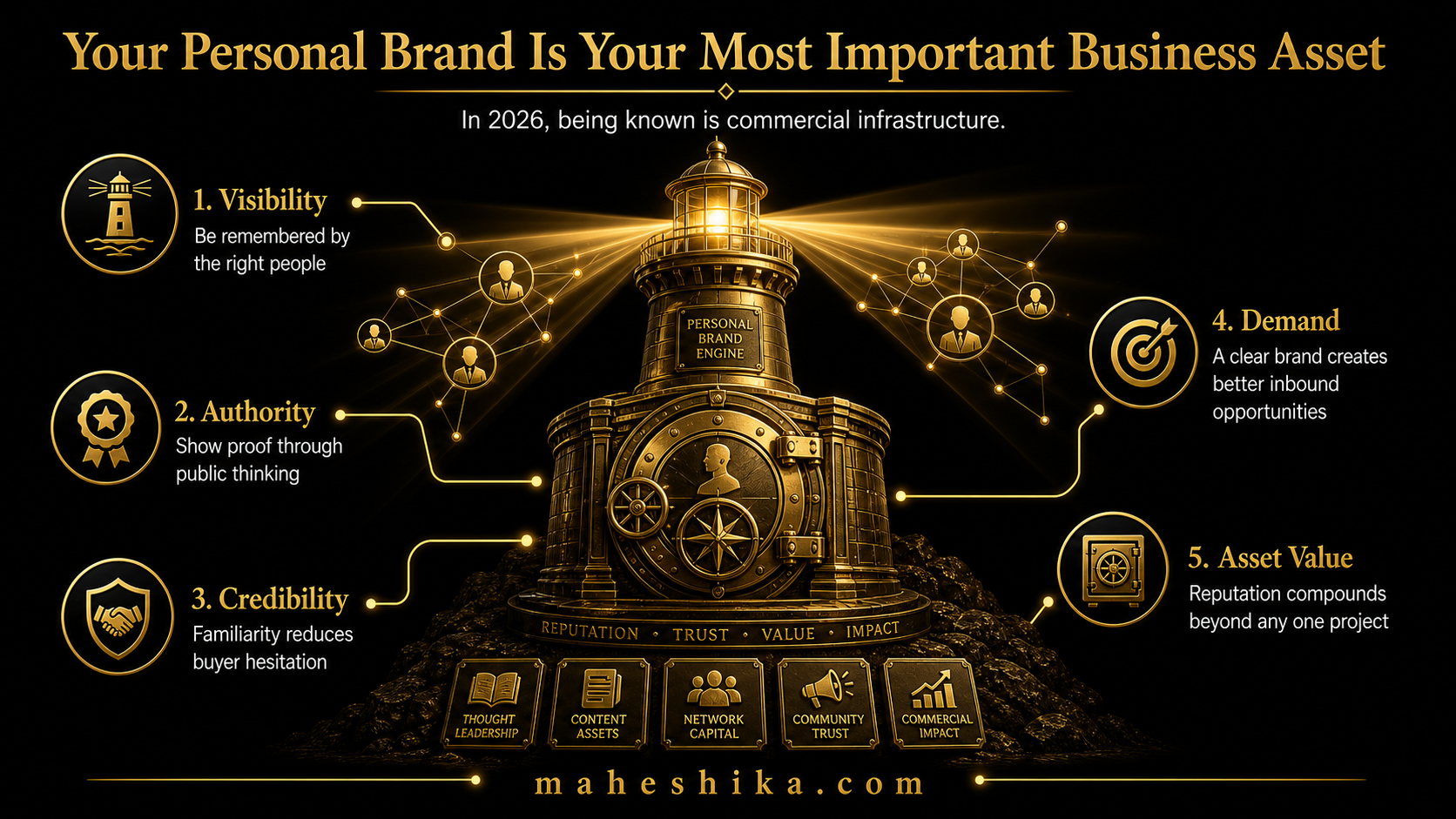
If you run an independent practice, your personal brand is not a marketing exercise you can defer until revenue is more stable. It is the infrastructure through which revenue arrives. The client who calls you, the organiser who books you, the editor who invites your contribution: they all arrive because your brand made you findable, credible, and legible before you ever spoke to them. In 2026, that is not a nice-to-have. It is the mechanism.
What Has Changed in the Last Three Years
Three years ago, an experienced independent professional could build a reasonable practice primarily through referrals and direct network outreach. Their personal brand was implicit: the accumulated reputation from a career well spent. That still works, but it works for a shrinking proportion of the available market.
The reason is that the market for expert services has expanded significantly beyond existing professional networks. Organisations are increasingly comfortable hiring advisors they have not met through a mutual contact, because the due diligence process has moved online. Before a client makes first contact, they will have read your website, scrolled your LinkedIn, watched a video clip, and potentially read several of your articles. By the time they contact you, they have already formed a view.
If your online presence is absent or incoherent, that pre-contact process still happens. It just concludes with the client moving on to someone else. You never know the opportunity was there.
The Asset That Cannot Be Taken From You
Every other asset in an independent business is contingent. Clients can leave. Platforms can change their terms. Referral sources can retire. A single organisation might have provided the majority of your income for several years and then, through restructuring or change of leadership, that relationship ends.
Your personal brand, built properly, is not contingent in the same way. The reputation you have built, the content that exists under your name, the speaking engagements that have been recorded, the relationships that have formed because of your public presence: none of that disappears when a client relationship ends. It compounds.
The professional who has built a genuine personal brand over five years carries that asset into every new client relationship, every new market, every new phase of their career. It is the only business asset that grows with you indefinitely and cannot be acquired by someone else.
Related Reading
How Personal Brand Affects Your Pricing
There is a direct relationship between brand clarity and the fees you can command. An expert with a strong, specific personal brand can charge more for the same work than an equally qualified expert with a weak or absent brand. This is not unfair. It reflects the actual value that brand clarity delivers to the client: confidence, reduced risk, and the certainty that comes from choosing someone whose thinking they already understand.
When a client already knows your work because they have been reading your content for six months, the sales conversation is fundamentally different. They are not evaluating you; they are confirming a decision they have already largely made. That dynamic shifts the negotiating position entirely. You are not competing to be chosen; you are clarifying the terms of an engagement they want to enter.
This is how the most successful independent practitioners I know operate. Not by selling harder or networking more, but by building a brand strong enough that clients arrive pre-qualified, already convinced, asking about availability and process rather than trying to be persuaded.
Free Tool
Start free: where do you actually stand?
Two free tools give you an honest answer in minutes. The AI Risk Score shows how exposed your role is. The Expertise Ownership Score shows how findable and owned your expertise is.
AI Risk Score Expertise Ownership ScoreThe AI Effect on Personal Brand Importance
The proliferation of AI-generated content has made genuine personal brand more valuable, not less. When anyone can produce a well-structured article on any professional topic in minutes, the market's ability to distinguish between genuine expertise and surface-level content becomes more important, and more difficult.
The expert who has been writing about the same specific domain for three years, with a consistent voice and a clear point of view, stands out not because the content is more polished but because it is unmistakably theirs. The accumulated track record, the specific references to real situations, the voice that has evolved over time: these are the signals that distinguish authentic expertise from generated content.
Clients who are hiring for high-value work have become more discerning, not less, in the face of AI-generated noise. A personal brand built on genuine intellectual contribution is more valuable in that environment, not less.
The Cost of Not Building One
The cost of not building a personal brand is not visible in any given month. It accumulates silently in the opportunities that do not arrive, the referrals that go to someone more visible, the rates that stay lower than they should be because the pricing conversation never tips in your favour.
The senior professional who has been consulting for ten years with no meaningful personal brand presence has often generated a fraction of the revenue available to them. Not because the work was poor, but because the market did not know they existed in the first place.
The One Asset Worth Building Now
So the question this article opened with has one honest answer: your personal brand is not a marketing layer on top of your business, it is the business. It is the infrastructure that decides whether a client finds you, trusts you before you speak, and pays what your work is actually worth. Clients can leave, platforms can change their terms, referral sources can retire. This is the one asset that does not depend on any of them.
But here is what the last three years have made unavoidable. Every title, every client relationship, every organisation you have ever depended on can end without warning, and now AI can produce competent content in a voice that sounds like everyone else's, all at once. In a market like that, the professionals who keep their place are not the ones who work hardest. They are the ones who have a place of their own to work from.
A personal website under your own name. Somewhere your thinking lives, your work is shown, and your signature is unmistakable: owned outright, findable in a search, impossible to flatten into a generic answer. That is not a branding exercise. It is the one asset that keeps compounding whether or not you are in the room, and the one thing no restructuring, algorithm change, or AI model can take from you.
You do not have to build it alone, and you do not have to build it later. If you want it done properly, by someone who has built exactly this for herself and for other experienced professionals, let us talk.