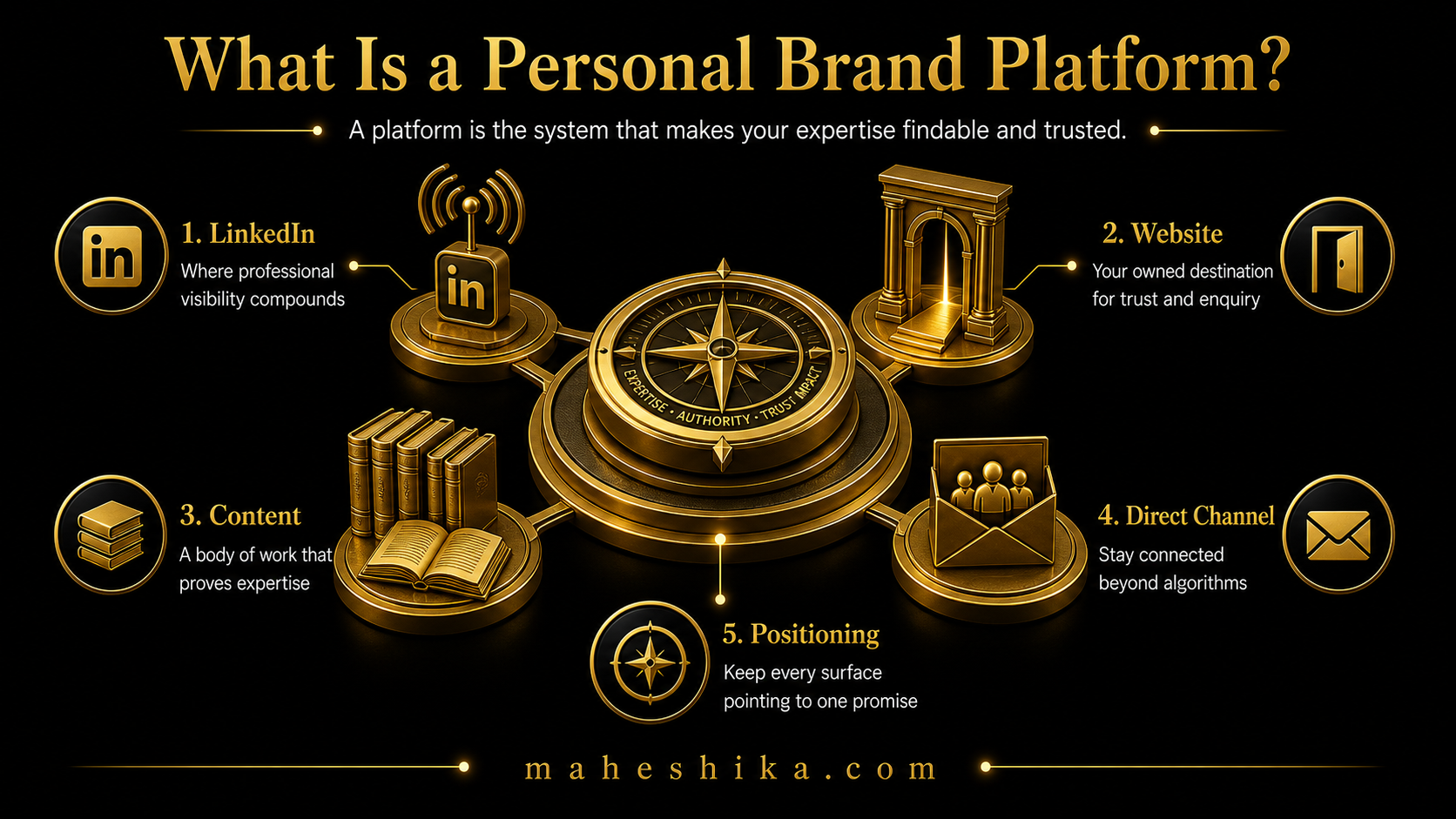
The phrase "personal brand platform" sounds more complicated than it is. It simply describes the collection of owned and social assets through which your expertise reaches the world and through which potential clients find their way to you. If you are an independent expert or thinking about becoming one, you need one. The only question is how comprehensive it needs to be, and how to build it without it consuming all of your time.
The Definition: What a Platform Actually Is
A personal brand platform has two tiers. The first tier is the owned infrastructure: your website, your email list, and any content you publish on domains you control. These are your permanent assets, unaffected by algorithm changes, platform policy shifts, or the collapse of any particular social network.
The second tier is the rented infrastructure: LinkedIn, YouTube, podcasts, industry publications, speaking stages. These extend your reach beyond your immediate network, but you do not own them. They are channels through which you build awareness, and every piece of awareness they generate should, where possible, be converted to your owned tier.
A platform, rather than just a presence, means these two tiers are connected and working together. Your LinkedIn content sends interested readers to your website. Your website captures email addresses. Your email list brings people back to new content. Your content establishes the expertise that generates speaking invitations. Speaking generates visibility that brings new people into the cycle. Each component reinforces the others.
Do You Actually Need One?
If you are employed and have no intention of changing that, a full platform is optional. A strong LinkedIn presence is sufficient to protect your professional reputation and keep your options open.
If you are an independent expert, a consultant, a freelancer, a speaker, or an author building a practice, you need a platform. Not because of any particular rule, but because your pipeline depends on it. The independent professional who relies entirely on referrals and personal network outreach is running a business that is one relationship away from crisis. The one with a platform has a distribution system that works independently of any single relationship.
The scale of the platform depends on your ambitions and your capacity. A minimal viable platform for an independent expert is: a professional LinkedIn profile with active content, a website with a clear service offer, and a simple way to capture email addresses from interested visitors. That is the foundation. Everything else, YouTube, podcasting, newsletter, speaking, additional social presence, is built on top of it when you are ready.
Related Reading
Building the Platform Without Losing Your Mind
The reason most professionals do not build a platform is not lack of understanding but lack of time. Running a consulting practice, delivering client work, and simultaneously building a content engine feels impossible. It is not, but it requires a realistic approach.
Start with the foundation only. Get your website live with a clear positioning statement, a services page, and a contact mechanism. Set up your LinkedIn profile properly. Commit to one piece of content per week. That is the minimum viable platform. It will take about two to three hours per week to maintain, which is an investment most serious independents can sustain.
Add each new component only when you have capacity to do it consistently. A YouTube channel you post to sporadically is less valuable than no YouTube channel. A newsletter you send every six weeks is less valuable than a weekly LinkedIn post. Do fewer things consistently rather than more things intermittently. Consistency is the compounding agent in platform building. It is the single quality that separates the platforms that build real visibility from the ones that generate a burst of activity and then go quiet.
Free Tool
Start free: where do you actually stand?
Two free tools give you an honest answer in minutes. The AI Risk Score shows how exposed your role is. The Expertise Ownership Score shows how findable and owned your expertise is.
AI Risk Score Expertise Ownership ScoreThe AI-Powered Platform: What Is Now Possible
Building and maintaining a personal brand platform used to require either significant time or significant budget for support. In 2026, AI has changed that economics substantially. A professional website can be built in days rather than months. Content can be drafted, structured, and refined in a fraction of the time it previously required. SEO research, social post variation, email newsletter drafts: all of these can be accelerated dramatically with AI tools used intelligently.
The caveat is that the inputs still have to come from you. Your perspective, your stories, your expertise, your voice: none of that can be generated by AI. What AI does is remove the production bottlenecks that previously made a full platform unmanageable for a solo practitioner. The thinking remains yours. The execution becomes faster.
This is the specific opportunity for experienced professionals right now. The barriers to building a professional platform have dropped substantially, while the value of genuine expertise in a content-saturated market has risen. The combination is unusually favourable. The experts who build their platforms in the next two years will enter a market dynamic where their visibility is compounding at the same time that the signal-to-noise ratio in their domain is deteriorating. That is a significant advantage, and it is available to anyone willing to start.
The One Asset That Makes the Rest of It Matter
So, do you need a personal brand platform? If you are independent, the answer is yes, without qualification. If you are employed and plan to stay that way, a strong LinkedIn presence will cover you for now. But the deeper question was never really about "platform" as a category. It is about whether there is one place, permanently, where your expertise lives and nobody but you controls it.
Here is what changes that calculation for everyone, employed or not. AI now answers the question a client, an employer or an audience used to have to ask a person, instantly, fluently, in a voice that sounds like everyone else who asked it. Meanwhile the title on your profile, the logo beside your name, the employer currently vouching for you: none of that is yours. It can change without warning, and your visibility changes the moment it does.
What survives that is the piece built on land you actually own. A personal website under your own name, where your thinking lives, your work is shown, and your signature is unmistakable. Findable in a search regardless of who employs you this year. Impossible to flatten into a generic answer, because it is not an answer, it is you. That is not decoration on top of the platform. It is the foundation everything else, the LinkedIn posts, the speaking, the referrals, quietly points back to.
If you already know this and simply have not built it yet, that is normal, and it is fixable faster than you think. Let us talk about what yours would look like.