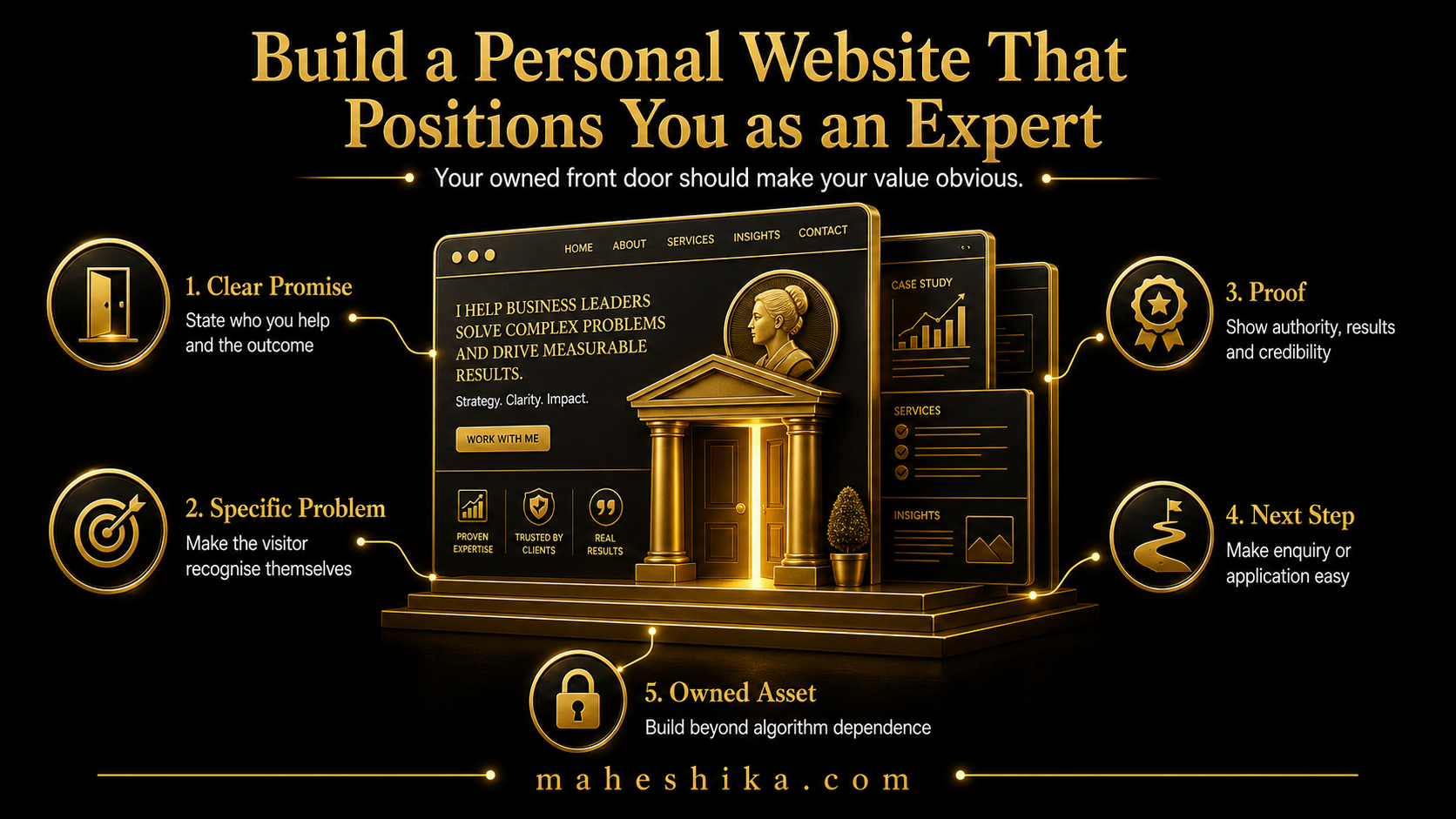
Your personal website is the one digital asset you own outright. LinkedIn can change its algorithm, its terms, or its existence. Your website cannot be taken from you, altered by someone else's product decision, or buried under an algorithm change. It is your owned territory on the internet, and for an independent expert, it serves a specific commercial function: to convert the visitor who found you into someone willing to take the next step.
What Most Expert Websites Get Wrong
The most common failure mode is the website that is too focused on the expert and not focused enough on the client. It opens with a biography, lists credentials and career history, and somewhere near the bottom mentions what services are available. The visitor who is evaluating whether to hire you does not start by wanting to know your story. They start with a problem and a question: can this person solve it?
The second failure mode is vagueness. "I help leaders unlock their potential and build resilient organisations" could describe almost anyone. It gives the visitor no way to self-select, no reason to believe you specifically are the right fit, and no urgency to make contact. Vague positioning is not professional modesty. It is a missed conversion.
The third failure is a website with no clear next step. A visitor who has read everything, found you credible, and is interested in working with you should have an obvious path forward. If that path is a complex contact form, a vague "get in touch" link buried in the footer, or no call to action at all, you are losing clients who were already ready.
The Structure That Works
A personal expert website does not need to be large. Five to six well-written pages will outperform a twenty-page site that lacks focus. Here is the structure that converts.
Home page. Your home page has one job: to tell the right visitor, within eight seconds, what you do and whether they are in the right place. Open with a specific, client-facing headline. Not your name. Not your title. A statement of outcome: what someone has after working with you that they did not have before. Follow that with a one-paragraph description of who you work with and how. Then a clear call to action: apply, book a call, or read more.
About page. This is where the biography lives, but written through a commercial lens. Open with the problem you have spent your career solving, not with where you were born. Use your career story as evidence for why you are equipped to help the specific client who is reading this page. End with what you offer and how to engage.
Services or consulting page. Be specific. Name the engagements you offer. Describe who they are for and what they deliver. If you have a typical engagement structure, describe it briefly. If you work with a limited number of clients at a time, say so. Scarcity is legitimate information, not manipulation.
Speaking page. If you speak, this page does the work of the speaker bio plus a visual sample. Include your topics, a short description of each, audience types you have addressed, and a video clip if you have one.
Blog or articles. Your content is how you build findability over time. A blog of genuinely useful articles in your domain will drive inbound traffic, establish your expertise to new visitors, and give return visitors a reason to come back.
Related Reading
Design: What Actually Matters
You do not need a custom-designed website to build a professional brand. You need a website that is fast, clean, clearly structured, and free of anything that distracts the visitor from the intended path. Templates from modern website builders can absolutely achieve this. The question is not how bespoke the design is; it is whether the design serves the content or fights it.
Prioritise: readability (sufficient contrast, comfortable type size, adequate line spacing), mobile performance (most visitors arrive on a phone), and loading speed (slow pages lose visitors before they have read a word). A website that is simple and fast will convert better than a website that is beautiful and slow.
Your photo matters more than almost any other design element. A professional photograph, properly lit, with a background that does not distract, tells a prospective client in one image whether you are someone they would take seriously. Invest in one good photograph. It will work for years.
Free Tool
Start free: where do you actually stand?
Two free tools give you an honest answer in minutes. The AI Risk Score shows how exposed your role is. The Expertise Ownership Score shows how findable and owned your expertise is.
AI Risk Score Expertise Ownership ScoreBuilding Your Website With AI
In 2026, building a professional website no longer requires a developer or a large budget. AI coding tools can build a complete, production-quality website from a detailed brief. The process involves writing a clear specification of what you need, then using an AI tool to generate the HTML, CSS, and structure. The result can be reviewed, adjusted, and deployed in days rather than months.
The critical input is the copy. No tool can write your specific value proposition, your genuine career story, or your authentic point of view. That must come from you. The technology builds the structure; you provide the substance. If the copy is clear and the positioning is specific, even a simple website will outperform an elaborate one with vague content.
The /website page on this site covers the AI-assisted website build process in more detail, including the approach I used for this site and what I have learned from helping other professionals build theirs.
The Site That Answers For You, Long After You Have Stopped Talking
So that is what a website that positions you as an expert actually requires: a home page that states an outcome instead of a title, a structure built around the visitor's question rather than your biography, and one clear next step on every single page. Ask, of every page you publish, whether a stranger reading it would understand what you do, whether they are the right fit, and how to act on it. Get that right and the site does the qualifying for you, quietly, whether or not you are in the room.
But look at what that page is really doing underneath the structure. It is the one place on the internet where your specific answer to a client's specific problem lives under your own name, not folded into a feed, not summarised into a generic paragraph by whichever AI tool someone asked first. Every day, more of the questions your future clients are asking get answered by AI in a voice that sounds like everyone. The expert who has no site of their own has no way to be found as themselves, only as an average of everyone who has ever written on the topic.
A personal website is how you opt out of that average. It is somewhere your thinking lives in full, your work is shown in context, and your signature on the answer is unmistakable, not paraphrased by something else. Owned outright, findable in a search, impossible to flatten into a generic response. That is not a design project. It is how you stay the person a client can actually find and hire, in a market that is getting better every month at hiding experts inside the crowd.
You do not have to work out the structure, write the copy, and brief the build all on your own, and you do not have to leave it for "someday." If you want it built properly, by someone who has done this for herself and for the professionals she works with, let us talk.