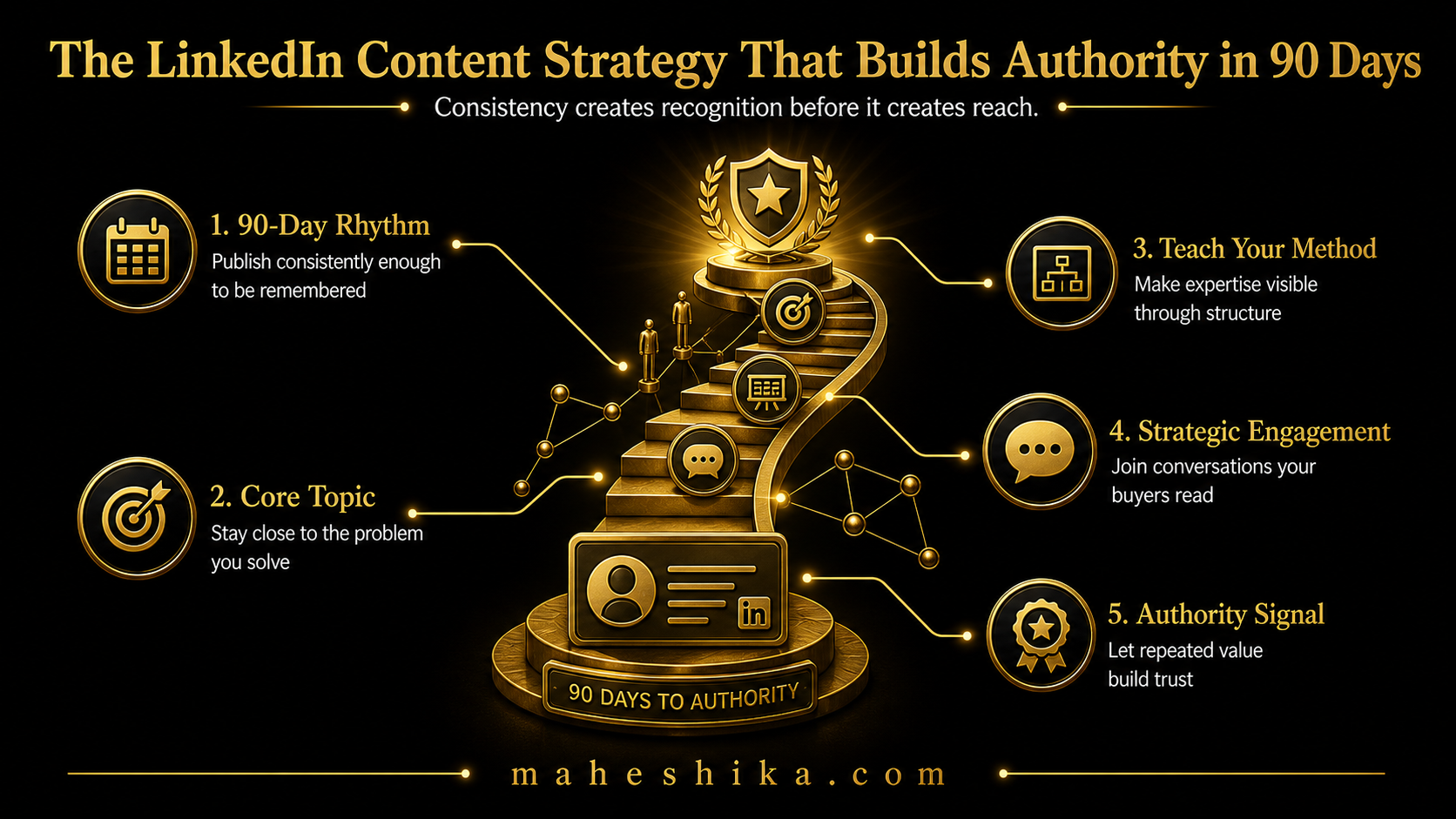
Ninety days is enough time to go from invisible to genuinely known in your niche, if you use those days with intention. Not by posting every day or gaming the algorithm, but by showing up consistently with content that demonstrates real expertise and gives your target audience a reason to pay attention. This is the strategy I use and recommend to every expert building a LinkedIn presence from scratch or rebuilding one after a period of absence.
Start With One Claim, Not Ten Topics
The most common content strategy mistake is too much breadth. You write about leadership one week, operational efficiency the next, then AI, then a personal reflection about running a marathon, then commercial strategy. Your audience cannot form a clear picture of what you stand for, so they do not follow you for any specific reason.
For the first ninety days, pick one clear claim: the single most important idea in your area of expertise. Something you genuinely believe that is not universally held. Not "strong leadership drives performance" (that is neither interesting nor contested) but something like "most commercial transformation programmes fail because they are designed by finance and implemented on sales, and nobody asks the channel partners what they actually need." A claim that reveals a perspective. Then write about that claim, and the evidence for it, from every angle you can find.
By day ninety, the people who follow you will be able to complete the sentence: "She is the expert who believes..." That is brand equity. That is what people reference when they recommend you.
The Content Mix for Ninety Days
Post once or twice per week. Twelve weeks, one to two posts per week: that is twelve to twenty-four pieces of content. Not overwhelming. Manageable. Here is how to distribute those posts across content types for maximum authority-building effect.
Perspective posts (40% of content). Your take on a specific situation, trend, or question in your domain. Write in the first person. Be direct. "Here is what I think most organisations get wrong about [topic], and why." These are your opinion pieces, but grounded in specific professional experience, not abstract principle.
Story posts (30% of content). A specific moment from your career, told as a story with a lesson attached. Set the scene briefly. Describe the decision or problem. Share what happened and what you learned. The lesson should be transferable to your reader's situation. These posts generate the most comments and the deepest connections because they are human.
Framework posts (20% of content). Break down a process, model, or way of thinking that your target clients would find useful. Number the steps. Be specific. These posts get saved more than any other type, which signals strong value to the algorithm and keeps your content visible long after you posted it.
Engagement posts (10% of content). Ask a question about something genuinely debated in your field. Share an observation and ask for reactions. These build comment volume, which extends reach. Use them sparingly: an account that only posts questions starts to look like it has nothing to say.
Related Reading
Writing Posts That Get Read
LinkedIn truncates posts after three to four lines. Everything below that cut requires a deliberate click. Your opening line is therefore doing an outsized amount of work. It needs to stop the scroll without being clickbait.
The openers that work best are: a specific, surprising claim ("Most channel strategies fail before the first partner meeting"); a direct question that your ideal client is asking themselves ("How do you know when your distribution model has outgrown your infrastructure?"); or a brief scene-setting line that pulls the reader into a story ("Three months into a EMEA restructure, the regional MD called me at 7am on a Sunday"). What does not work: starting with "I", with a generic observation, or with a question so broad it could apply to anyone.
After the hook, write clearly and concisely. Short paragraphs. One idea per paragraph. White space is not waste. The posts that get read to the end are almost always the ones formatted for mobile: three to five sentences per block, then a line break.
End every post with a closing thought that crystallises the point. Not a call to action every time. Just a final sentence that lands with some weight. Think of it like the closing line of a speech: memorable, purposeful, earned.
Free Tool
Start free: where do you actually stand?
Two free tools give you an honest answer in minutes. The AI Risk Score shows how exposed your role is. The Expertise Ownership Score shows how findable and owned your expertise is.
AI Risk Score Expertise Ownership ScoreThe Engagement Practice That Accelerates Everything
Your posts reach people. Other people's posts reach entirely different people. Commenting strategically on other creators' posts is the fastest way to grow your audience without growing your content volume.
Spend twenty minutes each day reading posts in your domain and leaving real comments. Not "Great perspective!" but a two to three sentence contribution that demonstrates your own thinking. Your comment is public. The author's audience sees it. If your comment is thoughtful and specific, a meaningful percentage of those readers will click through to your profile. That is free distribution.
Choose ten to fifteen accounts to engage with consistently: people who post about the same topics you do, whose audience overlaps with yours. Show up in their comments every week, not every month. Consistency here builds recognition. Within a few weeks, you will notice that the same names start appearing in your notifications. Community forms before audience.
What to Measure (and What to Ignore)
Track two things in your first ninety days: profile views and inbound messages. Profile views tell you whether your content is reaching new people. Inbound messages, whether from potential clients, collaboration enquiries, or speaking invitations, tell you whether your positioning is clear enough to trigger action.
Do not track follower count as a primary metric. Follower count is slow and noisy. A post that reaches five thousand people and converts three of them to enquiries is worth more than a post that gains fifty followers and converts none. You are building a business, not an audience for its own sake.
Review at thirty days, sixty days, and ninety days. At each review: what content generated the most genuine engagement? What comments revealed something your audience is struggling with? What topics attracted the highest quality connections? Adjust accordingly. Content strategy is not a plan you execute; it is a hypothesis you refine.
The Platform Under the Posts
So ninety days, done with one claim and real consistency, gets you from invisible to genuinely known. Not viral, but credible. Not famous, but findable by the right people. That is the entire goal: be the obvious answer when the person who needs your specific expertise finally starts looking.
But notice what LinkedIn actually is while you build that. It is rented ground. Every post lives inside someone else's algorithm, someone else's feed, someone else's decision about what gets shown and to whom. The audience you spend ninety days earning belongs to the platform first and to you second. And in a market where AI can now generate a plausible take on any topic in seconds, in a voice indistinguishable from the next person's, the posts alone stop being enough to prove the claim is genuinely yours.
The professionals who turn ninety days of content into lasting authority are the ones who give that content somewhere permanent to point to. A personal website under your own name, where the claim you have been building lives in full, the work behind it is shown, and your signature is unmistakable. Owned outright, findable in a search, impossible to reduce to a generic answer. LinkedIn introduces you. Your own site is where people go to confirm you are real.
You do not have to build that platform alone or wait until the ninety days are up to start. If you want it done properly, by someone who has built exactly this, let us talk.