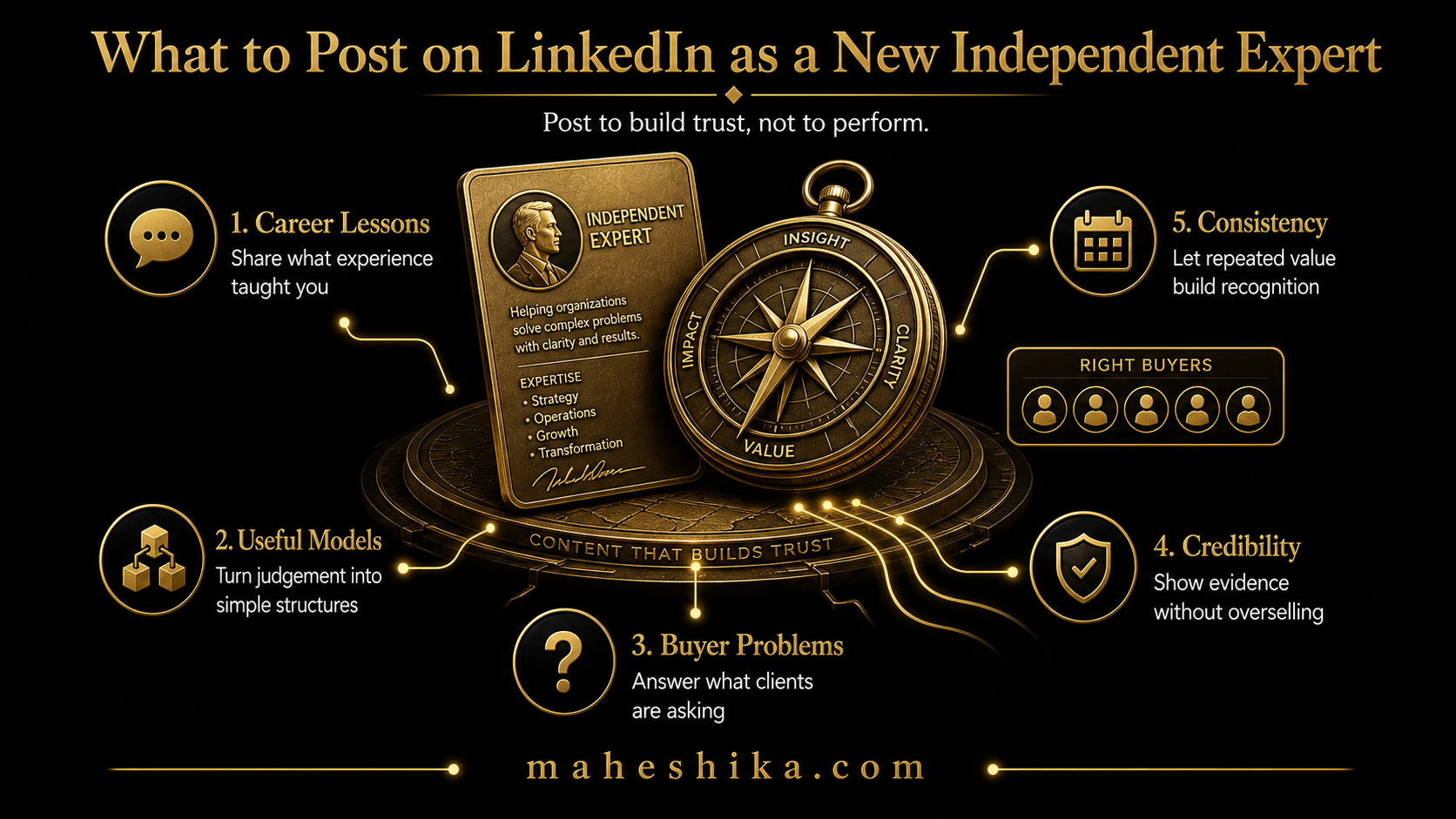
The blank post box is one of the more intimidating things about starting an independent practice. You have years of expertise and not a single clear idea what to type. Most new independents either post something vague and apologetic ("excited to announce my new venture!") or post nothing at all. Neither builds a client pipeline. Here is a practical map through the first twelve weeks of LinkedIn content.
Post One: The Transition Announcement (Done Properly)
Yes, announce your move to independent work. But not with a corporate press release, and not with forced positivity about "embracing a new chapter." Write it as a human being making a considered decision. What did you leave? What are you going to do? Who is it for? What made you decide this was the right move?
The announcement post serves a specific function: it updates your existing network on your status and signals that you are available for a new kind of engagement. Make it clear and professional, not breathless. End with a direct line about what you are now offering and who you are looking to work with. Something like: "I am now working with commercial directors in industrial businesses who are trying to build scalable channel partnerships without growing a field sales team. If that is your situation, my contact details are below."
That kind of specificity in an announcement post will generate more useful responses than any amount of warm, general language about "exciting opportunities ahead."
Posts Two Through Five: Establish Your Territory
After the announcement, your next four posts should each stake out a corner of your expertise. Think of these as four different ways of saying "here is what I know about," without ever saying that explicitly.
Write one post about the single biggest mistake you have seen organisations make in your specialist area. Be specific. Name the mistake clearly. Explain why it happens and what the consequence is. You do not need to name clients or employers. The specificity of the pattern is what builds credibility.
Write one post about a counterintuitive truth in your field. Something you believe that most people in your industry would push back on. State your position plainly and explain your reasoning from first-hand experience. These posts generate debate, which generates reach.
Write one post about a framework or process you use. It does not need to be proprietary. It needs to be explained in a way that is immediately useful to someone dealing with the problem it addresses. Walk through it step by step. Be specific about what changes at each step.
Write one post about a specific moment in your career when something you assumed was wrong. A decision that did not go as expected, a lesson that came from failure, a result that surprised you. Keep it professional and purposeful: the story is a vehicle for the insight, not a confessional.
Related Reading
Posts Six Through Twelve: Build the Rhythm
By week six, you should have a clearer sense of which topics generated the most genuine engagement (not just likes, but comments that reveal a real connection to the content). Double down on those themes. Do not chase the topics that got the most reach if they were not the topics most relevant to your positioning. A post about a personal resilience story might go wide, but if your clients are commercial directors, the post about procurement dysfunction in indirect channels is the one doing real business work.
In weeks six through twelve, introduce current events and industry commentary. When a relevant piece of news breaks in your sector, your take on it in two to three paragraphs is content that is both timely and demonstrates active engagement with the field. It signals that you are not just drawing on historical knowledge but thinking about what is happening now.
Also in this phase: start asking questions in some posts. Not open-ended questions that anyone could answer, but specific questions about the problems your target clients are dealing with. "What has been the most reliable way you have found to manage distributor performance without creating adversarial relationships?" is a question that will get answers from the exact people you want in your network.
Free Tool
Start free: where do you actually stand?
Two free tools give you an honest answer in minutes. The AI Risk Score shows how exposed your role is. The Expertise Ownership Score shows how findable and owned your expertise is.
AI Risk Score Expertise Ownership ScoreWhat to Avoid in the First Twelve Weeks
Do not post about being busy. "Things are moving fast" and "lots of exciting conversations happening" communicate nothing useful to a potential client.
Do not share other people's content as a substitute for your own. Reposting without a substantive comment is not content strategy; it is noise. If you share something, your comment on it should be longer than the caption you are sharing.
Do not post motivational content. Not because it is wrong, but because it does not position you as an expert in anything specific. Your first twelve weeks need to establish your intellectual territory, and motivational posts dilute that signal.
Do not disappear after a post lands quietly. Every post will not perform. Most early posts will reach a very small number of people. Post it, respond to any comments, and move on to the next one. The rhythm matters more than the reach in this phase.
The Single Most Useful Thing to Do After Posting
Spend twenty minutes engaging with other people's content in your domain. Find posts from the people your target clients follow and leave a comment that demonstrates your thinking. This is not optional extra work. In the early months, before your own content has had time to compound, commenting is often the primary driver of new profile visits.
The goal is not to be the most active person on LinkedIn. The goal is to be the person who, when someone relevant to your work searches their field on LinkedIn, appears in the results with a clear, credible, consistent presence. Twelve weeks of intentional posting and engagement will build that presence. Start tomorrow, not next month.
The Post Is Rented. Build the Place You Own.
So that is the answer: twelve weeks of deliberate posting, from the announcement through the territory-staking posts to the daily habit of commenting, will build you a clear and credible presence on LinkedIn. Not virality. Presence. That is the realistic, achievable outcome, and it is enough to start attracting the right conversations.
But notice what you have actually built when those twelve weeks are done. Every post lives on a platform you do not own, ranked by an algorithm you do not control, in a feed that buries your best thinking under tomorrow's scroll. And now AI tools can produce a plausible LinkedIn post on your topic in seconds, in a voice that sounds like every other confident expert saying roughly the same thing. Consistency of posting is no longer rare. What is rare, and what is about to matter far more, is having somewhere none of that can touch.
A personal website under your own name is the one asset LinkedIn cannot algorithm away, an AI tool cannot mimic, and no platform change can bury. It is where your twelve weeks of thinking gets collected, organised, and shown properly, findable in a search, unmistakably yours. Without it, your best posts are borrowed visibility. With it, they become the front door to something you actually own.
You do not have to figure out how to build that on your own. If you want your thinking to live somewhere permanent, let us talk.