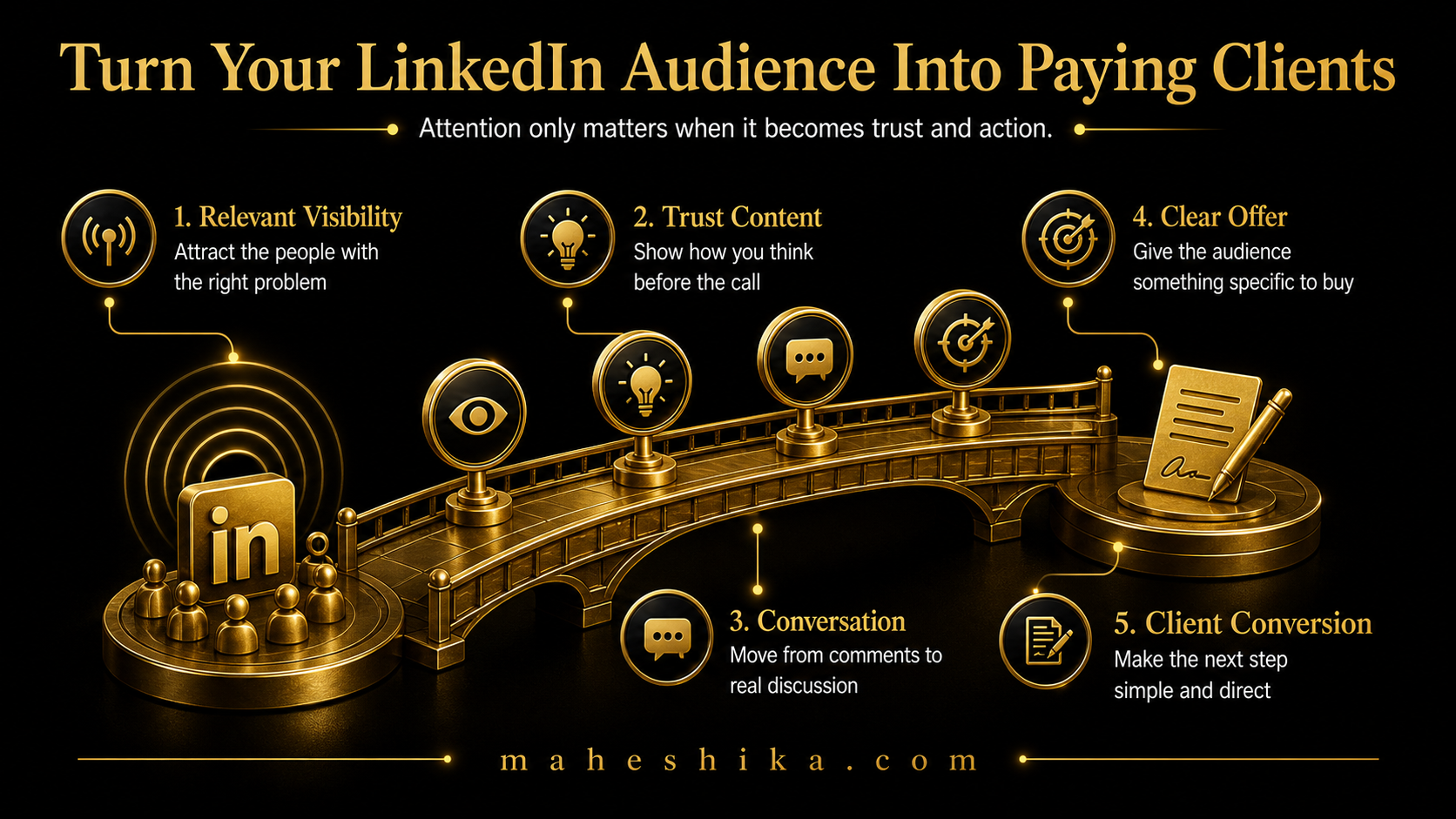
There is a gap that surprises many experts who build a LinkedIn following: the audience grows, the engagement increases, but the clients do not materialise. The content is good, the reach is real, but the commercial result is absent. This is not a content problem. It is a conversion problem, and it is entirely fixable.
Why an Audience Does Not Automatically Become Clients
LinkedIn followers follow you because your content is interesting, useful, or resonant. That is not the same reason they would hire you. The decision to engage with your content and the decision to pay you are separated by several steps, and those steps do not happen automatically. You have to create the path.
Most experts post content for months, never explicitly mention that they can be hired, and then wonder why no clients have arrived. The audience assumes that following you and reading your posts is the relationship. They have no reason to think there is a commercial offering available unless you tell them one exists.
This is not a failing of the audience. It is a design failure in the brand. The path from reader to client must be visible, legible, and easy to take. Your content creates the trust. Your profile, your website, and your calls to action create the path. Without the path, the trust accumulates but never converts.
The Role of Your Profile in Conversion
Every piece of content you publish sends interested readers to your profile. If that profile does not communicate clearly what you offer and how to engage, the conversion opportunity disappears. Your LinkedIn profile must function as a commercial landing page, not a biography.
Your About section should end with a clear statement of availability and a next step. Not a hard sell: a calm, direct invitation. "I work with a small number of commercial directors each year on [specific area]. If that is relevant to where you are, I am glad to have a conversation: [email] or connect here." That is all it takes. A reader who is ready to explore working with you needs only a clear signal that you are available and a way to reach you.
Check that your contact information is visible and correct. Use the website field in your profile to link to your consulting or services page, not to your generic homepage. Make the next step as frictionless as possible. For further guidance on the full profile rewrite, read How to Write a LinkedIn Profile That Attracts Consulting Clients.
Related Reading
How to Mention Your Services Without Being Pushy
The discomfort most experts feel about commercial calls to action comes from conflating two very different things: helpful promotion and aggressive selling. Mentioning your services in a professional context, to people who are already reading your content because it is relevant to them, is not aggressive. It is useful information.
In practice, include a brief mention of your services in roughly one in five posts. Not a sales pitch: a contextual note. "This is the kind of commercial challenge I work through with clients. If you are dealing with something similar and would find it useful to explore together, feel free to send a message." That is the entire call to action. Low pressure, clear, honest about what you offer.
Also: use the LinkedIn newsletter feature if you have one, or create a regular series of posts with a fixed theme, to build a recurring touch point with your audience. People who read your content every week are substantially more likely to think of you when a relevant need arises than people who see you once a month in their feed.
Free Tool
Start free: where do you actually stand?
Two free tools give you an honest answer in minutes. The AI Risk Score shows how exposed your role is. The Expertise Ownership Score shows how findable and owned your expertise is.
AI Risk Score Expertise Ownership ScoreMoving People Off LinkedIn and Into Your Ecosystem
LinkedIn owns your audience. If the platform changed tomorrow, you would lose access to every follower you have built. This is why the conversion goal should not just be "get a client from LinkedIn" but "move the relationship to an owned channel, then convert."
Owned channels include your email list, your website, and your direct calendar booking system. Every LinkedIn post can include a soft invitation to take one of these steps: download a resource from your website, join your newsletter, or book a thirty-minute introductory call. Each of these moves the relationship to a place you control.
A free tool, a downloadable framework, or a short diagnostic is particularly effective here. It provides immediate value, filters for the people who are genuinely interested in the problem you solve, and creates a reason to continue the conversation off-platform. The free AI Risk Score and Expertise Ownership Score on this site work exactly this way: each gives a real, specific answer in minutes, and each opens a relationship with someone who is already thinking seriously about their own position.
The Asset LinkedIn Can Never Take From You
So the audience becomes clients through a visible path, not a bigger following: a profile that states plainly what you offer, a habit of reaching out when someone signals real interest, and owned channels that carry the relationship somewhere you control. That is the entire mechanism, and none of it depends on going viral.
But notice what that mechanism is quietly telling you. Every method that actually works moves the relationship off LinkedIn and onto something you own. That is not a tactic, it is a warning. The platform can change its algorithm, restrict your reach, or suspend your account tomorrow, and the audience you spent years building would be gone by lunchtime. None of it was ever yours. You were borrowing attention on land someone else owns.
And the ground is shifting under the content itself. AI can now write a LinkedIn post in a voice that sounds close enough to yours, in seconds. What still cannot be copied is a place that is unmistakably, permanently yours: a personal website under your own name, where your thinking lives, your work is shown, and the way to reach you is never one algorithm update away from disappearing. Owned outright. Findable in a search. Impossible to mistake for anyone else's.
That is the one move that turns an audience you rent into an authority you keep. If you want it built properly, let us talk.