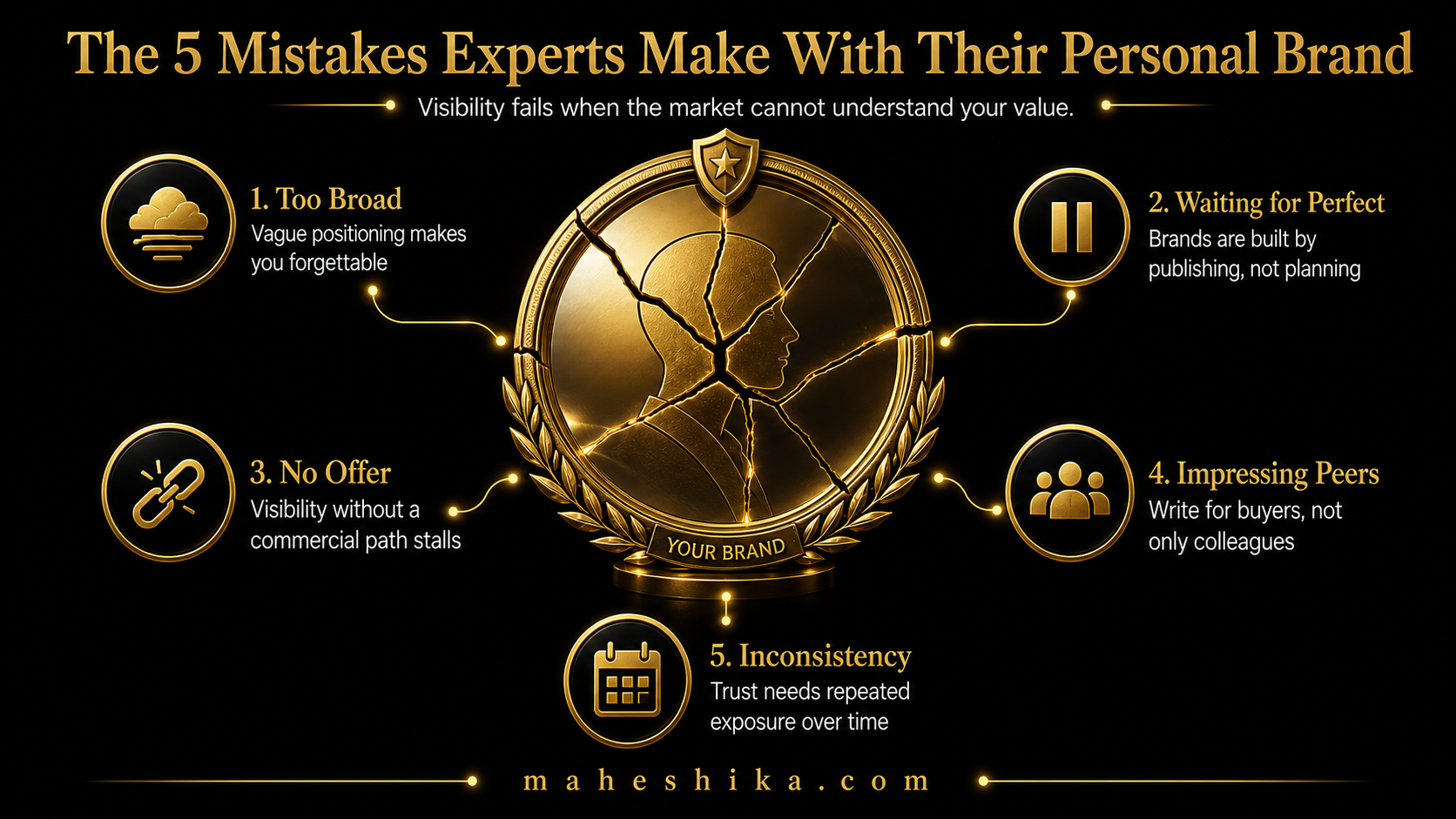
These are not the mistakes of beginners. They are the mistakes of highly capable professionals, people with impressive careers, genuine expertise, and every reason to succeed as independents, who are inadvertently undermining the brand they are trying to build. I have observed these patterns consistently, and each one has a specific, actionable fix.
Mistake 1: Positioning So Broadly That Nothing Lands
The most common mistake is a positioning statement so wide that it describes everyone and therefore attracts no one. "I help organisations improve performance." "I work with leaders on transformation and culture." "I bring strategic thinking to complex challenges." These phrases are technically true for thousands of consultants, which means they create no differentiation whatsoever.
The fear behind this mistake is understandable. Narrow your positioning and you might exclude potential clients. Widen it and you seem available to everyone. But the opposite is true in practice. A specific positioning statement ("I work with commercial directors in industrial distribution businesses who are transitioning from direct to indirect sales models") creates immediate recognition in the people who have that exact problem. They see themselves in the description. They make contact because they feel found, not filtered out.
The fix: Complete this sentence without using any word that could apply to ten other consultants in your field: "I help [specific type of person] solve [specific problem] so that they can [specific outcome]." If you cannot complete it specifically, you have a positioning problem that no amount of content or social media activity will solve. Fix the positioning first.
Mistake 2: Waiting for the Brand to Be Perfect Before Starting
The LinkedIn profile that never goes live because the headline is not quite right. The website that has been "almost ready" for four months. The content strategy that is being planned in detail before the first post is written. The pursuit of a perfect brand before launching anything is one of the most expensive decisions an independent professional can make, because the cost is measured in months of missed opportunities.
Your personal brand is not a product launch. It is a living thing that develops through doing. The best version of your positioning will be the one you arrive at after six months of posting and noticing which ideas resonate with the people you most want to reach. The best version of your website will emerge from watching how visitors actually behave on the initial version. None of that learning is available until you publish something.
The fix: Set a deadline of one week to publish your updated LinkedIn profile and post your first piece of content. It does not need to be excellent. It needs to exist. Excellent will come from iteration. Iteration requires a starting point. Create the starting point.
Related Reading
Mistake 3: Posting to Impress Peers Rather Than to Attract Clients
When you have spent a career surrounded by highly capable colleagues, it is natural to calibrate your content to their level. The result is posts that are technically impressive but entirely inaccessible to the client who is experiencing the problem you solve but not yet fluent in its language.
A commercial director dealing with a failing channel strategy does not necessarily know the academic vocabulary of distribution economics or the theoretical frameworks of indirect sales. They know they are losing partner engagement, that revenue forecasts keep slipping, and that their board is asking hard questions. Content written for that person, in their language, about their experience, converts. Content written to impress seasoned practitioners generates peer respect and few client enquiries.
The fix: Before writing any piece of content, name the specific person you are writing for. What is their title? What problem keeps them up at night? What would they type into a search engine? Write for that person, in language they would use, answering the question they are actually asking. Your peers can still find value in it. But your clients will find themselves in it.
Free Tool
Start free: where do you actually stand?
Two free tools give you an honest answer in minutes. The AI Risk Score shows how exposed your role is. The Expertise Ownership Score shows how findable and owned your expertise is.
AI Risk Score Expertise Ownership ScoreMistake 4: Building a Brand Disconnected From a Business
A personal brand without a commercial offer attached is a profile. It may generate interest, followers, and compliments, but it does not generate revenue. The mistake is treating brand building as a precondition for having a commercial offer, rather than running them in parallel.
You need to know what you are selling before you start building the brand that markets it. What is the specific engagement you offer? What does it cost? What does the client have at the end of it that they did not have at the beginning? Who is it for and who is it not for? These questions need answers, even provisional ones, before the brand can do commercial work. A brand without an offer is a flag with no country behind it.
The fix: Define your core offer in one clear paragraph before you publish anything. Name the engagement, the outcome, the audience, and the approximate investment required. It does not need to be final. It needs to be specific enough that a client who reads it knows whether they want to have a conversation with you about it. Then point your brand activity toward that offer consistently.
Mistake 5: Treating Consistency as Optional
The most damaging pattern I see is the expert who posts actively for six weeks when business is slow, disappears for three months when a project fills the calendar, reappears when the project ends, and repeats the cycle indefinitely. The brand never builds momentum because the audience never trusts that the next piece of content will actually arrive.
Algorithms reward consistency. Audiences trust it. Your pipeline reflects it. The months when you are too busy to post are precisely the months when your brand is working hardest in the background, reaching people who have not yet decided to reach out. If you go dark, you interrupt that process. The people who were on the cusp of making contact may find someone else instead.
The fix: Build a content rhythm that survives your busiest months, not your least busy. If you can only post once a week during peak client periods, post once a week all year. Batch content when you have more time. Use the slower periods to write posts in advance. A consistent once-per-week presence over two years is worth far more than intense periods of activity followed by silence. Set the sustainable minimum and hold to it as a non-negotiable commitment to your own business.
The Mistake Underneath the Five Mistakes
Every one of these mistakes is fixable today. None of them requires talent you do not have, technology you have not learned, or time you cannot find. They require decisions: about how specifically to position yourself, when to start rather than perfect, who you are really writing for, what you are actually selling, and how consistently you are willing to show up. Make those decisions and your brand will follow.
But there is a sixth mistake sitting underneath all five, and it is the quiet one. Even experts who fix their positioning, start before they feel ready, write for the client instead of their peers, attach a real offer, and show up consistently, often build all of that on borrowed ground: a LinkedIn profile, a platform's algorithm, an audience they do not own. Fix five mistakes on land that belongs to someone else, and you are still one policy change away from starting over.
That is the real risk now. AI can answer almost any question in a voice that sounds like everyone else's, and a platform can change its rules overnight. The professionals who stay findable, and stay themselves, are the ones with a place that is theirs outright: a personal website under their own name, where their positioning is stated plainly, their work is shown, and their thinking cannot be mistaken for a generic answer. That is not a sixth item on the list. It is the ground the other five stand on.
You do not have to fix all six at once, and you do not have to work it out alone. If you want a second pair of eyes on where your brand actually stands, and what it would take to build it on ground you own, let us talk.