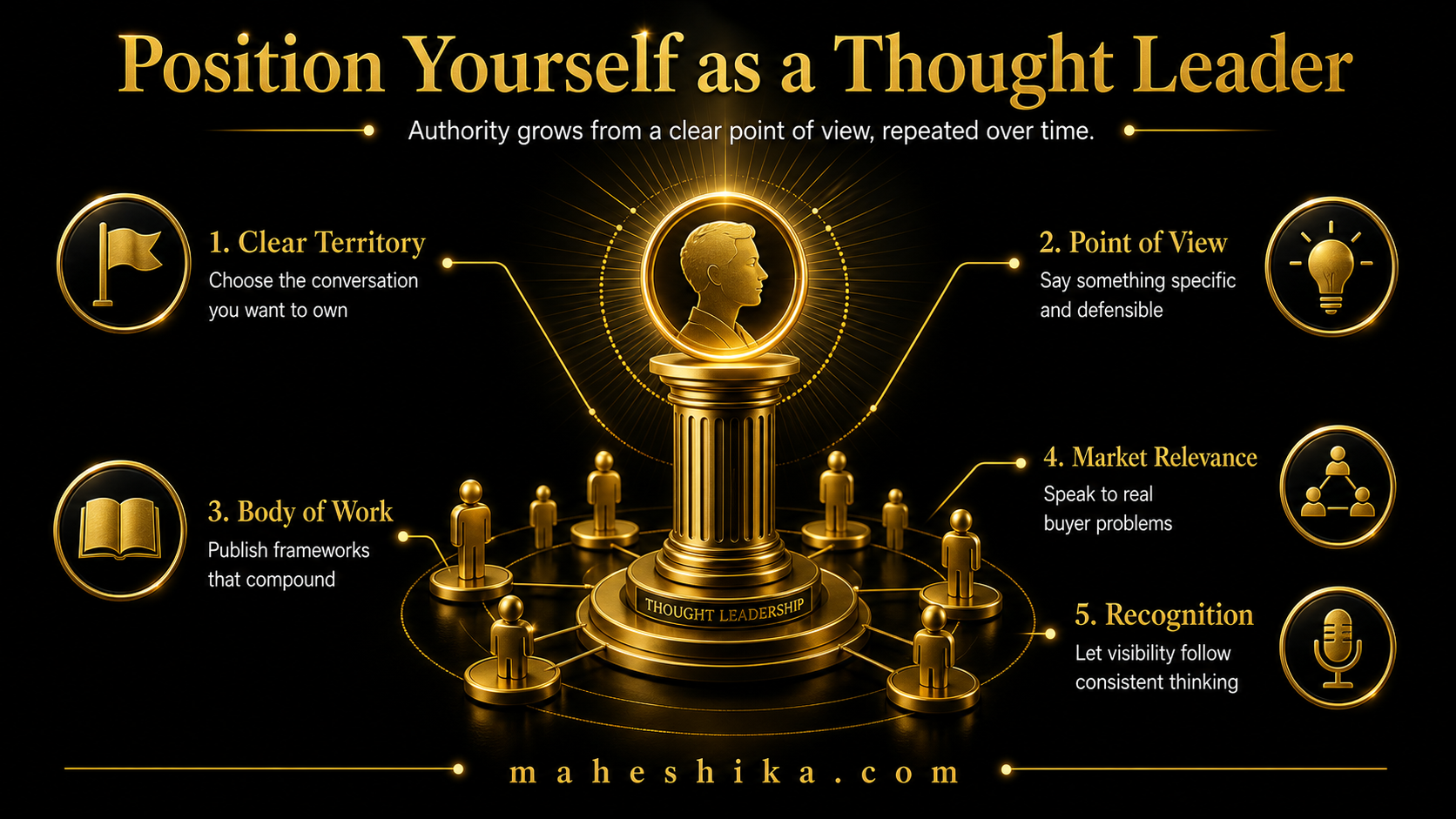
Thought leadership has become one of the most overused phrases in professional circles, applied to everything from daily LinkedIn posts to ghostwritten op-eds. But the real thing, the kind that opens doors and commands premium fees, is rarer and more specific: it is the state of being the person your industry turns to when a hard question needs a thoughtful answer. Here is how to build that position deliberately.
The Difference Between Expertise and Thought Leadership
Expertise is what you know. Thought leadership is what you say about what you know, publicly, in a way that shifts how others think. Many highly qualified professionals have deep expertise and zero thought leadership presence. They have not translated their knowledge into a visible point of view. That gap is the opportunity.
Thought leadership requires two things expertise alone does not: a distinct position on something that matters in your field, and the willingness to defend that position in public. The distinct position does not have to be radical. It just has to be yours, clearly stated, and different from the consensus view in some meaningful way. "Diverse teams perform better" is not a position, it is received wisdom. "Most diversity initiatives in commercial teams fail because they address headcount without addressing decision rights" is a position.
Once you have a position, you can build everything else around it. Content, speaking, publications, media commentary: all of it flows from a clear point of view expressed consistently over time.
Define Your Intellectual Territory
Thought leaders own a territory. Michael Porter owns competitive strategy. Clayton Christensen owned disruption theory. You do not need the scale of an HBS professor, but you do need a defined domain within your industry where you have both deep experience and something to say.
To define yours, answer three questions honestly. First: what problem in your industry do you understand better than almost anyone you know? Not just competently, but with the kind of depth that comes from having been in the middle of it multiple times. Second: what does the mainstream get wrong about that problem? Where does the conventional wisdom fall short? Third: what does the better approach look like, based on what you have actually seen work?
The intersection of those three answers is your intellectual territory. It should be narrow enough to be ownable and broad enough to sustain a year of content.
Related Reading
Build a Signature Framework
The most effective thought leaders give people a new way to see something. A framework that names a problem or a process in a way that makes it suddenly legible. The framework does not have to be groundbreaking: it just has to be yours, consistently used, clearly named.
Think about the problem you solve most often. What are the stages, the failure points, the variables that most people miss? Can you map that into a three to five part model? Name each component. Give the overall model a name that reflects the transformation it describes. Then use that framework consistently in your content, your speaking, your client work, and your website.
When someone can say "she uses the [Your Framework] approach," your thought leadership has crystallised into something transferable. That is when it starts spreading without you.
Free Tool
Start free: where do you actually stand?
Two free tools give you an honest answer in minutes. The AI Risk Score shows how exposed your role is. The Expertise Ownership Score shows how findable and owned your expertise is.
AI Risk Score Expertise Ownership ScoreGet Your Ideas Into More Places
LinkedIn is a starting point, not a ceiling. To build genuine industry-level thought leadership, your ideas need to appear in contexts that carry institutional credibility: industry publications, conference programmes, podcasts with established audiences, and media coverage in respected outlets.
Start with the platforms that already reach your target audience. Identify the five publications your ideal clients read. Note which ones accept contributed pieces. Write one strong, opinionated article on your signature topic and pitch it. Not a promotional piece, an editorial piece that teaches something and reveals your perspective. Most industry editors are actively looking for original contributor content from practitioners, not just academics.
For podcasts, search for shows where your target clients are the audience. Listen to three episodes. Send a brief pitch that names a specific topic you could address, with a clear angle, relevant to their audience. Make the pitch about what their listeners will gain, not about your credentials.
Conference speaking is covered in more depth in How to Get Speaking Engagements Using LinkedIn and Your Personal Brand. The short version: most conference speaking comes from being already known in the room. Your LinkedIn content and publications create the conditions for speaking invitations to arrive.
Sustaining the Position Over Time
Thought leadership is not a campaign. It does not have a launch date and an end date. The experts who maintain genuine industry authority are the ones who treat intellectual contribution as a permanent practice: reading widely, forming views, sharing them, updating them when evidence warrants it.
Set aside time each week to stay genuinely current in your field. Read the publications, attend the conversations, note what is changing and what you think about the change. The content will follow naturally from active, curious engagement with your domain. The experts who run out of things to say are usually the ones who stopped learning when they stopped being employed.
And when the industry evolves in a direction that challenges your position, say so. The willingness to revise your thinking publicly is one of the most credibility-building things a thought leader can do. It signals intellectual honesty over brand protection. That distinction, in a landscape full of people who never change their minds, stands out dramatically.
The One Move That Secures Your Position
So the answer to positioning yourself as a thought leader is not one bold move. It is a territory you claim, a framework you name, and a position you defend consistently, in public, until other people start repeating it back to you without prompting. It is slow and then it is fast, and the professionals who get there are the ones who kept showing up on their point of view long after it stopped feeling new.
But there is a quiet risk underneath all of that effort. Every article you place, every podcast you appear on, every conference you speak at builds your reputation on land you do not own. The publication can close its contributor programme. The platform can change its algorithm. And in a market where AI can now generate a plausible answer to almost any question in a voice that sounds like everyone, the professionals who keep their standing are the ones who have a place that is unmistakably theirs.
A personal website under your own name is that place. Somewhere your framework lives in full, your body of work is gathered in one view, and your signature on your ideas cannot be diluted into a generic answer. Owned outright, findable in a search, built to outlast any single publication or platform. That is not a nice extra once the thought leadership is working. It is the ground it should be standing on.
You do not have to build it alone, and you do not have to wait until you feel established enough. If you want it done properly, by someone who has walked exactly this path, let us talk.