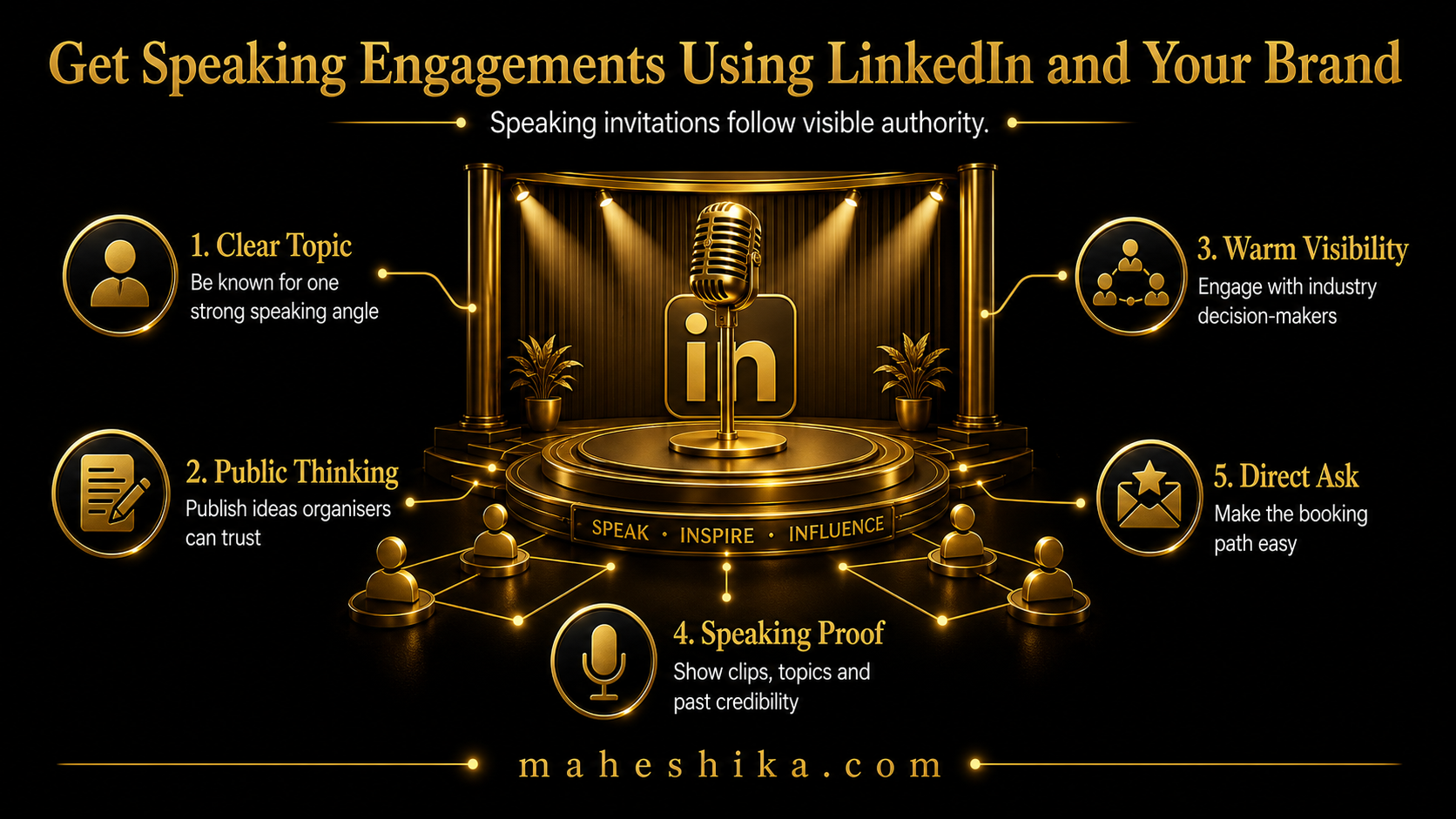
Conference organisers do not discover speakers from cold applications. They discover them because a speaker's name keeps appearing: in their feed, in conversations with colleagues, in articles they have read. By the time the invitation comes, the organiser already knows who you are and what you stand for. Your job is to make sure that recognition happens, deliberately and systematically, before the speaking opportunity arises.
Understand How Speakers Actually Get Booked
The vast majority of paid speaking engagements are filled through one of three routes: direct referral from someone the organiser trusts, the organiser having followed the speaker's online presence and content, or the speaker having been seen at a previous event that the organiser also attended or heard about.
Notice that "submitted a speaker application to an open call" does not appear prominently in that list. Open calls exist, and they occasionally lead to bookings. But the most reliable path to speaking consistently is to become the person who is already being talked about by the people who run events in your domain.
That is a function of visibility and positioning. LinkedIn is one of the most efficient platforms for building that visibility in a professional context. Your content, your commentary, and your profile all contribute to the picture that forms in an organiser's mind over time.
Build Your Speaking Profile on LinkedIn
If you want to be booked as a speaker, your LinkedIn profile needs to make that clear. Add "Speaker" to your headline alongside your consulting positioning. Create a dedicated section in your About text that describes the topics you speak on and the audiences you address. Be specific: not "leadership and strategy" but "commercial transformation in industrial businesses" or "building high-performing teams in regulated environments."
Use the Featured section to pin a speaking clip. Even a short clip from an internal presentation, a webinar, or a smaller event is worth pinning. It answers the first question every organiser has: what is this person like on a stage? A written speaker bio cannot answer that question. A sixty-second video clip can.
Post about your speaking engagements when they happen. Not to brag, but to signal that you speak, that events book you, and that the topics you cover are relevant. A post that says "Speaking next week at [event] on [specific topic]: here is the core argument I am going to make" does two things. It markets your appearance and it demonstrates the intellectual depth of what you are bringing to that stage.
Related Reading
Create Content That Demonstrates What You Are Like on Stage
The content you post on LinkedIn is an audition that runs continuously. When an organiser reads your posts over six months, they form a clear view of how you think, how you communicate, and whether your perspective would be valuable to their audience. Write your LinkedIn content with this in mind: clarity, specificity, and a genuine point of view.
Video content is particularly effective for speaking positioning. A short LinkedIn video in which you walk through a key argument, illustrate a framework, or respond to a question in your domain demonstrates precisely the communication quality that organisers are looking for. It does not need to be produced. It needs to be clear, confident, and substantive.
Consider going live on LinkedIn for a short session: a thirty-minute Q&A on a specific topic in your domain, a walkthrough of a framework you use, or a response to a recent development in your industry. This creates content and gives organisers a live sample of your speaking presence simultaneously.
Free Tool
Start free: where do you actually stand?
Two free tools give you an honest answer in minutes. The AI Risk Score shows how exposed your role is. The Expertise Ownership Score shows how findable and owned your expertise is.
AI Risk Score Expertise Ownership ScoreMaking Direct Outreach Work
Cold outreach to event organisers can work, but it works best when it is not fully cold. Before you pitch, spend a few weeks engaging with the organiser's content on LinkedIn. Follow the event's page or account. Comment on their posts. Attend one of their events, even virtually, and post about it. By the time you send your pitch, you are a warm contact, not an unsolicited approach.
Your pitch should be brief and specific. Name the topic you would speak on. Name the specific angle that is relevant to their audience. Include one concrete credential: a previous speaking engagement, a published piece, a quantified career achievement that directly supports the talk. Attach or link to a short video sample. Ask for a fifteen-minute call, not for them to commit to booking you.
Follow up once, two weeks after the first message, and not again after that. Persistence is appropriate once. More than that damages the relationship you have been building.
The Step Most Speakers Miss: Build Relationships With Other Speakers
The fastest route to more speaking engagements is often through the speakers who are already on the stages you want to reach. When you speak at the same event as someone else, introduce yourself properly. When you read their book or listen to their podcast, tell them what you thought, specifically. When an organiser asks them to recommend someone for a topic adjacent to theirs, you want your name to be immediately accessible.
This is not networking in the transactional sense. It is genuine community building within your field. The speakers, authors, and practitioners who are visible in your domain are your professional peers. Investing in those relationships, over time and without immediate expectation of return, creates a referral ecosystem that no amount of LinkedIn posting can replicate.
Speaking success compounds. One engagement on a small stage leads to a larger one. A recording of a talk gets shared. An organiser who enjoyed working with you books you again and recommends you to peers. Build the first rung deliberately. The rest follows from there.
Own the Stage Before You Are Booked For One
So the honest answer is that speaking engagements are earned before the invitation ever arrives. Organisers book the person they already recognise: someone whose name has surfaced in their feed, whose argument they remember, whose presence they have some evidence of. Build that recognition deliberately, on LinkedIn and through the relationships you invest in, and the bookings follow. There is no shortcut around visibility.
But there is a risk sitting quietly inside that strategy. Everything you have just built lives on a platform you do not own. LinkedIn decides what your network sees, changes its algorithm without asking you, and could limit your reach or your account tomorrow. Years of posts, your speaking reel, the audience you have earned: all of it sits on land you rent, not land you hold.
And in a market where AI can write a LinkedIn post that sounds like anyone, the speakers who keep their booking pipeline are the ones who also have a place organisers can land that is unmistakably theirs. A personal website under your own name, where your speaking topics, your reel, your testimonials and your specific point of view live permanently. Owned outright, findable the moment someone searches your name, impossible to mistake for anyone else's feed.
You do not have to build that alone, and you do not have to figure it out later. If you want a home for your speaking career that no algorithm can take away from you, let us talk.