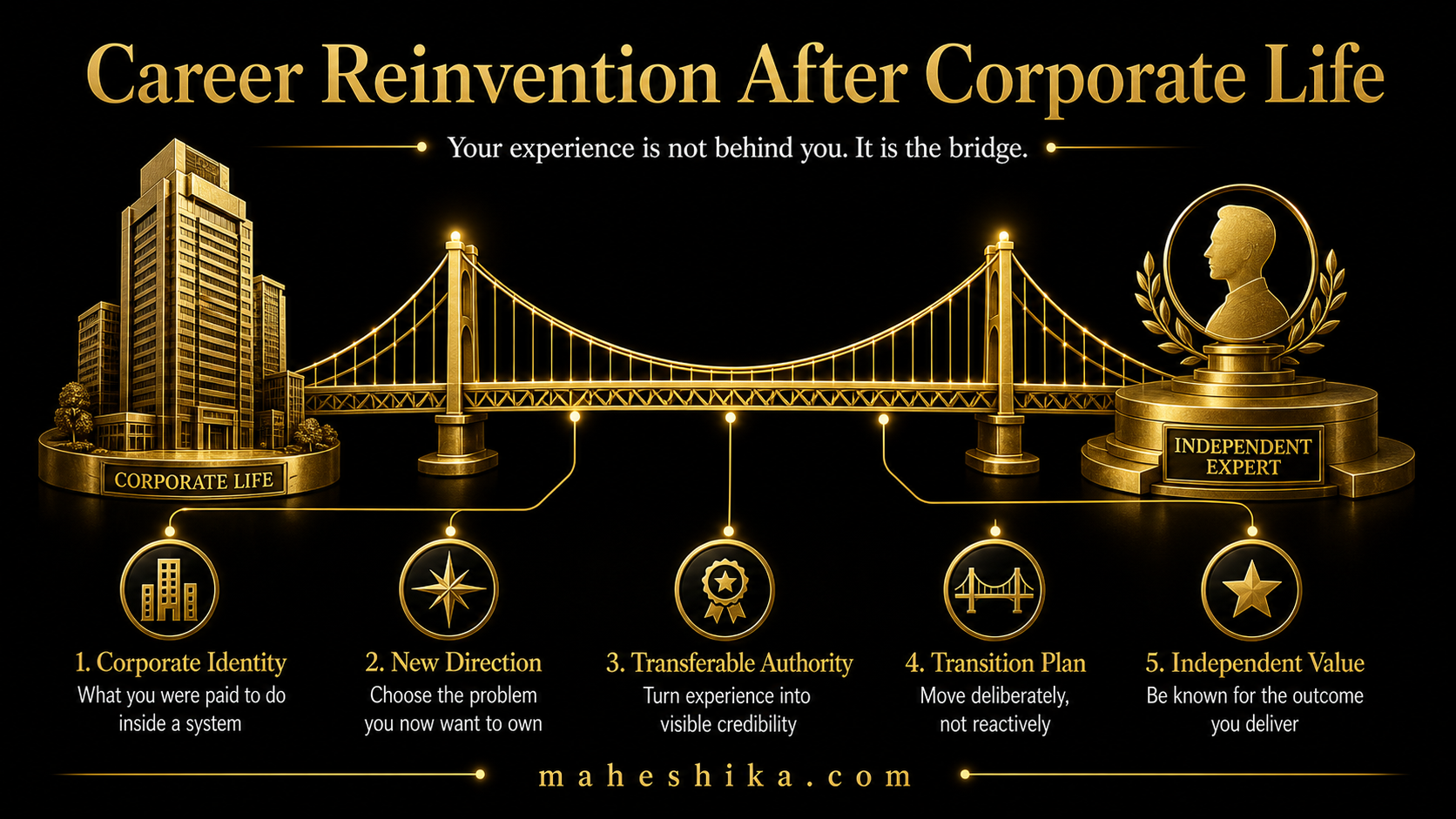
Something shifts when you have spent 15 or 20 years building a career at a senior level and you suddenly find yourself on the outside. It is not just the loss of a role. It is the loss of a context, an identity, a daily structure that has defined who you are and how you spend your time. For many professionals in their 40s and 50s, this moment, whether it arrives through redundancy, a choice to leave, or a quiet realisation that the corporate model no longer fits, is the most disorienting thing they have experienced since their early career.
This guide is for those people. It is not a motivational piece. It is a practical, structured resource that addresses the real questions: what do you do first, what are your options, how do you make the transition without starting over, and how does the landscape of 2026 change what is possible for experienced professionals.
Who This Guide Is For
This guide is written for three groups of people. The first is the senior professional who has been made redundant and is trying to figure out their next move before the shock wears off and the drift begins. The second is the professional who is still employed but feels the ground shifting, whether through restructuring, a change in leadership, or a growing sense that the role they have held for years is no longer the one they want to hold. The third is the person who has left, intentionally, and is now staring at a blank calendar wondering what to do with their freedom.
What all three groups have in common is this: they have more options than they think, more transferable expertise than they recognise, and more market value in the independent space than the corporate job market has ever credited them with.
Why Mid-Career Redundancy Is Different From Early-Career Job Loss
When you lose a job in your 20s, the path is relatively clear: update the CV, apply for roles, start fresh. The stakes are lower because the financial commitments are smaller, the identity investment in the role is shallower, and the time horizon for recovery feels longer.
Mid-career redundancy is structurally different. You are more likely to have a mortgage, dependants, and a lifestyle built on a specific level of income. You have an identity that is deeply entangled with your professional role and the status it carries. And you are entering a job market that has a complex, often unconscious bias against experienced professionals with high salary expectations.
But here is what is also different: you have assets that early-career redundancy cannot produce. You have deep domain knowledge, an extensive professional network, a track record of results at senior level, and the confidence that comes from having navigated complex organisations for decades. Those assets are worth far more in the independent market than the corporate employment market will ever pay for them.
The Three Paths After Corporate Life
When senior professionals leave corporate roles, they tend to follow one of three broad paths. Understanding which path fits your situation, your goals, and your financial position is the foundation of a smart reinvention.
Path One: Return to Employment. Some professionals choose to return to a senior employed role, either immediately or after a period of reflection. This is a legitimate choice, particularly when financial commitments are pressing and the opportunity is right. The risk is re-entering a market that may undervalue you and then finding yourself in the same position again in three years.
Path Two: Independent Consulting. This is the path that best leverages the assets you have built over a long corporate career. Independent consulting means selling your expertise directly to organisations that need it, without the intermediary of an employer. The learning curve is real, but the upside in income, autonomy, and professional satisfaction can be significant.
Path Three: Building a Business. Some professionals use the transition as an opportunity to build something more substantial than a consulting practice: a business with a product, a platform, a book, a course, or a combination of all four. AI has made this path more accessible than it has ever been, and 2026 is arguably the best moment in history to pursue it.
Most people who navigate this well eventually combine elements of two or three paths. They consult while building, or they write while consulting, or they speak while serving clients. The independent model is not a single track.
What You Need to Do First
Before you update your CV, before you change your LinkedIn headline, before you tell anyone what you are planning, you need to do one thing: a genuine expertise audit.
An expertise audit is not a list of job titles. It is a structured excavation of what you actually know, what problems you have solved, what results you have produced, and which of those things the market will pay to access. Most senior professionals have spent their careers delivering value inside organisations without ever having to articulate that value in commercial terms. The audit forces that articulation.
Ask yourself the following. What specific problems have I solved repeatedly across my career? What do colleagues, clients, or direct reports ask me for most often? Where have I produced measurable results that organisations would pay to replicate? What knowledge do I have that took years to build and cannot be easily Googled? The answers to those questions are the raw material of your next chapter.
Only once you understand your expertise clearly can you make intelligent decisions about how to package it, who to sell it to, and what to charge.
Building Your Next Chapter on Your Own Terms
The phrase "on your own terms" is not a luxury aspiration. It is a practical description of what becomes possible when you stop selling your time to a single employer and start deploying your expertise across multiple clients, channels, and formats.
Building on your own terms means choosing your clients rather than applying to employers. It means setting rates that reflect your value rather than accepting a band that was determined by someone else's internal structure. It means working on problems that genuinely interest you rather than whatever the organisation has decided is the priority this quarter.
It also means accepting responsibility for all of it. The pipeline, the pricing, the client relationships, the marketing, the administration, and the discipline to keep going when things are slow. The professionals who thrive in this model are those who treat their expertise as a business from day one, not as a freelance hobby.
The structural elements you need to build include: a clear positioning statement that describes who you help and what outcomes you produce, at least one core consulting offer with a defined scope and price, a professional online presence that signals authority rather than availability, and a short list of warm contacts who might either hire you or refer you. You do not need all of this in place before you start. But you need to be working on all of it in the first 90 days.
The Role of AI in Career Reinvention
AI has changed the calculus of going independent in ways that are still not fully understood by most senior professionals. The barriers that used to make building an independent business time-consuming and expensive have been substantially removed.
Content that used to take a team can now be produced by one person with the right tools. Websites that required developers can be built in days. Research that required assistants can be done in hours. Administrative work that consumed consulting time can be automated. The practical result is that a single experienced professional, working intelligently with AI tools, can operate with the output and infrastructure of a small organisation.
More importantly, AI does not compete with the thing that makes experienced professionals valuable. It cannot replicate your 20 years of pattern recognition, your network, your credibility, or your judgement about what actually works in complex organisations. It can extend your capacity. It cannot replace your expertise.
The professionals who are winning in 2026 are the ones who understand both sides of this: what AI can do for them, and what makes them irreplaceable even in an AI-enabled world.
Common Mistakes to Avoid
Most reinvention mistakes are not strategic errors. They are psychological ones: decisions made from fear, urgency, or an incomplete understanding of what is actually available.
The first and most common mistake is accepting the first offer that comes along out of financial anxiety, particularly if it is a role that does not represent your true level or pay what your experience is worth. Accepting below-market positions early in a transition can set a precedent that is difficult to recover from.
The second mistake is positioning yourself as a generalist. "I can help with strategy, operations, commercial development, change management, and leadership." This is how most senior professionals describe themselves, and it is commercially invisible. The market pays premiums for specific expertise applied to specific problems.
The third mistake is waiting until everything is perfect before starting. The website is not ready. The positioning is not clear enough. The offer needs more work. Meanwhile, months pass and momentum evaporates. The professionals who build successfully do so by starting with what they have and refining as they go.
The fourth mistake is underestimating the psychological dimension of the transition. Leaving a senior corporate role involves a genuine identity shift that takes time to navigate. Getting support for that process, whether through a coach, a peer group, or a structured programme, is not a luxury. It is part of the work.
Related Reading
Free Tool
Start free: where do you actually stand?
Two free tools give you an honest answer in minutes. The AI Risk Score shows how exposed your role is. The Expertise Ownership Score shows how findable and owned your expertise is.
AI Risk Score Expertise Ownership ScoreA Guide to This Series
This pillar guide is supported by twelve in-depth articles that cover every stage of the career reinvention journey. Each article goes deep on a specific question or challenge. Read them in order for the complete roadmap, or jump to the one most relevant to where you are right now.
- What to Do When You Are Made Redundant in Your 40s or 50s
- Made Redundant at 50: How to Turn Job Loss Into Your Best Career Move
- How to Reinvent Your Career After Redundancy Without Starting From Scratch
- Why Redundancy at Mid-Career Is Actually an Opportunity in 2026
- What to Do in the First 30 Days After Losing Your Job
- How to Audit Your Own Expertise After a Job Loss
- Is It Too Late to Start a Business After 50?
- How to Use Your Redundancy Package to Fund Your First Year as an Independent
- Why Senior Professionals Are the Most Undervalued People in the Job Market
- The Psychology of Redundancy: How to Move Forward With Confidence
- How to Tell Your Story After Redundancy: LinkedIn, Website, and Personal Brand
- How to Go From Employee to Entrepreneur When You Have Never Run a Business
The One Move That Secures Your Place
So the answer to reinvention is not a single leap. It is a first week of concrete action: get clear on the specific value you already hold, choose one position the market can actually see, and start before everything feels ready. The professionals who navigate this well are not the boldest. They are the ones who move while the momentum is still there.
But there is a deeper move underneath all of it, and it is the one almost everyone misses. When you leave the corporate structure, you lose the very thing that made you visible: the title, the logo, the org chart that told the world who you were. Twenty years of hard-won expertise suddenly lives nowhere anyone can find it. And in a market where AI answers every question in a voice that sounds like everyone, the professionals who keep their place are the ones who have a place of their own.
A personal website under your own name. Somewhere your thinking lives, your work is shown, and your signature is unmistakable. Owned outright, findable in a search, impossible to reduce to a generic answer. That is not vanity. It is the single most powerful thing you can do to secure your place in this next chapter, because it is the one asset that keeps working for you whether or not you are in the room.
You do not have to build it alone, and you do not have to build it later. If you want it done properly, by someone who has walked exactly this path, let us talk.