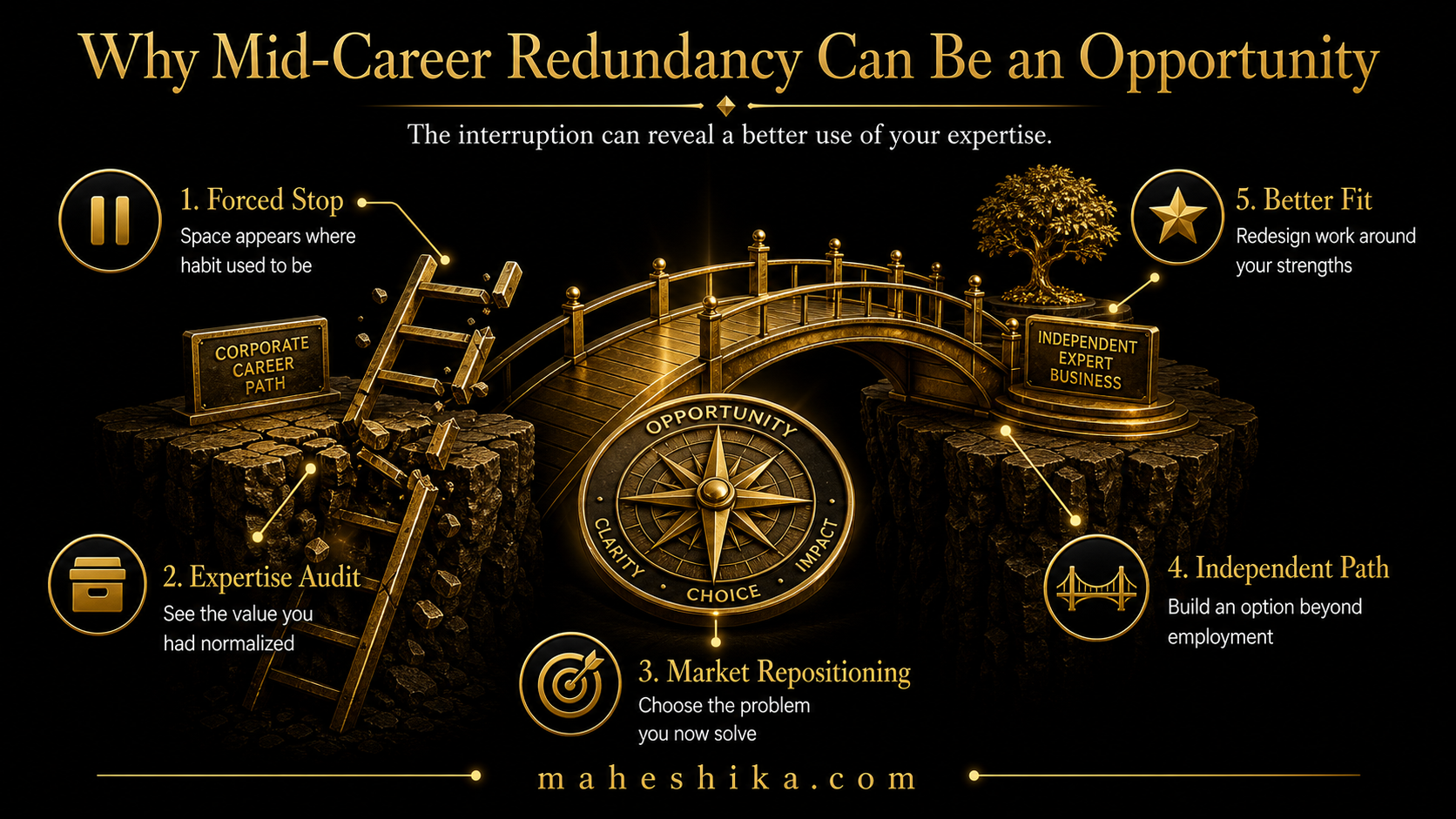
I want to be careful here, because the claim that redundancy is "actually an opportunity" can sound like the kind of thing people say to someone who has just had a shock, when what they really need is practical clarity rather than reassurance. So let me be specific about what I mean, and why the conditions of 2026 in particular make this argument more substantive than it would have been five years ago.
Why 2026 Is Structurally Different
Four things have changed in the past three to five years that materially alter the economics and practicalities of going independent at mid-career.
AI has removed the infrastructure barrier. Building and operating an independent professional practice used to require either significant upfront investment (in websites, marketing, administration, content) or a long runway of slow, manual effort. AI has compressed all of that. One person with the right tools can produce the content, the proposals, the client communications, and the operational infrastructure that used to require a small team.
Demand for senior independent expertise is growing. Organisations are increasingly reluctant to hire expensive senior leaders as permanent employees, particularly after years of restructuring. At the same time, they still need the expertise those leaders carry. The result is a growing market for independent senior advisors, fractional executives, and specialist consultants, precisely the roles that mid-career professionals are best positioned to fill.
The digital visibility infrastructure is mature. LinkedIn, a professional website, and a consistent content strategy are enough to build a credible independent practice. The tools, the platforms, and the expected formats are now well understood. Building professional visibility in 2026 does not require the resources or luck it did a decade ago.
The independent professional community is larger and better resourced. There are communities, peer groups, tools, and support structures for independent professionals that simply did not exist at scale before. The isolation that used to define going solo is substantially reduced.
The Specific Advantages of Mid-Career Timing
Beyond the 2026 conditions, there are structural reasons why redundancy at mid-career creates genuine opportunity that early-career redundancy does not.
You have enough career capital to build on immediately. You are not starting from scratch in terms of knowledge, network, or reputation. The independent practice you can build in your 40s or 50s starts at a higher level than anything you could have built in your 30s, because the raw material is richer.
You have enough career ahead to justify the investment. Building an independent practice takes one to two years to reach consistent profitability for most people. At 50, you have 15 or more productive professional years ahead. The investment pays back many times over.
Your financial commitments, while real, are often manageable. Most mid-career professionals receiving redundancy have mortgages, savings, a redundancy payment, and sometimes a pension contribution they can access. The financial runway is usually longer than it feels in the first days after redundancy.
What the Opportunity Actually Looks Like
The opportunity is not abstract. It is specific, and it is worth naming concretely. Senior professionals with deep domain expertise in areas like commercial development, enterprise technology, regulatory environments, international markets, organisational change, and financial leadership are in genuine demand as independent advisors, fractional executives, and consultants.
The market pays differently for this expertise when it comes from an independent rather than from an employed consultant inside a large firm. The overhead is lower, the relationships are more direct, and the value delivered is often higher because the independent is accountable only to the client outcome rather than to a utilisation target.
The professionals who capture this opportunity are not necessarily the most technically skilled. They are the ones who are clearest about what specific problem they solve, for whom, and at what price.
Related Reading
Free Tool
Start free: where do you actually stand?
Two free tools give you an honest answer in minutes. The AI Risk Score shows how exposed your role is. The Expertise Ownership Score shows how findable and owned your expertise is.
AI Risk Score Expertise Ownership ScoreThe Honest Caveat
None of this is to say that going independent is easy or that redundancy is not genuinely difficult. It is. The financial pressure is real. The psychological adjustment is significant. The skills required to build and run an independent practice are different from the skills required to succeed as an employee, and the learning curve is steeper than most people expect.
The point is not that the opportunity is automatic. It is that the conditions in 2026 have never been more favourable for experienced professionals to build something genuinely valuable and genuinely theirs. Whether that opportunity is captured depends entirely on the clarity, commitment, and sequencing of the decisions you make in the months ahead.
The Asset That Makes the Opportunity Real
So the answer to whether redundancy at mid-career is an opportunity is not a comfortable platitude. It is conditional: yes, if you move with clarity about what you offer, if you build before the redundancy payment runs out, and if you make yourself visible on your own terms rather than waiting to be found. The conditions in 2026 are genuinely favourable. What decides whether you capture that favour is what you build in the months right after.
Here is the realisation most people miss in the first weeks after redundancy. The job did not just pay you, it also made you visible. The title on the door, the company logo next to your name, the internal directory that told colleagues and clients who you were, all of that made your expertise findable without you having to do anything. The day the job ends, that visibility ends with it. Twenty years of judgement and track record does not disappear, but it goes quiet, and quiet is expensive when you are trying to be found.
It gets sharper in 2026 specifically, because AI now answers most questions in a voice that sounds like everyone else, drawn from the same generic sources. The professionals who stay visible in that world are not the ones with the best CV sitting in a drawer. They are the ones with a place of their own: a personal website under their own name, where their thinking lives, their work is shown, and their signature is unmistakable. Owned outright, findable in a search, impossible to flatten into a generic answer. That is not marketing. It is what keeps your name attached to your expertise once the employer's name no longer is.
You do not have to build that alone, and you do not have to wait until it feels urgent. If you want to talk through what it looks like for your background, let us talk.