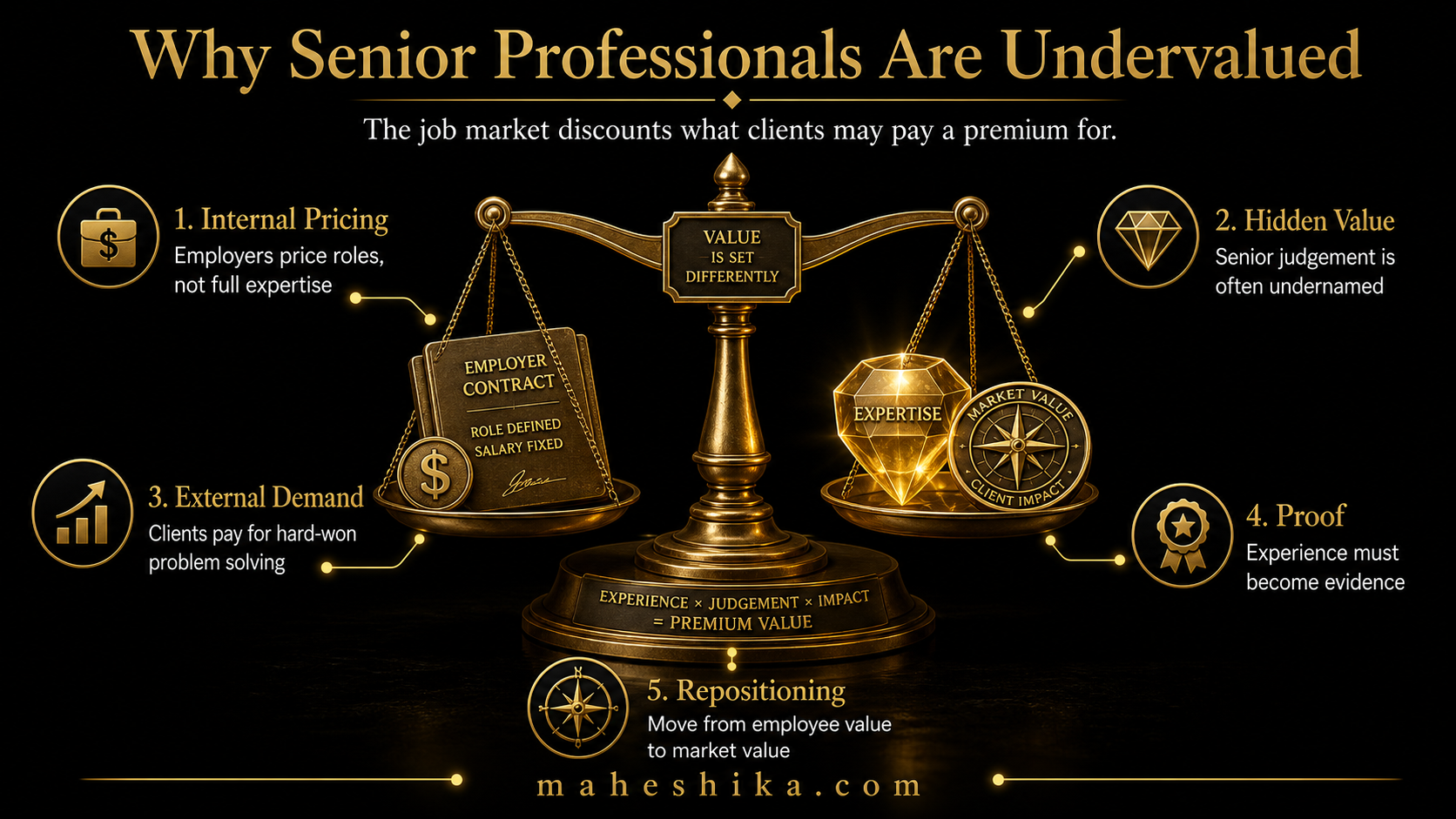
There is a structural mismatch at the heart of the modern employment market, and it is costing senior professionals both money and professional dignity. The corporate job market systematically undervalues experienced professionals in their 40s and 50s, while the independent and advisory market pays a premium for exactly the expertise they have spent their careers building. Understanding this mismatch is not just intellectually interesting. It changes the decisions you make about where to deploy your career.
How the Corporate Job Market Prices Experience
The corporate employment market was designed to value and develop people in the ascending phase of their careers. It has well-established mechanisms for hiring and promoting people from junior to mid-level to senior roles. It is significantly less well-designed for professionals who have reached the ceiling of what the employment structure can offer.
At the senior level, organisations face a fundamental tension. They need the expertise and judgement that comes with 20 years of experience, but they are reluctant to pay the true market price for it. The HR salary band system, the preference for "cultural fit" with younger leadership teams, the reflexive concern about someone being "overqualified": all of these are mechanisms, often unconscious, that systematically discount the value of senior experience.
The result is that a 52-year-old with two decades of board-level commercial experience often finds themselves competing for roles at salary levels that bear no relationship to the value they would actually deliver if hired. Or they simply do not get hired at all, because the organisation opts for a cheaper, less experienced candidate who fits the budget better.
The Independent Market Prices Experience Differently
In the independent market, the pricing mechanism works entirely differently. You are not being compared against a salary band. You are being evaluated against the value of the outcome you will produce. And those two things are rarely related.
A consulting engagement that helps an organisation enter a new market, restructure a commercial function, navigate a complex regulatory transition, or build a strategic partnership ecosystem is worth tens or hundreds of thousands of pounds in value to the client. The consultant who delivers it charges a fraction of that value and earns many times what an employed role would pay for the same expertise.
The independent market also prices scarcity correctly. If you are one of a hundred candidates for a senior employed role, your pricing power is limited. If you are one of five people in the world who understands the specific commercial dynamics of your sector at the level you do, your pricing power is significant.
The Specific Things That Are Undervalued
To be precise about where the undervaluation occurs, it is worth naming the specific assets that the employment market fails to price correctly.
Pattern recognition across business cycles. A professional who has seen multiple market expansions and contractions, who has managed through financial crises, industry disruptions, and organisational transformations, has a form of knowledge that cannot be built in a classroom or in the first ten years of a career. This knowledge is enormously valuable in an advisory context. Employed roles rarely pay for it explicitly.
Network capital. The relationships you have built over 20 years with clients, partners, regulators, investors, and industry leaders are a commercial asset of significant value. Employers benefit from this network but do not typically price it in your salary. Clients who engage you independently do, because they are often buying access to your network as much as your direct expertise.
Accumulated credibility. Your reputation, speaking record, publication history, and public professional profile have a cumulative value that is invisible in employment contexts but highly visible in independent ones. Clients and event organisers who find you independently are already partially sold before the first conversation.
Related Reading
Why This Matters Beyond Salary
The undervaluation of senior professionals in the employment market is not just a financial issue. It is a motivation and meaning issue. When your work is priced below its real value, when your contributions are filtered through institutional structures that dilute your impact, when your seniority is perceived as a constraint rather than an asset, the effect on professional engagement is corrosive.
Many of the most talented professionals I have seen leave corporate roles were not primarily motivated by money. They were motivated by the recognition, or lack of it, that the employment market provided for what they had built. Moving to an independent model, where your pricing reflects your actual value and your impact is direct and measurable, addresses both the financial and the psychological dimensions of that frustration.
Free Tool
Start free: where do you actually stand?
Two free tools give you an honest answer in minutes. The AI Risk Score shows how exposed your role is. The Expertise Ownership Score shows how findable and owned your expertise is.
AI Risk Score Expertise Ownership ScoreWhere Your Value Actually Gets Priced
So the answer to why the market undervalues you is not personal, it is structural. The corporate salary band was never built to price two decades of pattern recognition, network capital, and accumulated credibility. The independent market was. The professionals who close that gap are not the ones who wait for the next review cycle to notice what they are worth. They are the ones who move to where their value is already priced correctly.
But there is a deeper shift underneath that move, and it is easy to miss. Inside a company, your title did the pricing for you. It told the market who you were before anyone had to ask. Take the title away, through redundancy, retirement, or your own choice to leave, and two decades of expertise suddenly has no address. Nowhere anyone can find it, verify it, or price it on your terms.
That is the real exposure now, not just being undervalued, but becoming unfindable. AI can answer almost any question today, in a voice that sounds like everyone else's. The professionals who keep their pricing power are the ones who own a place the algorithm cannot touch: a personal website, under their own name, where their judgement, their record, and their signature are unmistakable. Findable in a search, owned outright, impossible to flatten into a generic answer.
That is the one asset that keeps your expertise priced correctly whether or not you are in the room. If you want to build it properly, let us talk.