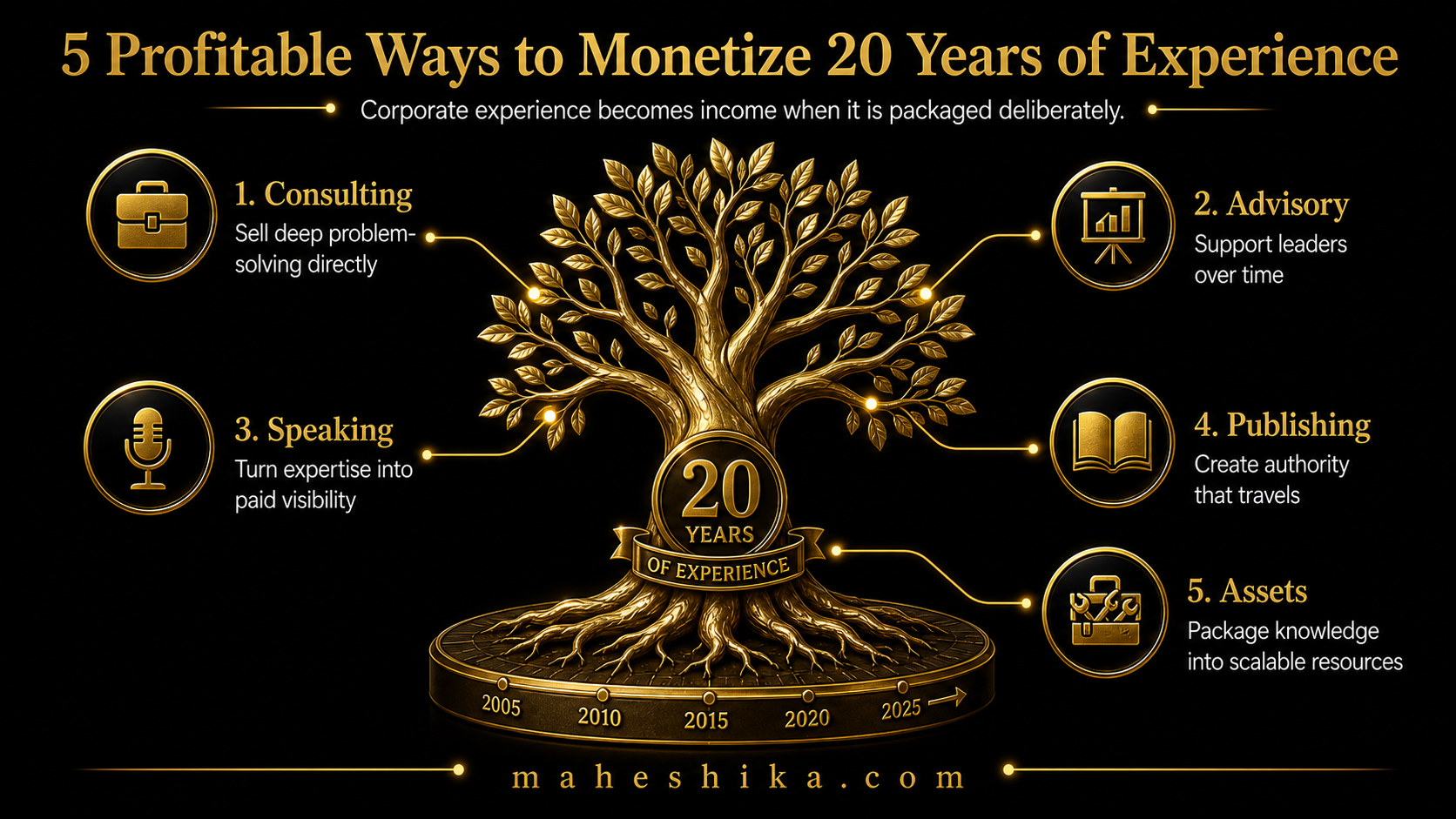
Twenty years of corporate experience is not a single asset. It is a collection of capabilities, relationships, pattern recognition, domain knowledge, and hard-won judgement that can be packaged and sold in several very different ways. The professionals who make the most of it are not the ones who find the one right model and execute it perfectly. They are the ones who understand all the options well enough to build a portfolio of models that reflects their strengths, their preferences, and the genuine needs of their market.
1. Private Consulting: The Highest Rate Per Hour
Private consulting is the most direct translation of corporate expertise into independent income. You take what you know, define the specific problem you solve for a specific type of client, and sell your ability to solve it. The rates for genuinely senior expertise, positioned correctly and delivered to clients for whom the stakes are high, are substantially higher than most people realise when they first make this transition.
The key variable is specificity. The more precisely you can define the problem you solve, the industry you serve, and the outcome you reliably deliver, the more you can charge. A consultant who helps "organisations with strategy" is expensive but comparable to many others. A consultant who helps PE-backed healthcare businesses navigate their first 12 months post-acquisition is rare, and rare expertise commands premium pricing. The discipline of niching down is also the discipline of maximising consulting income.
Private consulting scales poorly in time terms but scales well in rate terms. As your reputation and case studies build, your rates should rise consistently. The ceiling is much higher than most corporate careers ever reach.
2. Advisory Retainers: Predictable High-Value Income
The advisory retainer is where private consulting economics meet recurring revenue logic. Rather than billing per project, you bill a fixed monthly fee for ongoing access to your thinking and availability. Clients who have worked with you on a project, or who have come to you with a known and ongoing need for your perspective, are natural advisory retainer clients.
A portfolio of four to six advisory clients, each paying a monthly retainer appropriate to the value you provide and the level of access they receive, creates a very substantial and stable annual income. The time commitment is typically light compared to full consulting, because the work is reactive and conversational rather than delivery-oriented. You are not producing documents and strategies every month. You are being available when the client needs you, attending relevant meetings, and providing perspective on decisions that matter.
The advisory model also deepens with time. The longer you are in an advisory relationship, the more context you have, the more valuable your contribution, and the harder it becomes for the client to imagine operating without you. Renewal is the natural outcome of a good advisory relationship. This compounding dynamic is one of the most powerful income drivers available to an experienced independent.
Related Reading
3. Speaking: High Impact, High Income, Built on Authority
Professional speaking is one of the most lucrative applications of corporate expertise, and one of the most underused by people who are entirely capable of it. A senior professional with 20 years of experience in a domain that boards and executive teams care about can command substantial speaking fees at conferences, corporate events, and leadership programmes.
The economics are attractive: a keynote speech is typically a 45 to 60 minute commitment for the delivery, with perhaps a day or two of preparation for a new topic. The fee for an established speaker with genuine authority can range from several thousand to tens of thousands per engagement. You can speak at ten to twenty events per year without it dominating your schedule, and the income is significant. The authority-building side effect is equally valuable: speaking at the events where your ideal clients gather is one of the most efficient client acquisition mechanisms available.
Speaking builds on itself. The first paid speaking engagement leads to referrals to other events. A published book accelerates the process dramatically, as does a consistent body of public writing that establishes your point of view before anyone hears you speak. The investment in building a speaking practice is primarily in the beginning, after which the pipeline becomes largely self-sustaining.
Free Tool
Start free: where do you actually stand?
Two free tools give you an honest answer in minutes. The AI Risk Score shows how exposed your role is. The Expertise Ownership Score shows how findable and owned your expertise is.
AI Risk Score Expertise Ownership Score4. Publishing: A Book Changes Everything
Writing a book from your corporate experience is not a vanity project. It is one of the highest-leverage investments an independent expert can make. A book does several things simultaneously that nothing else can replicate: it establishes your authority with buyers who have never met you, it provides a permanent calling card that opens doors across your entire career, and it creates a low-cost entry point into your world for people who are not yet ready to hire you at full rates.
The direct revenue from a book is rarely the primary benefit, though awards and sustained sales can generate meaningful additional income. The indirect benefits are where the real value lies. A published book gets you speaking invitations. It gets you media mentions. It shortens the sales cycle for consulting engagements because the prospect has already engaged with your thinking and built a degree of trust before the first conversation. It makes you referable: it is far easier to recommend someone to a colleague when there is a book you can also recommend.
AI has made the book-writing process significantly more accessible for people who have the expertise but not the time or writing confidence. The bottleneck is no longer production. It is the clarity of the ideas and the discipline of the structure. Both of those come from experience, and you already have that.
5. Digital Products and Courses: Expertise at Scale
The fifth model is the one that most resembles truly passive income, though "passive" is a slight misnomer because the upfront investment in creating excellent content is substantial. An online course, a structured training programme, or a suite of tools and templates built from your expertise can be sold repeatedly without requiring your direct involvement in each sale.
The key is to build digital products that encode the rarest and most valuable part of your expertise, not the generic knowledge that anyone can find online. A course on "leadership fundamentals" from someone with 20 years of senior commercial experience competes with thousands of other products. A course on "how to structure a commercial partnership in a regulated market" from someone who has built them across four continents competes with almost nothing. Specificity is the differentiator here too.
Digital products work best as part of a broader offer stack, not as the primary business model for most senior experts. They provide leverage and passive income on top of consulting and advisory work, not instead of it. But for a professional with genuine, specific expertise, a well-designed course or set of tools represents a meaningful long-term asset.
The One Asset That Makes Every Model Work
So the answer to how you monetise 20 years of corporate experience is not a single model. It is a mix: consulting for direct income, advisory for stability, speaking for authority and reach, publishing for credibility, digital products for leverage. The experts who do this well typically run three of the five at once, and the mix evolves as their reputation grows. The full picture of how to structure this is in the guide at how to turn your expertise into a business.
But every one of those five models depends on something underneath them, and it is the part almost everyone skips. A consulting rate, a retainer, a speaking fee, a book deal, a course launch: each one is priced on how visible and how owned your expertise looks to the person paying for it. Right now most of that visibility rents space you do not control: a LinkedIn feed an algorithm can bury, a corporate bio page that disappears the day you leave, a search result an AI answer can absorb and never credit back to you.
When your entire body of work sits on ground you do not own, five income models can look impressive and still be one platform change away from losing their footing. A personal website under your own name fixes that. Your positioning, your case studies, your book, your speaking reel, your courses, all living somewhere permanent, findable in a search, unmistakably yours whether or not any single platform stays kind to you.
That is what a Signature does, and it is worth building properly rather than assembling piece by piece. If you want to see what that looks like for your specific mix of these five models, let us talk.