There is a structural gap between what you are paid and what you are worth. Not a small one. If you have spent 15 or 20 years developing genuine expertise in a specific domain, your employer is almost certainly capturing far more value from your knowledge than they are returning to you in salary. Understanding why that gap exists, and how it is closing, is the first step to doing something about it.
What the Expert Economy Actually Means
The expert economy refers to the growing market for specialised, experience-based knowledge sold directly by the individual who holds it, rather than through an organisational intermediary. It is not a new phenomenon, but the scale and accessibility have changed dramatically in the past five years.
For most of the 20th century, if an organisation needed expertise, they hired a firm. The firm provided credibility and distribution. The individual expert was bundled inside the firm's brand and billed at rates that reflected the firm's margins as much as the expert's knowledge. The expert received a salary. The firm captured the premium.
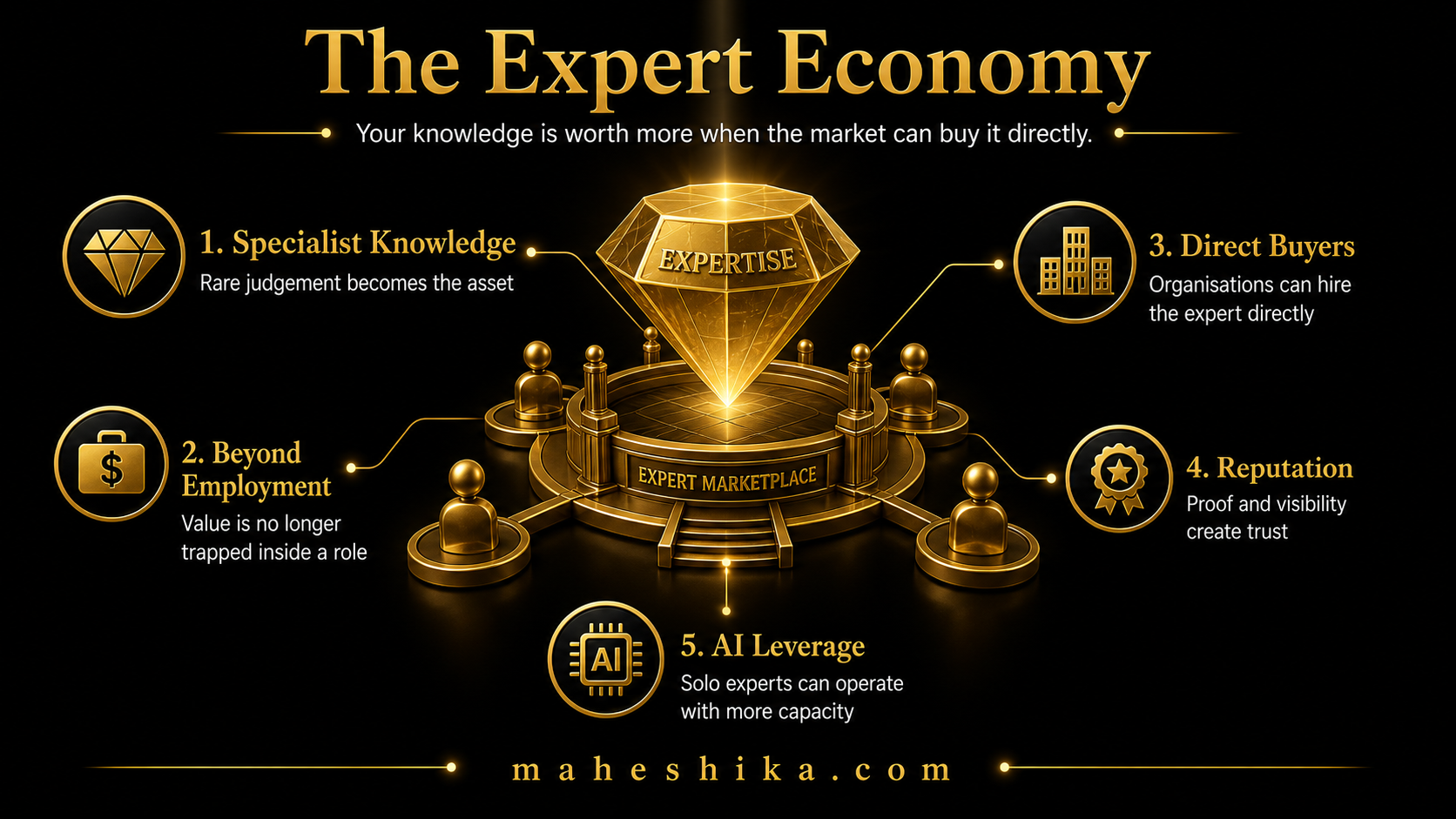
That arrangement is being disrupted from both sides. Buyers are increasingly willing to hire independent experts directly, especially when they can verify a track record through a LinkedIn profile, a published book, or a body of public writing. And experts are increasingly able to operate as solo businesses because the operational tools required to run a professional practice, from invoicing to content production to client management, are now available at minimal cost. AI has accelerated this by removing the last significant barrier: bandwidth. A single expert with the right AI stack can now do what previously required a team.
Why Your Salary Underprices Your Knowledge
Your salary is not a market price for your expertise. It is a negotiated compromise between what you asked for and what your employer was willing to pay, constrained by internal salary bands, HR benchmarking, and the politics of what your peers are earning. None of those factors have anything to do with the actual market value of your knowledge.
Consider what happens when an organisation hires a consultant to do something you have done routinely for a decade. The day rate is almost certainly three to five times your effective daily salary. The consultant is not necessarily more expert than you. They are positioned differently. They are selling a specific outcome rather than selling their time. They are working for a fixed period on a defined problem, which means the buyer is paying for results rather than presence.
The same knowledge, positioned as a service and sold to the right buyer, commands a fundamentally different price. This is not unfair: it reflects the risk the buyer is taking, the specificity of what they are getting, and the clarity of what success looks like. When you are an employee, your employer absorbs that risk and charges the market accordingly. When you are independent, you absorb it and price it accordingly.
What Is Actually Being Sold in the Expert Economy
The expert economy does not reward knowledge in the abstract. It rewards the application of specific knowledge to specific problems that specific buyers urgently need to solve. This is a crucial distinction for experienced professionals making the transition to independence.
You are not selling your CV. You are not selling 20 years of experience as a generalised resource. You are selling your ability to solve a particular category of problem faster, more reliably, and with less risk than an organisation could solve it on its own. The more precisely you can name that problem, and the more clearly you can point to evidence that you have solved it before, the more valuable your offering becomes.
This is why niche specificity matters so much in the expert economy. The professional who can say "I help mid-sized organisations navigate the first two years of a regulated market entry" is far more visible and compelling to the right buyer than the professional who says "I have broad commercial leadership experience across multiple sectors." Both may be equally capable. Only one is easy to hire.
Related Reading
Who Is Already Winning in the Expert Economy
Look at the professionals who have made this transition successfully and you will find a pattern. They are not the most credentialled. They are not the most well-known. They are the ones who made a clear decision about what they specifically offer, who they specifically help, and how they want to be found.
Many come from corporate careers that lasted 15 to 20 years. They left, deliberately or through redundancy, and instead of seeking another senior role, they packaged what they knew into a service, built a visible body of work, and let the market find them. They are working fewer hours, earning more per hour, and doing work that is far more directly connected to the expertise they actually possess.
The ones who struggle are not less capable. They are less clear. They have not made the decision about what problem they solve, so they try to solve all of them, position themselves as generalists, and wonder why the right clients are not coming.
Free Tool
Start free: where do you actually stand?
Two free tools give you an honest answer in minutes. The AI Risk Score shows how exposed your role is. The Expertise Ownership Score shows how findable and owned your expertise is.
AI Risk Score Expertise Ownership ScoreThe Connection to Career Reinvention
The expert economy and career reinvention are not separate topics. For many senior professionals, understanding the expert economy is what makes reinvention feel possible rather than terrifying. When you realise that your knowledge has an independent market value, that you do not need a corporate structure to give it credibility, the question shifts from "what job should I apply for?" to "how do I build something of my own?"
If you are in the middle of that shift, or contemplating it, the Career Reinvention After Corporate Life guide covers the practical and psychological territory in full. The expert economy is the market condition that makes reinvention viable. The specific mechanics of making it happen are what the rest of this series addresses.
The One Move That Closes the Gap
So your knowledge is not a cost centre. It is a product, and the expert economy exists because buyers need what you know and are willing to pay for it at a price that reflects its actual value, not the value constrained by an employer's salary band. The gap between what you earn and what you are worth is real, and it closes the moment you stop routing your expertise through someone else's structure and start owning it yourself.
But here is what most people miss when they hear that. Being bought at market price requires being found at market price, and right now an AI can answer almost any question a buyer might type, in a voice that sounds like everyone else who has ever written about your field. If your 20 years of expertise live only inside a LinkedIn feed or a former employer's website, they are borrowed space. The moment the algorithm changes, the job ends, or the company restructures, that visibility disappears with it, and you are back to being unfindable.
The professionals who actually capture the premium are the ones who own a place the market can find on its own terms: a personal website under their own name, where their thinking lives, their proof of work is shown, and their signature is unmistakable. Not rented, not borrowed, not bundled inside a firm's brand. Owned outright, findable in a search, impossible to flatten into a generic answer. That is what turns "worth more" into "paid more".
You do not have to work out how to build that on your own. If you want to see exactly what it would look like for your expertise, let us talk.