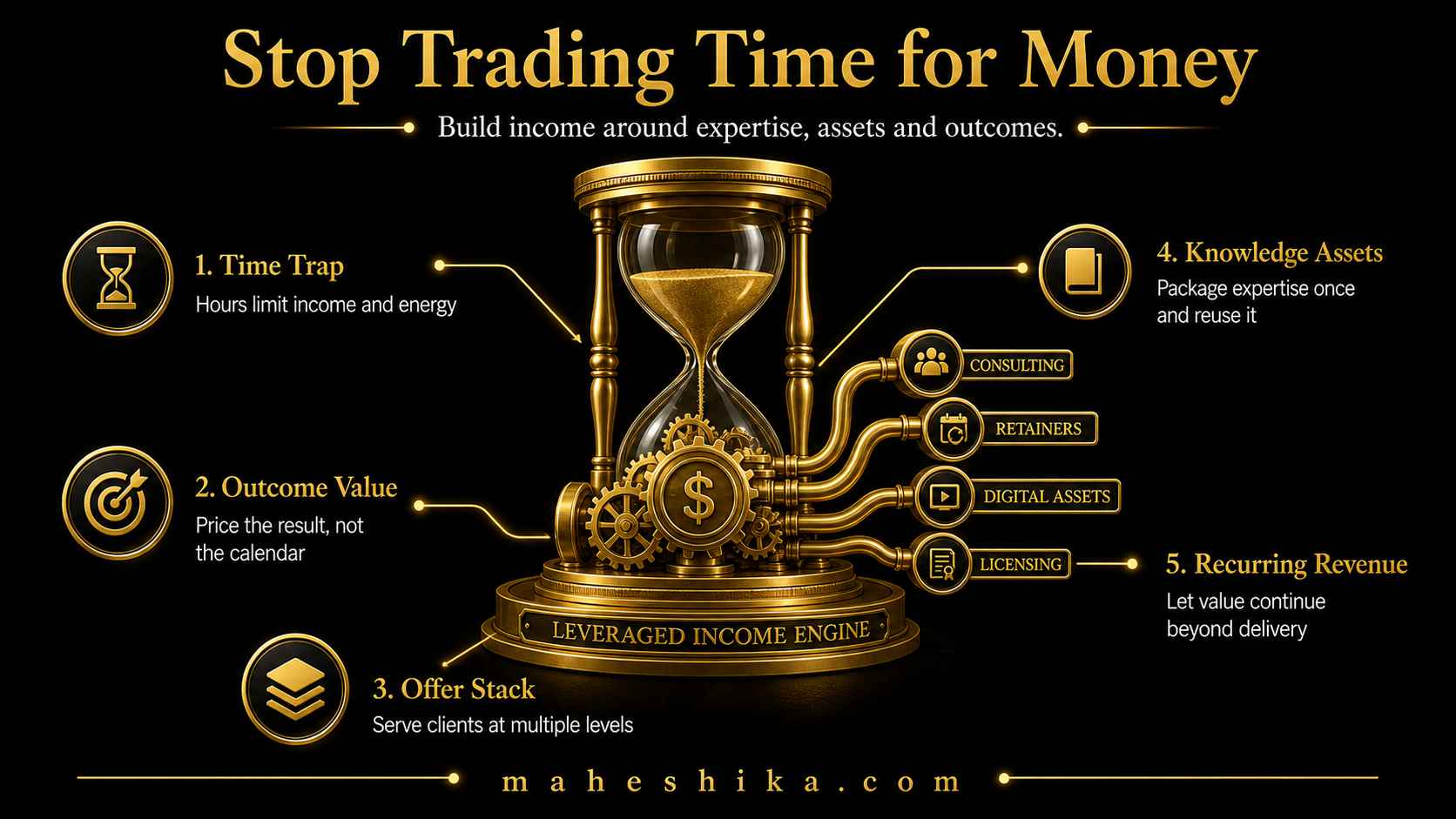
Every independent professional eventually arrives at the same ceiling. They have left corporate life, they are doing good work, they are billing by the hour or by the day, and they have realised that the only way to earn more is to work more. The hours run out before the ambition does. This is the time-for-money trap, and it is not a niche problem for overworked freelancers. It is the default operating model for most people who go independent without intentionally designing something different.
Why Hourly Billing Caps Your Earnings and Your Value
When you bill by the hour, you create a perverse incentive structure. The more efficiently you work, the less you earn. The faster you solve a problem, the smaller the invoice. This punishes the very thing that makes you valuable: your speed, your precision, your ability to cut straight to the solution because you have seen this problem a hundred times before.
It also anchors the buyer's perception of your value to a rate that looks like a salary calculation rather than an outcome calculation. When someone sees a day rate of £1,500, they mentally divide it by eight to get an hourly rate, then compare it to what they or their peers earn per hour. That comparison always makes you look expensive, even if the value you deliver in a single day would take their internal team six weeks to replicate. The comparison is the problem, and hourly billing invites it.
The solution is to stop selling time and start selling outcomes. This shift is not semantic. It requires a different kind of offer, a different kind of conversation, and a different relationship with how your expertise is priced.
The Outcome-Based Model: What It Looks Like in Practice
An outcome-based engagement is defined by what the client will have, know, or be able to do at the end of it, not by how many hours you spend getting them there. You price the engagement based on the value of the outcome to the client and the risk you are absorbing in delivering it.
For a senior expert, this typically means scoping projects around specific deliverables: a market entry strategy, a commercial partnership structure, a leadership development programme, a go-to-market plan. The deliverable has a defined shape, a defined timeline, and a defined price. The client does not know or care how many hours it took you to produce it. They care that it is excellent and that it solves their problem.
The mental shift required is significant. You have to trust that your expertise is genuinely worth the price you are charging, regardless of the hours required. This is uncomfortable at first, particularly if you have spent your career in environments where effort was the metric. But the discomfort is precisely the point: it means you are operating on the basis of value rather than input, which is where real leverage lives.
Related Reading
Productising Your Expertise: Three Models That Work
Beyond project-based consulting, there are three core models for building an expertise-based income that is not directly tied to your hours.
Retainer arrangements. A monthly retainer gives a client ongoing access to your thinking, judgment, and responsiveness for a fixed fee. This is not about promising a number of hours. It is about being available as a trusted resource for a defined type of problem. The client pays for the certainty of access and the peace of mind that comes from knowing you are there when they need you. Retainers are excellent for senior advisors with deep domain expertise, because the client is paying for your brain to be on their team, not just for a discrete deliverable.
Group programmes and workshops. If the problem you solve is one that many organisations face, you can address it at scale through a structured group offering. A one-day intensive workshop for ten organisations commands a fundamentally different economics than ten separate day engagements. You deliver the same value, but the ratio of income to time improves dramatically. Workshops also position you as the authority who teaches the framework, which builds your reputation faster than private work alone.
Productised services. A productised service is a narrowly scoped, fixed-price, fixed-deliverable offering that you can deliver efficiently because you have done it many times. A "90-day market entry strategy" or a "commercial partnership audit" with a defined scope, defined process, and defined output is something a client can buy and understand immediately. The predictability is attractive to buyers, and the repeatability is what creates leverage for you.
Free Tool
Start free: where do you actually stand?
Two free tools give you an honest answer in minutes. The AI Risk Score shows how exposed your role is. The Expertise Ownership Score shows how findable and owned your expertise is.
AI Risk Score Expertise Ownership ScoreThe Role of Intellectual Property in Escaping the Time Trap
The most powerful lever for decoupling income from time is building intellectual property: frameworks, methodologies, tools, courses, and books that encode your expertise in a form that can be sold or used independently of your direct involvement.
A framework is the beginning. When you have a repeatable way of approaching the problems you solve, you can teach it, license it, build a course around it, and use it as the basis for a book. Each of these creates a revenue stream that does not require you to be present for every transaction. The leverage is different in kind, not just degree. A book that sells 2,000 copies is not just about the royalties: it is a client-acquisition system and a credibility asset that works continuously without demanding any of your time.
AI accelerates this significantly. Building a course, writing a book, creating a tool, or producing a series of teaching resources that would previously have taken months can now be done in weeks by a single expert who is clear about their content and competent with the available tools. The bottleneck is no longer production. It is the clarity of thought that only the expert can provide.
Making the Transition Without Losing Revenue
You do not have to abandon time-based work overnight. The practical transition looks like this: continue taking on time-based work while deliberately designing one outcome-based or productised offer alongside it. Run both models simultaneously for a period. As the outcome-based work grows and you get more confident with the pricing, gradually reduce your dependence on day-rate work. Within 12 to 18 months, most people who approach this deliberately have moved to a majority outcome-based income.
The key is not to wait until the time-based work dries up before building the alternative. That creates urgency in the wrong direction. Build the new model from a position of relative stability, and it will arrive faster than you expect.
The Asset That Makes the New Model Real
The answer to the time-for-money trap is not a single clever tactic. It is a deliberate stack: price outcomes instead of hours, build one retainer or productised offer alongside the work you already do, and let a piece of intellectual property carry your name into rooms you are not in. Run the old and new model side by side, and within 12 to 18 months the majority of your income is priced on value, not on the clock.
None of it works, though, if a client cannot find you when it matters. Every offer in that stack depends on someone searching for the exact problem you solve and landing on you, not a summary of you. And right now AI answers that search first, in a voice that sounds like every other expert's thinking blended into one. Your framework, your track record, your particular way of solving this: none of it survives being flattened into a generic answer unless it lives somewhere that is unmistakably yours.
That is the real cost of staying invisible. Not one lost client, but quietly ceasing to be the answer at all. A personal website under your own name is where your outcome-based offers live, where your IP is shown as yours, and where the client who searches for you finds you. It is the one asset in this whole shift that keeps working, and keeps you visible, whether or not you are in the room.
You do not have to build that alongside everything else on your own. If you want it done properly, by someone who has made this exact shift, let us talk.