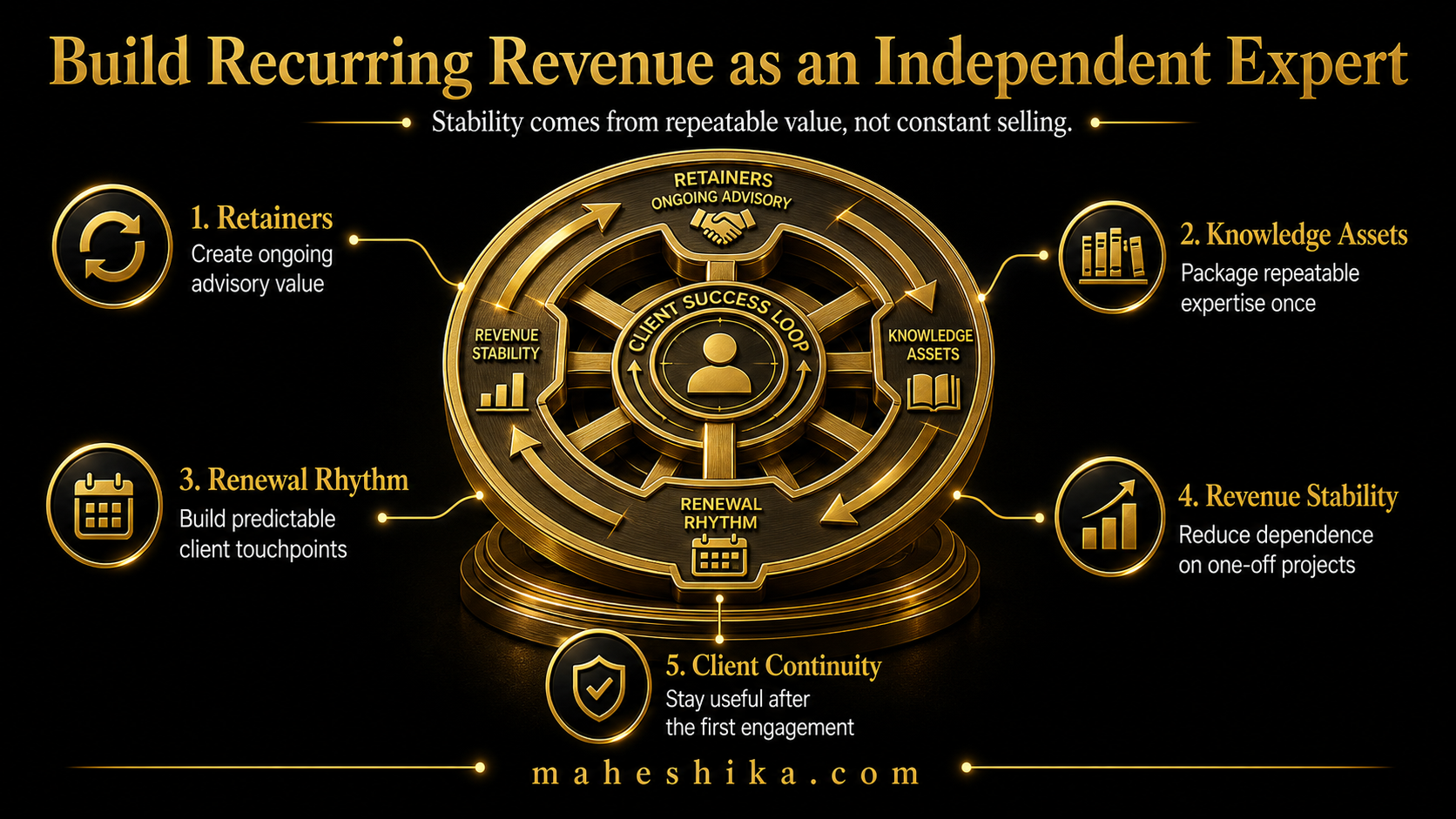
The hardest part of going independent is not the first client. It is the income volatility that follows: a strong month, a slow month, a strong quarter, a gap. Project-based income swings. The pipeline fills and empties. For someone who has come from the predictability of a monthly salary, this is destabilising in a way that has nothing to do with capability and everything to do with structure. Recurring revenue is how you solve it.
Why Recurring Revenue Changes Everything
When a meaningful portion of your income renews automatically each month, the psychology of running your business changes completely. You are no longer asking "where is next month's income coming from?" You are asking "how do I continue delivering excellent work to the clients I already have, and what opportunities do I want to add to this stable base?"
The practical benefits are equally significant. With predictable revenue as your floor, you can make better decisions about what new work to take on: you can afford to be selective rather than accepting everything. You can invest time in longer-term activities like writing, speaking, and product development that build the business without generating immediate income. You can plan your own finances with confidence. Recurring revenue is not just a financial structure. It is a foundation for building something deliberately rather than reactively.
The Advisory Retainer: the Most Natural Recurring Model for Senior Experts
The advisory retainer is the most natural recurring revenue model for experienced professionals with deep domain expertise. It works like this: a client pays you a fixed monthly fee in exchange for ongoing access to your thinking, your availability for regular conversations, and your presence in relevant decisions. You are not delivering a defined project. You are being a trusted resource that the client can call on consistently.
The economics of advisory retainers are attractive. A senior expert with genuine authority in a domain can build a portfolio of four to six advisory clients, each paying a monthly fee that reflects the value of what they are accessing. The time commitment per client is typically one to two sessions per month plus availability for ad-hoc questions. The income compounds as client relationships deepen and referrals come from satisfied clients. Retainers also tend to renew, unlike projects, which creates the baseline stability the business needs.
The key to selling an advisory retainer is being very clear about what the client gets. Not hours. Not deliverables. Access to your thinking on a defined category of challenge, with defined touchpoints and defined responsiveness. The more clearly you can describe what good looks like in this relationship, the easier it is for the right client to say yes.
Related Reading
The Subscription Model for Knowledge Products
If you have built intellectual property that others find consistently valuable, there is an opportunity to create a lower-priced subscription that provides ongoing access to it. This might be a membership community where you share insights and frameworks monthly, a regular private briefing or analysis on developments in your domain, or a structured peer-learning group that you facilitate.
These models work best when there is genuine ongoing need for the content, not just initial curiosity. The domain needs to be one where things change, where there is always new application to consider, and where the community or content remains fresh. Subscription models require more active curation and community management than advisory retainers, but they can serve many clients simultaneously and provide a meaningful recurring revenue stream alongside higher-touch engagements.
Free Tool
Start free: where do you actually stand?
Two free tools give you an honest answer in minutes. The AI Risk Score shows how exposed your role is. The Expertise Ownership Score shows how findable and owned your expertise is.
AI Risk Score Expertise Ownership ScoreConverting Project Clients to Recurring Clients
The most natural path to recurring revenue is through your existing project clients. You have done the work of finding them, building trust, and delivering value. The question at the end of a project engagement is always: what happens next?
Do not wait for the client to ask. At the end of every project engagement, proactively present an ongoing option. Frame it specifically: given what we have built together, there are decisions ahead where my perspective will add value. An advisory arrangement at a monthly retainer makes sense as the next step. Many project clients, particularly those who have experienced the quality of your work directly, will be receptive to this. They know what they are getting. The transition from project to retainer is far easier to make than winning a new client from scratch.
The recurring revenue base builds gradually in this way: each successful project becomes a potential ongoing relationship. Over 18 to 24 months, the compounding effect of retaining even a fraction of project clients on advisory arrangements can transform the financial stability of the business entirely.
The Asset Underneath the Retainer
So the answer to income volatility is not luck, it is design. Convert your best project clients into retainers, price for access to your thinking rather than for hours, and add a lower-priced subscription if your knowledge has genuine ongoing relevance. Start with one retainer client, prove the model, and let the base grow from there. That is how the income that replaces a corporate salary gets built, deliberately, one renewing relationship at a time.
But even a full retainer book has a quiet vulnerability. Every one of those relationships lives in a client's memory, a referral, a WhatsApp thread. Nothing about it is visible to the next prospective client who has never met you, and nothing about it survives if the person who introduced you moves on. Your expertise is real and your income is stable, yet your authority has nowhere permanent to stand.
That gap matters more each year, not less. AI can now answer almost any question in a voice that sounds like everyone else's, and a retainer, unlike a title, is not something a search engine or a stranger can find. The professionals who keep their place in this market are the ones who own a space of their own: a personal website under their own name, where the thinking behind the retainers lives, the work is shown, and the signature is unmistakable. Findable, owned outright, impossible to mistake for a generic answer.
You do not have to build that asset alone, and you do not have to leave it for later while the retainers keep you busy. If you want it done properly, let us talk.