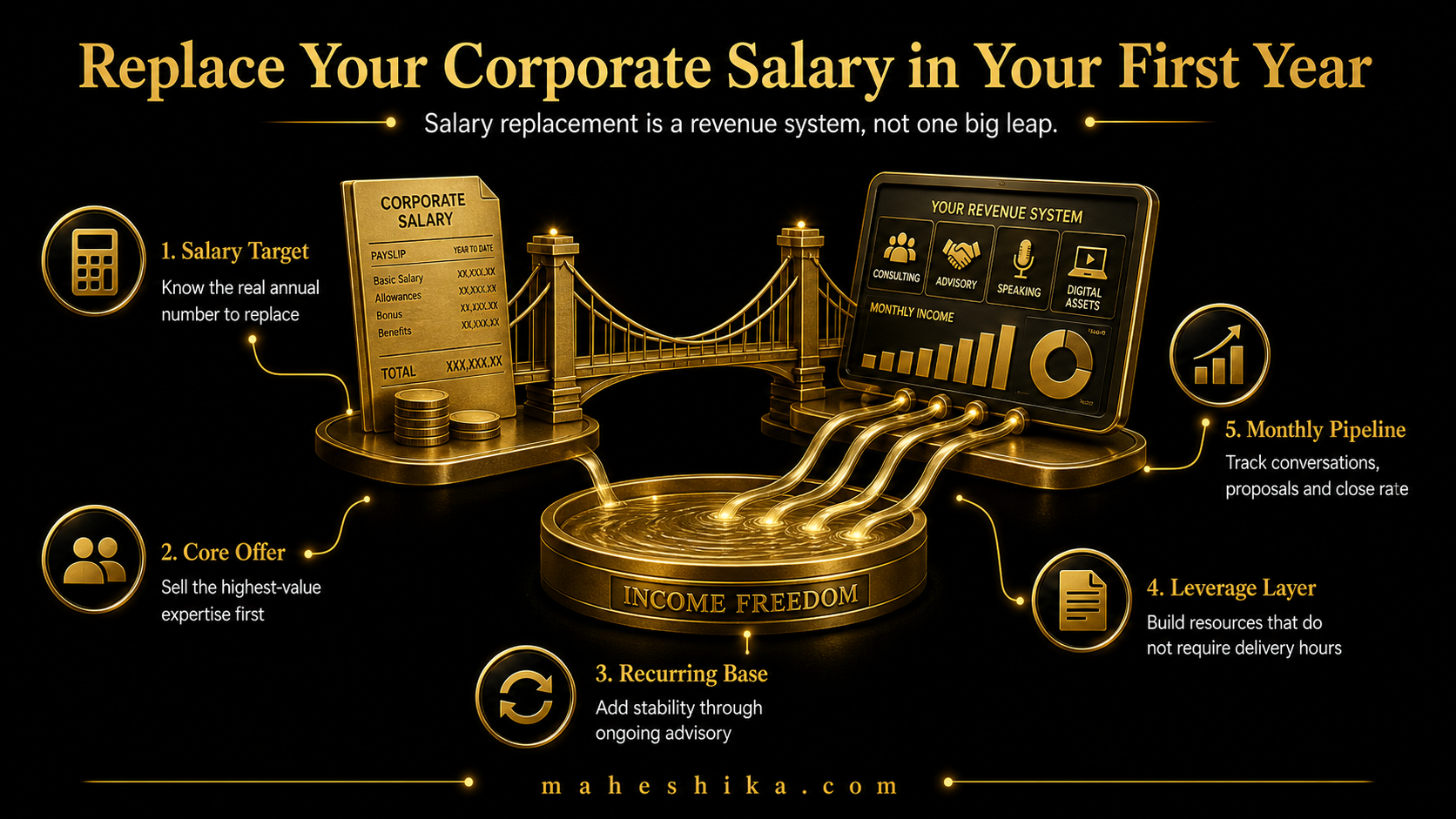
The most common question I hear from senior professionals considering independence is not about strategy or positioning or which clients to target. It is: "Will I be able to replace what I earn now?" It is a fair question. It deserves a direct answer, not a motivational speech.
Year one as an independent expert is not a mystery. It is arithmetic, sequencing, and nerve. Here is the framework I use with every professional I work with, drawn from experience building commercial ecosystems and then building an independent practice from scratch.
Start with the real number, not the salary headline
Your corporate salary is not your true cost of living. It is your gross figure before tax, pension contributions, and benefits. Before you calculate your replacement target, work out your actual net take-home and identify which benefits matter: health cover, life insurance, pension contributions, car allowance. Some of these disappear when you leave. Factor their cost into your independent pricing, not your expenses.
The number you need to replace is your net income plus the cost of benefits you will now self-fund. For most senior professionals, this sits between 60% and 75% of gross salary. That is your year-one target. Write it down. Everything else flows from this single figure.
Price for the value you deliver, not the day rate you were paid
This is where most experienced professionals undercharge themselves into poverty. They take their annual salary, divide it by 220 working days, and offer that as their day rate. It is the wrong calculation entirely.
You are not an employee who needs to fill 220 days. You are an expert delivering concentrated, high-value outcomes. A client does not pay you for your time. They pay you to solve a problem that costs them significantly more than your fee. Price accordingly.
A realistic starting point for a senior professional with 15 or more years of experience is a day rate that generates your full annual income target in 80 to 100 client days. That leaves you 120 days for business development, writing, speaking, and building scalable assets. The mathematics work if you price correctly from the start.
For project-based engagements, anchor your price on outcomes. A commercial strategy engagement that helps a client unlock a new market is worth a fraction of the value created. Start there, not from your hourly rate.
Sequence your income streams deliberately
Year one is not the time to build five revenue streams simultaneously. It is the time to build one well, validate it, and then layer. The sequence that works consistently for experts coming out of senior corporate roles is as follows.
First: advisory and consulting work. This is your fastest path to revenue because it draws directly on what you know, and your network already trusts you. One or two retainer clients in the first six months can cover the majority of your year-one target.
Second: speaking and workshops. Once you have two or three client engagements to reference, speaking fees become attainable. Speaking also generates consulting enquiries. The two feed each other.
Third: productised offerings. A defined programme, a workshop package, an assessment tool. These take longer to build and sell, but they reduce the time-per-pound ratio significantly. Start designing these in months four to six so they are ready to sell in months seven to twelve.
Related Reading
Build your pipeline before you need it
The single biggest mistake senior professionals make is waiting until they are independent to start building their pipeline. By then, they are under financial pressure, and pressure makes you price poorly and accept the wrong clients.
Your network is your pipeline, and it is already warm. You have spent 15 or 20 years building relationships with people who respect your judgement. Many of them are already decision-makers at organisations that need what you know. Start having conversations now: "I am planning a transition to independent consulting in the next few months and I wanted to get your perspective on where you see the biggest challenges in your business right now." This is not selling. It is research. But it surfaces opportunities, and it means that by the time you leave your role, you have two or three people who are mentally ready to engage you.
Free Tool
Start free: where do you actually stand?
Two free tools give you an honest answer in minutes. The AI Risk Score shows how exposed your role is. The Expertise Ownership Score shows how findable and owned your expertise is.
AI Risk Score Expertise Ownership ScoreTrack three numbers every week
Year one demands financial discipline that is different from anything you have experienced as an employee. You do not have payroll giving you certainty on the 25th of each month. You have pipeline, proposals, and receivables. Track three numbers each week without fail.
Pipeline value: the total value of all active proposals and conversations. Keep this at least three times your monthly revenue target, because most opportunities take longer to close than expected and not all will convert.
Confirmed revenue: signed engagements only. This is your certainty number. It should cover your essential outgoings at minimum by month three.
Cash in the bank: independent work is often invoiced on completion or in stages. Clients delay payment. You need at least three months of runway in the account at all times to avoid making decisions from panic.
The income replacement arithmetic in practice
Let me make this concrete. Suppose your net income target for year one is £120,000. You need two retainer clients at £5,000 per month each, plus four project engagements at £15,000 each. That is £120,000 in signed revenue from six clients. Six clients, across twelve months, from a network you have spent two decades building. It is achievable. It requires focus, not luck.
Most senior professionals who fail to hit their income target in year one make one of two errors: they price too low because they are afraid of rejection, or they take any work offered because it feels safer than being selective. Both errors are expensive. Low pricing attracts clients who do not value you and drains your time. Non-strategic work fills your calendar with the wrong problems and keeps you from finding the right clients.
Know your number. Price for your value. Build your pipeline before you leave. Sequence your income streams. Track three numbers weekly. This is the architecture of year one. It is not glamorous, but it works.
The One Asset That Makes the Arithmetic Work
So yes, you can replace your salary in year one, and it will not happen by accident. It happens through the arithmetic above: know your real number, price for the value you create rather than the day rate you used to earn, sequence advisory work before you build anything else, and track pipeline, confirmed revenue and cash every single week. The professionals who hit their number are not the boldest or the most connected. They are the ones who treat their first year as a business to be run, not a leap of faith to survive.
But there is a second risk hiding underneath the income question, one most people only see after they have already left. The moment you step outside the company, you lose the thing that made you findable: the title on the door, the logo on your email signature, the org chart that told clients who you were before you said a word. Twenty years of judgement and results suddenly live nowhere anyone can search for them, right as AI starts answering questions in a voice that sounds like everyone else's.
Clients paying a premium day rate are not comparing generic answers. They are choosing a specific person they already trust, and that trust needs a place to live. A website under your own name, holding your thinking, your results and your voice, owned outright and impossible to mistake for anyone else. That is not a nice extra once the retainers start coming in. It is the asset that makes the retainers possible, because it keeps working for you between the conversations, long after any one client relationship ends.
You have already done the hardest part: building the expertise that took twenty years to earn. If you want help putting it somewhere the right clients can actually find it, let us talk.