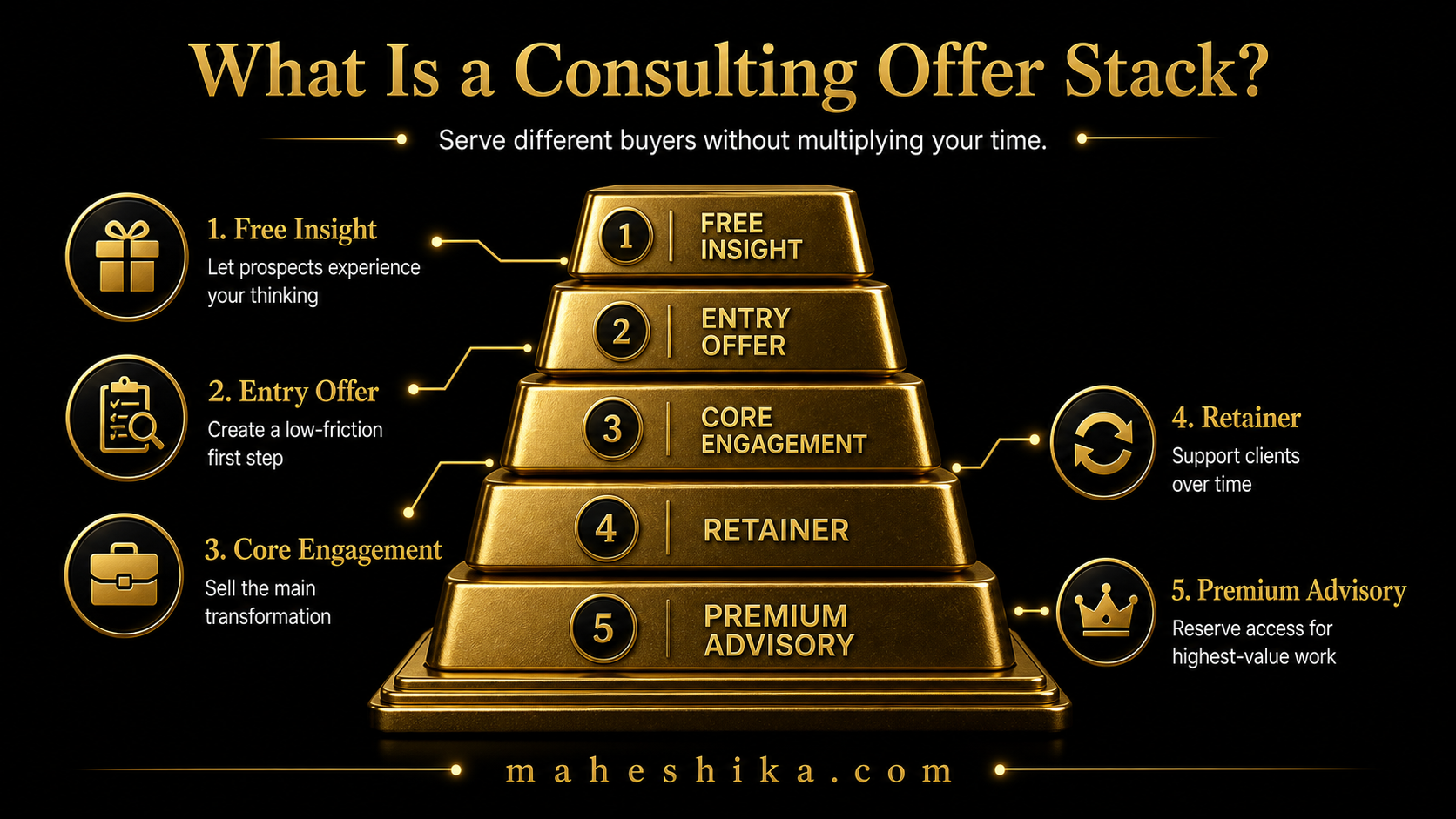
Most independent consultants start with one offer. It is usually some version of "here is what I do, here is my day rate." This works initially, but it creates a business with a single mode of operation, a single price point, and no way to serve clients who are not yet ready for the full engagement. An offer stack changes this. It is the difference between a vending machine with one item and a structured menu that serves every buyer, regardless of where they are in the decision-making process.
What an Offer Stack Is
An offer stack is a tiered set of offerings from the same expert, addressing the same domain, at different levels of access, investment, and intimacy. The top tier is your highest-touch, highest-price work, typically private consulting or advisory. Below it sits a mid-tier offering with somewhat less direct access but still significant value. Below that sits an accessible entry point: a workshop, a course, a book, or a diagnostic that gives the buyer a taste of your thinking without requiring a large commitment.
The stack is not designed to funnel everyone up to the top tier. It is designed to ensure that every type of buyer who encounters your work can engage with it at the level that is appropriate for them right now. The startup founder who cannot yet afford your retainer can buy your course, apply your frameworks, get results, and come back when they are ready for the full engagement. The corporate buyer who wants to trial your thinking before committing to a long engagement can start with a workshop. The stack creates multiple entry points and multiple revenue streams from a single body of expertise.
The Three Tiers in Practice
Tier One: High-touch private work. This is your premium offering. Private consulting, retained advisory, or a bespoke project engagement. Typically the highest price you charge, the smallest number of clients you work with simultaneously, and the work that requires the most of your attention and judgement. This is where the value of your specific experience commands a premium. Limit this tier deliberately: scarcity is not artificial when you are genuinely protecting the quality and focus you can bring to each client.
Tier Two: Structured group or productised work. A programme, a workshop series, a cohort-based offering, or a well-defined project with a repeatable process. The client gets significant access to your expertise but not exclusive, unlimited access. You can serve multiple clients simultaneously because the engagement has a defined shape. This tier is often where the best unit economics live: good revenue per client, manageable time investment per client, and enough volume to provide business stability.
Tier Three: Accessible entry products. A book, an online course, a masterclass, a diagnostic tool, or a paid community. These require your expertise to create but minimal ongoing time to deliver. They allow people who cannot afford higher tiers, or who are not yet ready to commit to them, to begin benefiting from your knowledge. They also function as a continuous trust-building and pipeline-development mechanism. People who engage with your tier-three work and find it valuable are the most qualified prospects for tier two and tier one.
Related Reading
How to Build Your Stack From Scratch
Begin from the top down, not the bottom up. The mistake many experts make is building a course first because it feels lower-risk. You spend three months creating something without yet knowing if the audience wants it or will pay for it, and you have no income during that period.
Start instead with your premium private offer. Define what it looks like, who it is for, and what the outcome is. Get your first two or three clients at that level, do excellent work, and gather case studies and testimonials. Only then begin developing your mid-tier offering, based on what you now know about the problems your clients actually have. The tier-three product comes last, once you have enough testimonials and case studies to validate that it will resonate and enough authority to make it worth a buyer's investment.
Building in this sequence also ensures that your lower-tier products are informed by real client experience rather than assumptions. The questions people ask in your private work become the structure of your course. The recurring challenges across multiple clients become the curriculum for your workshop. The advice you find yourself giving most consistently becomes the book. The stack builds itself from the evidence of real engagements.
Free Tool
Start free: where do you actually stand?
Two free tools give you an honest answer in minutes. The AI Risk Score shows how exposed your role is. The Expertise Ownership Score shows how findable and owned your expertise is.
AI Risk Score Expertise Ownership ScoreCommon Mistakes When Building an Offer Stack
The most common error is building too many tiers too quickly. Three well-designed tiers, each with a clear purpose and a clear buyer, is more effective than six vaguely defined offerings that confuse both you and the prospect. Clarity is more important than comprehensiveness.
The second common error is pricing the tiers incorrectly. The price gap between tiers should be significant, not marginal. If your retainer is £3,000 per month and your course is £2,500, the buyer will almost always choose the course because the gap seems small relative to the difference in access. The course should be priced to reflect its lower-touch nature: perhaps £500 to £1,500. The premium of the higher tier needs to be obvious and justified by the depth of access it provides.
The third error is treating the stack as a fixed structure. Your offer stack should evolve as you learn what your clients value most. The tier that gets the most traction tells you where your highest-leverage work is. The tier that never sells tells you that either the pricing is wrong, the positioning is unclear, or there is no genuine demand for that format from your particular audience.
The Tier Your Stack Is Built On
So the answer is this: an offer stack is not a pricing trick, it is a structure. One body of expertise, offered at three honest levels of access, built top-down from real client evidence rather than guesswork. Get the sequence right and you turn a single-service consultancy into a business with multiple revenue streams and a natural path from first contact to deepest engagement, without adding a single hour to your week.
But every tier in that stack rests on one thing that has nothing to do with pricing: whether people can find you at all. AI now answers most questions in a voice that sounds like everyone else's, and a job title or a former employer can vanish overnight, taking your visibility with it. Your tier-three product, your workshop, your private retainer, none of it converts if the person searching for exactly what you know cannot find you and cannot tell, in thirty seconds, why you are the one to trust.
That is what a home does that a stack alone cannot. A personal website under your own name, where your thinking lives, your offers are shown in full, and your signature is unmistakable. Owned outright, findable in a search, impossible to mistake for a generic answer. It is the asset that makes every tier above it actually sellable.
You do not have to design that home alone, and you do not have to wait until the stack is finished to start. If you want it built properly, let us talk.