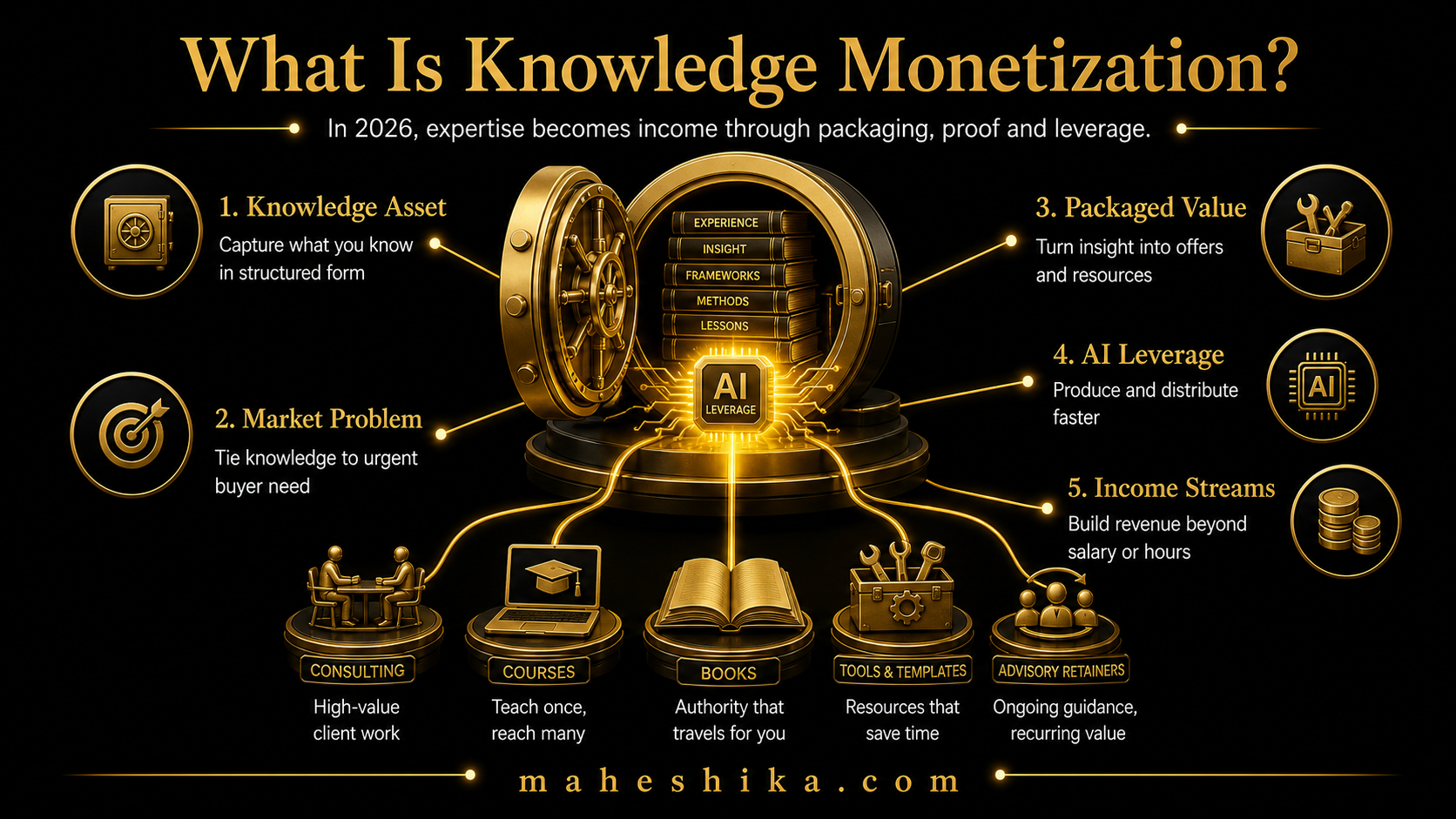
Knowledge monetisation is not a new concept. People have been paid for what they know, in various forms, for as long as there have been markets for expertise. What has changed, and changed substantially over the past several years, is the infrastructure, the accessibility, and the economics. If you understood knowledge monetisation five years ago and have not revisited your understanding since, you are working with an outdated map.
The Basic Definition and Why It Matters
Knowledge monetisation is the process of converting specialised knowledge into income. It encompasses everything from a consultant charging for strategic advice, to an author receiving royalties, to a speaker earning fees for sharing their perspective, to a teacher selling a course online. The common thread is that the value being exchanged is primarily cognitive rather than physical or mechanical.
For senior professionals, knowledge monetisation is relevant because it represents a fundamentally different relationship with income than employment does. As an employee, you monetise your knowledge indirectly: you apply it within the organisation, the organisation captures the value it creates, and you receive a salary that is a negotiated approximation of what that contribution is worth. As an independent, you monetise your knowledge directly: you define the problem you solve, find the buyer who has it, and price the solution based on its value to them.
The shift from indirect to direct monetisation is the core of what going independent means. Everything else, the offer, the positioning, the platform, the pricing, is just the specific mechanism through which that shift is executed.
What Has Changed in the Last Five Years
Three shifts have materially changed the knowledge monetisation landscape, and all three compound to make independent knowledge businesses more viable than they have ever been.
The first is the collapse of distribution costs. Creating and distributing high-quality content, whether written, video, audio, or interactive, has become essentially free in marginal terms. A senior expert who would previously have needed a publisher, a production company, or a large marketing budget to reach a meaningful audience can now publish directly, build an audience on owned and platform-based channels, and be found by the right buyers without intermediaries. The cost of being visible has approached zero. The cost of being ignored has not changed.
The second shift is the growth of buyer sophistication and willingness to engage directly with independent experts. Organisations that previously required the comfort of a well-known consultancy name to justify a purchase are increasingly comfortable engaging directly with credible independents. This has happened partly because the independents themselves have become more credible through their own publishing and profile-building, and partly because organisations have had enough experience with consultancies to know that the name on the door does not guarantee the quality of the person in the room. They have learned to evaluate the individual.
Related Reading
The Role of AI in 2026
The third and most significant shift is AI. This warrants specific attention because it has changed the economics of knowledge monetisation in ways that are still being absorbed by most of the market.
AI has done two things that are in apparent tension with each other. On one hand, it has automated the production of generic knowledge content. The kind of general advice, standard frameworks, and surface-level analysis that used to require a junior consultant or a decent content team can now be generated in seconds. This has reduced the value of generic knowledge significantly. If your offering is essentially something that a capable AI prompt could replicate, you are in a difficult market position.
On the other hand, AI has created enormous leverage for experts with genuine, specific, hard-won knowledge. The expert who can direct AI tools to express, structure, and distribute their deep domain expertise, which the AI cannot generate on its own, now has the production capacity of a team without the cost of a team. I build in a day what would have taken months without these tools. The expert's time is concentrated on the judgment and insight that only humans with genuine experience can provide. The production and distribution work is largely handled by AI. This is an extraordinary amplification of leverage for the right kind of expert.
The implication is clear: the market for generic knowledge has been compressed by AI. The market for genuine, specific, experienced expertise has been amplified by it. The senior professional with 20 years of real domain experience is in a better position in the knowledge economy of 2026 than at any previous point.
Free Tool
Start free: where do you actually stand?
Two free tools give you an honest answer in minutes. The AI Risk Score shows how exposed your role is. The Expertise Ownership Score shows how findable and owned your expertise is.
AI Risk Score Expertise Ownership ScoreWhat Has Not Changed
Amid all of this, certain things about knowledge monetisation remain constant and are worth naming explicitly, because they tend to get lost in the enthusiasm about new tools and platforms.
Buyers still need to trust you before they will pay for your knowledge. Trust is built through demonstrated expertise, consistent behaviour over time, and a track record of delivering what you promise. No platform, AI tool, or distribution mechanism changes this. The mechanics of getting seen have changed. The mechanics of being trusted have not.
Specificity still beats breadth in every knowledge market at every price point. The narrower and more precise your expertise, the more valuable you are to the right buyer. The more broadly you position, the less visible you are to anyone specific. This was true in 2006, it was true in 2016, and it is true in 2026. The platforms and tools change. The underlying logic of how buyers find and hire expertise does not.
The One Asset AI Cannot Generate for You
So here is the answer: knowledge monetisation in 2026 rewards ownership, not access. The professionals doing best right now are not the ones with the cleverest AI prompts or the biggest platform following. They are the ones who own the direct relationship with their buyer, under their own name, with nothing rented from an employer, an agency, or an algorithm.
There is a realisation sitting underneath that answer, and it is worth naming plainly. AI can now produce a plausible answer to almost any question, in a tone that sounds like everyone else who typed the same prompt. That is precisely what happened to generic knowledge: it became free, then it became invisible. What AI cannot manufacture is twenty years of judgement, a name a buyer already trusts, or a body of work only you could have produced. But none of that protects you on its own. If your expertise lives only inside an employer's systems, or only in your head, it is not doing its job.
That is the quiet risk hiding in this shift. Not that AI replaces you, but that you stay unfindable while it answers every question in your place, in a voice indistinguishable from everyone else's. The professionals who keep their place are the ones who have somewhere of their own: a personal website under their own name, where their thinking lives, their work is shown, and their signature is unmistakable. Owned outright, findable in a search, impossible to reduce to a generic answer.
You do not have to build that alone, and you do not have to wait until the risk feels urgent. If you want to talk through what your specific expertise is worth as an owned, independent asset, let us have a conversation.