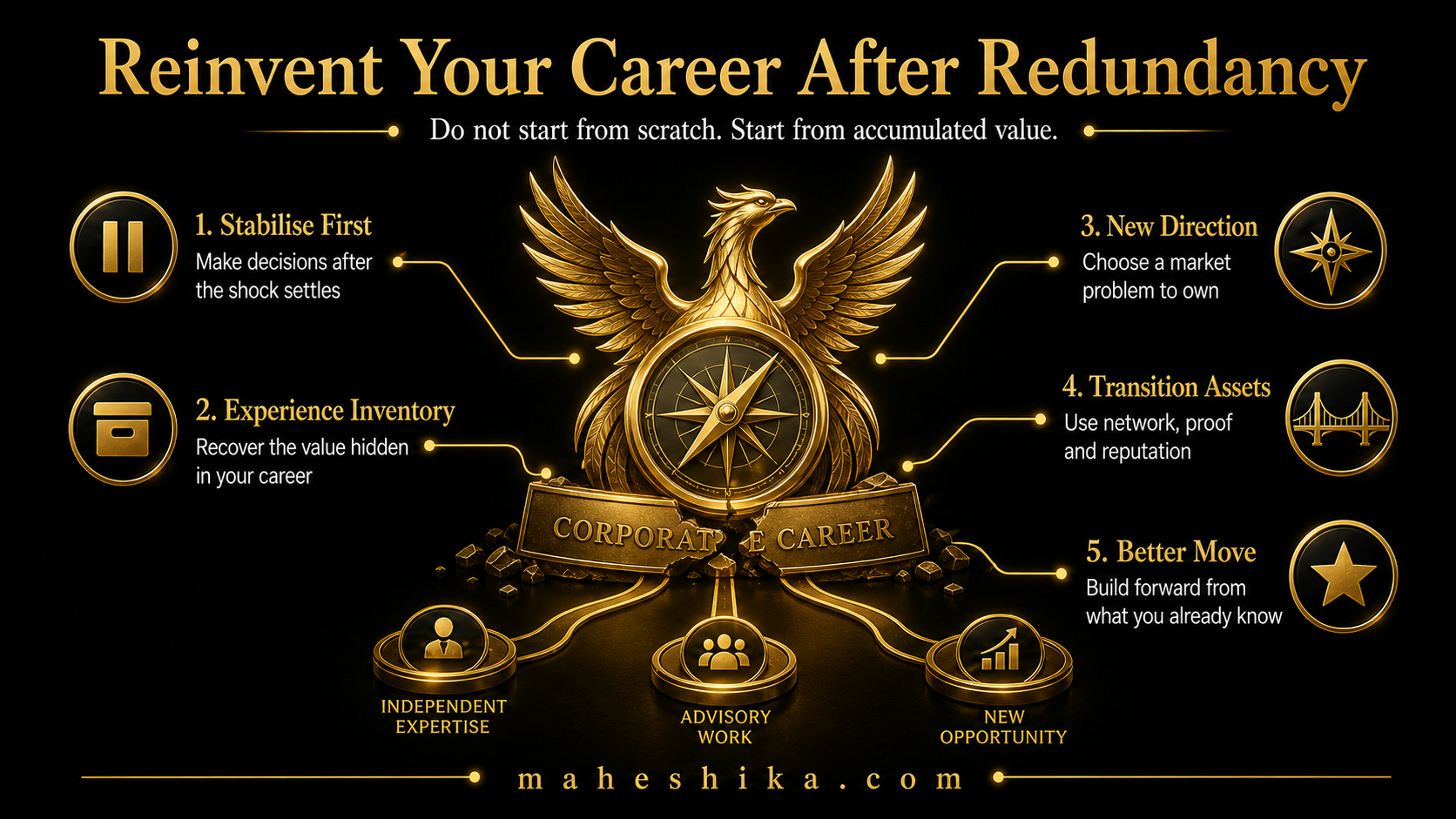
The word "reinvention" is often used in ways that imply you are abandoning what you were and becoming something entirely new. For senior professionals after redundancy, that framing is both inaccurate and unhelpful. You are not starting from scratch. You are repackaging what you have built across a career into a form that serves a new context, on better terms. The question is not "what do I become?" but "how do I deploy what I already am, more effectively?"
The Repackaging Mindset
Reinvention after redundancy is a repackaging exercise. The raw material: your knowledge, your methods, your judgement, your network, your reputation, is already there. What changes is the container: the title, the employment relationship, the institutional context, the way you present and price what you offer.
This distinction matters because it removes the false urgency of "figuring out who you are now." You know who you are. You have 15 or 20 years of evidence. The work is translating that into a form the independent market can recognise and pay for, rather than presenting it in the format an HR department expects.
Most professionals who have been through this transition describe a moment of clarity when they realise they were doing the same substantive work before and after the transition. They were solving the same kinds of problems, using the same expertise, producing similar results. What changed was the structure around it, and significantly, the price.
What to Keep, What to Leave Behind
Not everything from your corporate career is worth carrying forward. Being deliberate about what you keep and what you leave behind is one of the most useful exercises in the early stages of reinvention.
Keep: your domain expertise and the specific problems you are best at solving; the professional relationships with people who respect your work; the body of results and case studies that demonstrate what you can produce; the frameworks and mental models you have developed; your professional reputation and credibility.
Consider leaving behind: the corporate identity that comes with a title; the assumption that you need institutional backing to be taken seriously; the habit of selling your time rather than your outcomes; the reflex to minimise your pricing to fit within budget structures you no longer need to work within.
One of the most liberating realisations of the transition is that much of what felt like professional identity in a corporate context was actually structural. The status, the authority, the credibility, much of it came from the organisation's name rather than from you personally. But the substantive expertise, the real intellectual and commercial value, that came entirely from you. And you take it with you.
The Three Layers of Career Capital
Your career capital operates on three levels, and understanding each helps you work out where your reinvention should focus.
Layer one: Specific expertise. The domain knowledge, skills, and methodologies you have developed through practice over time. This is the most directly monetisable layer. It is what clients pay you for.
Layer two: Systemic knowledge. How large organisations work, how decisions get made, where projects get stuck and why, how to navigate commercial complexity. This layer is less visible than your technical expertise but often equally valuable to clients who are trying to achieve things in those environments.
Layer three: Relational capital. The network of people who know you, trust your judgement, and are in a position to hire you, refer you, or collaborate with you. This layer takes decades to build and cannot be shortcut. It is also the layer that most people underestimate at the start of their transition.
The most successful reinventions leverage all three layers simultaneously. They position around specific expertise, communicate systemic knowledge, and activate relational capital from the first week.
Related Reading
How to Position Yourself for the Independent Market
The biggest mistake in transitioning from employment to independence is trying to present yourself the same way you would on a CV. A CV says: here is where I have been and what I have done. An independent positioning statement says: here is the specific outcome I produce for specific clients, and here is why I am the person best placed to produce it.
To build your positioning, you need to answer three questions with precision. First: who is your client? Not "organisations" or "businesses" but a specific type of decision-maker in a specific context. Second: what problem do they have that you solve? Not a vague problem like "they need better leadership" but a specific, recognisable pain like "they are trying to enter a new market but do not have the commercial infrastructure to do it without burning capital." Third: what makes you the right person to solve it? The combination of your domain expertise, your track record, and your specific method.
When you can answer all three of those questions with confidence, you have the foundation of a positioning statement that will attract the right clients and repel the wrong ones.
The First Steps in Your Reinvention
Reinvention does not begin with a website or a LinkedIn update. It begins with a conversation, specifically several of them, with people who know your work and can help you understand how the market sees your expertise from the outside.
Spend the first two weeks having at least ten conversations with former colleagues, clients, mentors, and peers. Ask them what they would come to you for. Ask what problems in your field they are seeing that are not being solved well. Ask whether they know anyone who is actively looking for the kind of expertise you have. Those conversations are your research phase, and they frequently produce the first real lead before any formal marketing begins.
From there: define your positioning, build a simple one-page online presence, create one core offer with a clear scope and price, and begin working your network deliberately. The website can follow. The offer comes first.
Free Tool
Start free: where do you actually stand?
Two free tools give you an honest answer in minutes. The AI Risk Score shows how exposed your role is. The Expertise Ownership Score shows how findable and owned your expertise is.
AI Risk Score Expertise Ownership ScoreThe One Move That Secures Your Place
So reinvention after redundancy is not a leap into someone new. It is repackaging what you already are: the specific expertise, the systemic knowledge, the relationships built over years, into a form the independent market can see and pay for properly. You do not need a new identity. You need to translate the one you have, price it on your own terms, and put it in front of the right people. That is the whole answer.
But underneath that answer sits a harder truth. When the role ended, so did something quieter: the title that made you findable went with it. Twenty years of judgement, results and relationships suddenly had no address. And in a market where AI can produce a plausible answer to almost any question, in a voice that sounds like everyone else's, the professionals who get overlooked are rarely the ones without expertise. They are the ones without a place of their own where that expertise can be found.
That is why, alongside the positioning work and the first conversations, a personal website under your own name matters so much. Not a placeholder page, a real home for your thinking, your case studies, your point of view, owned outright, findable in a search, carrying a signature no generic answer can replicate. It is the one asset in this whole transition that keeps working whether or not you are in the room, and it is the difference between being remembered and being searched for and not found.
You do not have to build that on your own, and you do not have to leave it until later. If you want it done properly, by someone who has made this exact transition herself, let us talk.