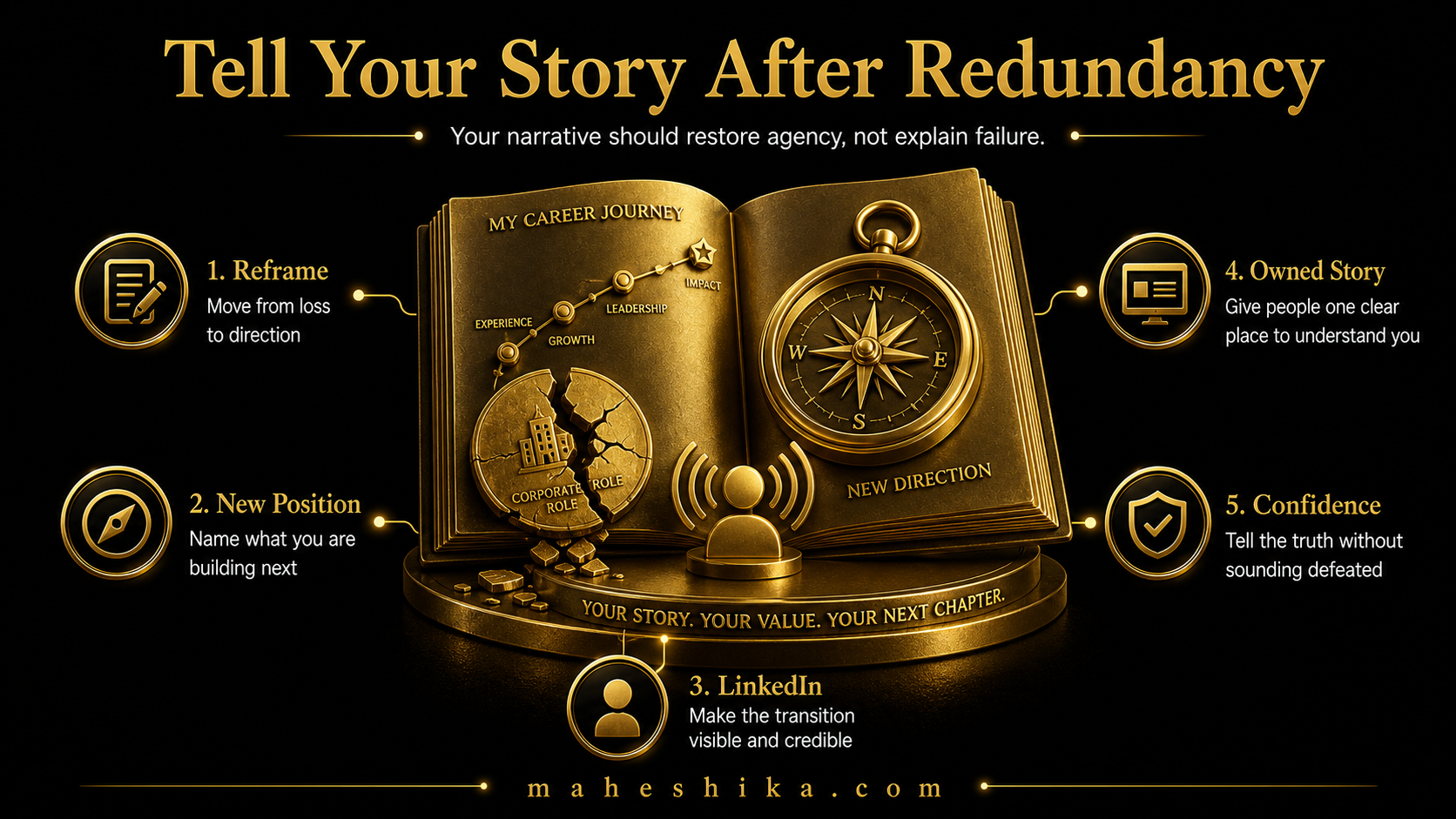
The narrative you build around your professional transition matters more than most people realise. Not because you need to spin or disguise what happened, but because the story you tell about yourself shapes how others see your potential, and how you see it yourself. Redundancy is a fact. What it means, and what comes next, is a story you get to write.
This article gives you a concrete framework for crafting and communicating that story across the three most important channels: LinkedIn, your personal website, and the broader personal brand you are building for your next chapter.
The Narrative Principle: Lead With Where You Are Going, Not Where You Have Been
The most common mistake professionals make in telling their story after redundancy is structuring it around their past role and explaining the departure. "I was the VP of Commercial Development at [company] until the recent restructuring." That is a backward-looking frame. It positions the redundancy as the defining event and invites questions about what went wrong rather than about what you are building next.
The more effective frame is forward-looking. "I help organisations entering new markets build the commercial ecosystem and partnership infrastructure they need to generate revenue in year one. After building that capability across EMEA for 18 years, I now do this as an independent advisor." The redundancy is not hidden, but it is contextualised as the start of a new chapter rather than the end of the previous one.
The shift from backward-looking to forward-looking narrative is not always comfortable immediately after redundancy, because it requires a clarity about direction that may still be forming. That is acceptable. Start with whatever forward-looking clarity you have, and refine it as the clarity builds.
LinkedIn: The Most Important Channel to Get Right
For most senior professionals, LinkedIn is the single most important channel during a career transition. It is where your existing network will find you, where new contacts will form a first impression, and where potential clients or employers will go to understand your positioning before any conversation takes place.
Your LinkedIn profile after redundancy needs to do three things. First, it needs to signal confidence and forward momentum rather than availability and uncertainty. Profiles that scream "I am looking for my next role" attract sympathy but rarely attract the right opportunities. Second, it needs to be clear about what you offer and to whom, not just a chronological list of employers. Third, it needs to give people a reason to engage: a point of view, a body of expertise, something that makes them want to start a conversation.
The most important elements to update are the headline and the About section. Your headline should describe what you do and for whom, not just your most recent title. Your About section should read like a business introduction, not a career summary. It should answer "why you?" in the first two sentences.
See the detailed guidance on this in How to Write a LinkedIn Profile That Attracts Consulting Clients.
Your Personal Website: The Platform You Control
LinkedIn is valuable but rented. Your personal website is yours, and it signals a level of seriousness and intentionality that LinkedIn alone cannot convey. For professionals building an independent practice, a well-positioned personal website is the difference between looking like someone who is "between jobs" and looking like someone who is building something deliberate.
Your website does not need to be complex. At its simplest, it needs: a clear statement of what you do and who you help, a short biography that positions you as an authority rather than a job applicant, evidence of your expertise such as publications, speaking, or case studies, and a clear way for visitors to contact you or take the next step.
The tone should be consistent with the tone you use on LinkedIn: confident, specific, and forward-looking. It should not read like a CV dressed up as a website. More on building this correctly in How to Build a Personal Website That Positions You as an Expert.
Related Reading
The Personal Brand: Consistency Across All Channels
Your personal brand is not a logo or a colour scheme. It is the consistent impression you create across every interaction, online and offline, about who you are, what you do, and what makes you worth engaging. After redundancy, rebuilding and reorienting that brand is one of the most important pieces of work you can do.
The foundation of that brand is your positioning: the clear, specific articulation of the problem you solve, for whom, and why you are the right person to solve it. Once that is clear, everything else, your LinkedIn content, your website copy, how you describe yourself in conversations, the type of articles you write, the events you speak at, all of it should reinforce the same positioning.
Consistency is what makes a personal brand powerful. A single clear message repeated across multiple channels and interactions is far more effective than a sophisticated but inconsistent narrative. Start with clarity. Let the sophistication come later.
Free Tool
Start free: where do you actually stand?
Two free tools give you an honest answer in minutes. The AI Risk Score shows how exposed your role is. The Expertise Ownership Score shows how findable and owned your expertise is.
AI Risk Score Expertise Ownership ScoreWhat to Say When People Ask
One of the practical challenges after redundancy is knowing what to say when people ask what you are doing. The hesitant, apologetic answer, "Well, I was made redundant, so I am looking for my next thing," invites sympathy and closing questions. The confident, forward-looking answer, "I have just moved into independent consulting, focusing on [specific area]," invites interest and opening questions.
You do not have to pretend you are further along than you are. You do not have to have every detail worked out. But you do need to be able to describe your direction with confidence, even if the direction is still forming. "I am building an independent advisory practice focused on commercial market entry for technology businesses" is a confident answer even if the first client has not yet signed. It is not a lie. It is a true statement about direction.
The One Move That Makes the Story Permanent
So the real answer is not one clever line for your headline. It is consistency: the same forward-looking narrative, repeated with confidence, across LinkedIn, your website and every conversation, until it simply becomes true. Get that right and redundancy stops being the story people remember about you. Your direction becomes the story instead.
But here is what most people miss once they have the narrative sorted. A platform you rent can change its algorithm, bury your posts, or stop being where your audience looks. Your title is gone. Your employer's name no longer opens doors for you. The one thing left that is unquestionably yours is whatever you choose to build next, and if that only exists as a profile inside someone else's platform, it is borrowed, not owned.
This matters more now, not less. AI can answer almost any question today, in a voice that sounds like everyone else's average opinion. The professionals who still get chosen are the ones whose name returns something unmistakably theirs: their thinking, their proof, their signature, on a page that belongs to them and nobody else. A personal website under your own name is not a nice extra for later. It is the one asset that keeps telling your new story, in your voice, long after the LinkedIn post has scrolled out of anyone's feed.
You already have the narrative, we have just walked through how to shape it. The next honest step is giving it a permanent home. If you would like help building that properly, from someone who has made this exact transition herself, let us talk.