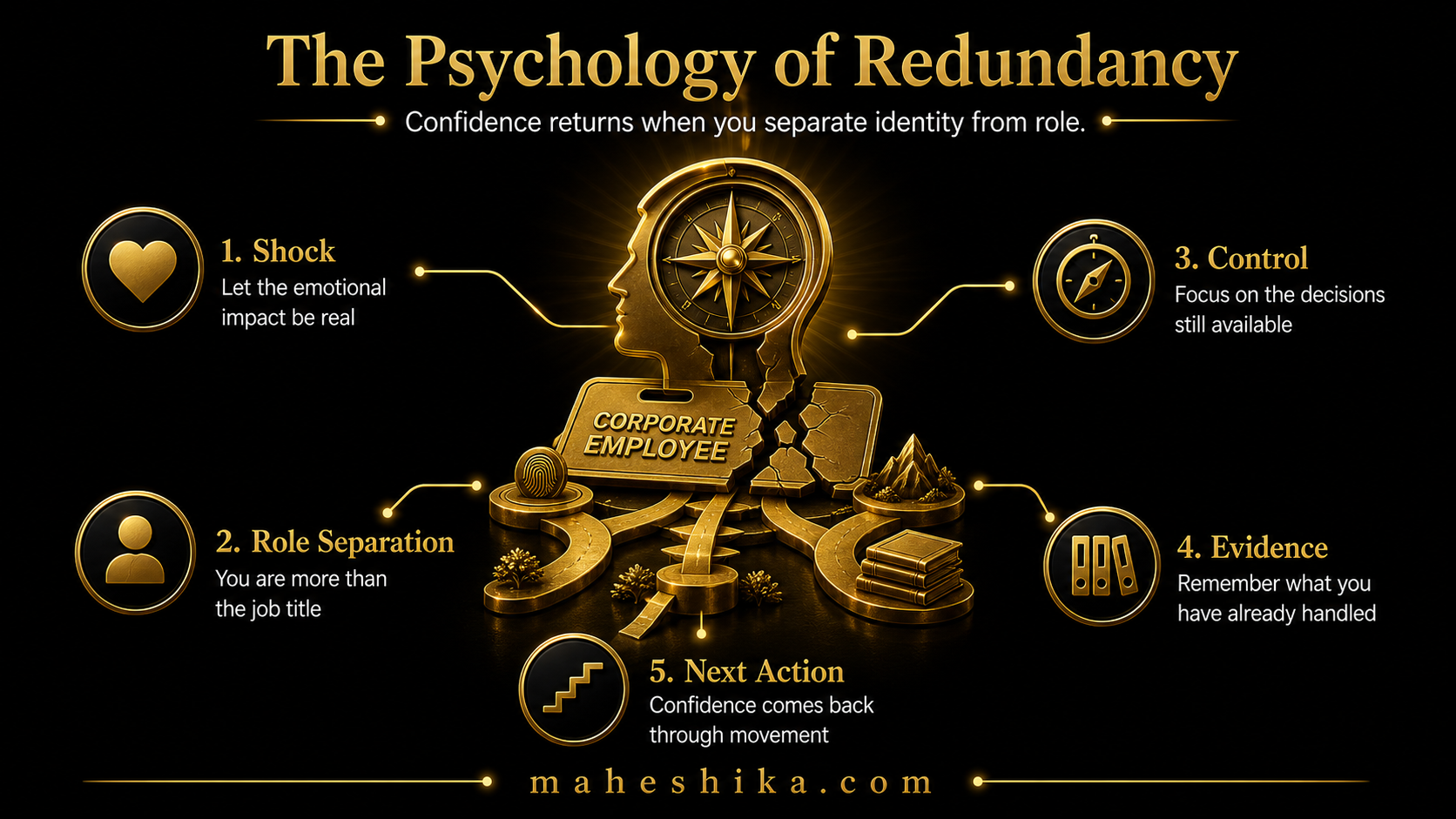
Nobody talks clearly about the psychology of redundancy, particularly when it happens at the senior level. The professional world expects you to be composed, strategic, and forward-looking from the moment it happens. But the emotional reality is usually messier than that, and pretending otherwise does not help. What does help is understanding what is actually happening psychologically, so that you can navigate it with intention rather than be driven by it without realising.
The Identity Disruption
For senior professionals who have invested 15 or 20 years in building a career, the role is not just a job. It is a significant part of how they understand themselves. The title, the team, the responsibility, the institutional affiliation: all of these are woven into the professional identity in ways that are invisible until they are suddenly removed.
When that happens, the psychological experience is not just the loss of work. It is the loss of a self-concept. "I am the commercial director at [organisation]" becomes "I am a person who used to be the commercial director at an organisation." That shift is more disorienting than most people expect, and it is worth naming it for what it is: a genuine identity loss that takes time to process, not a character weakness or a failure of resilience.
The professionals who navigate this most effectively are not those who feel it least. They are those who allow themselves to feel it, understand it for what it is, and then move deliberately through it rather than being dragged along by it.
The Emotional Sequence
Redundancy, particularly at the senior level, tends to move through a recognisable emotional sequence. Understanding the sequence does not make it comfortable, but it does make it navigable.
Shock and disbelief. Even when redundancy has been anticipated, there is typically a period of shock when it actually happens. The mind struggles to integrate what it knows intellectually with what it is experiencing emotionally. This phase is usually brief but intense.
Anger and resentment. Often directed at the organisation, the decision-makers, or the process. This is a natural response to an experience of rejection and loss of control, and it is psychologically necessary. Suppressing it does not make it go away; it makes it resurface at inconvenient moments.
Anxiety about the future. Financial anxiety, identity anxiety, anxiety about the job market: all of these converge in the weeks following redundancy. This is the phase where panic-driven decisions are most likely. Recognising that the anxiety is partially driven by the shock rather than by the actual facts of your situation is important.
Reflection and reorientation. For most people, a period of genuine reflection eventually emerges, often within the first month or two. This is the phase where honest questions about what you actually want begin to surface, sometimes for the first time in years. It is the most valuable phase of the transition if you use it well.
Momentum and confidence. As clarity increases and action begins to produce results, confidence returns. This phase is self-reinforcing: each conversation that goes well, each piece of interest from a potential client, each piece of positive feedback about your positioning, builds on the last.
What Slows the Transition
Understanding what slows the psychological transition is as important as understanding the transition itself.
Isolation. Redundancy can produce a withdrawal from professional and social contact that feels protective but is actually harmful. The feedback loop from conversation with people who know and respect you is one of the most effective mechanisms for rebuilding confidence and clarity. Avoiding those conversations prolongs the transition unnecessarily.
Rumination about the past. Spending significant mental energy on the injustice, the mismanagement, or the unfairness of the redundancy decision keeps you emotionally tied to the organisation and the role you have left. The past is informative but not actionable. Process it and move forward.
Premature closure. Some professionals avoid the uncomfortable uncertainty of the transition by making a quick decision and committing to it before they have done the reflective work that would produce a better outcome. Accepting the first offer, however unsuitable, or defaulting to an exact replica of the previous role, is a form of avoiding the opportunity that the transition genuinely represents.
Related Reading
Free Tool
Start free: where do you actually stand?
Two free tools give you an honest answer in minutes. The AI Risk Score shows how exposed your role is. The Expertise Ownership Score shows how findable and owned your expertise is.
AI Risk Score Expertise Ownership ScoreBuilding Confidence Through Action
Confidence does not return on its own. It is rebuilt through action, specifically through the experience of taking steps, having them produce results, and integrating those results into a revised understanding of your situation. The sequence is action, then evidence, then confidence, not the other way around.
The practical implication is that the most important thing you can do for your psychological wellbeing during this period is not to wait until you feel confident before you take action. Take action while you feel uncertain, and let the results build the confidence. Start with the smallest, lowest-risk actions: a conversation with a trusted former colleague, a draft of your expertise audit, a change to your LinkedIn profile. The momentum is cumulative.
The Place That Cannot Be Made Redundant
So the psychology of redundancy is not something to fight or rush past. It is a sequence, and the professionals who come through it fastest are not the ones who suppress the shock or skip the anger. They are the ones who let each phase do its work while quietly taking small, deliberate action alongside it, because confidence is not the precondition for moving forward, it is the result of it.
But there is a second loss inside redundancy that the emotional sequence does not fully explain. When the title, the team and the institutional affiliation disappear, so does the infrastructure that made your expertise visible to anyone outside your old organisation. Twenty years of judgement, relationships and results do not vanish, but they stop being findable. And in a market where AI can now answer almost any question in a voice that sounds like everyone else's, findable is what separates a professional who is still standing from one who has quietly become interchangeable.
The professionals who rebuild their confidence fastest also tend to rebuild something structural alongside it: a place of their own. A personal website under your own name, where your thinking lives, your work is shown, and your signature is unmistakable. Owned outright, not rented from a platform or borrowed from an employer. It is the one asset that keeps representing you whether or not you are in the room, and it is what stops the identity loss you have just read about from becoming permanent.
You do not have to rebuild your visibility on your own, or wait until you feel ready to start. If you are in this period and want to talk it through honestly, let us talk.