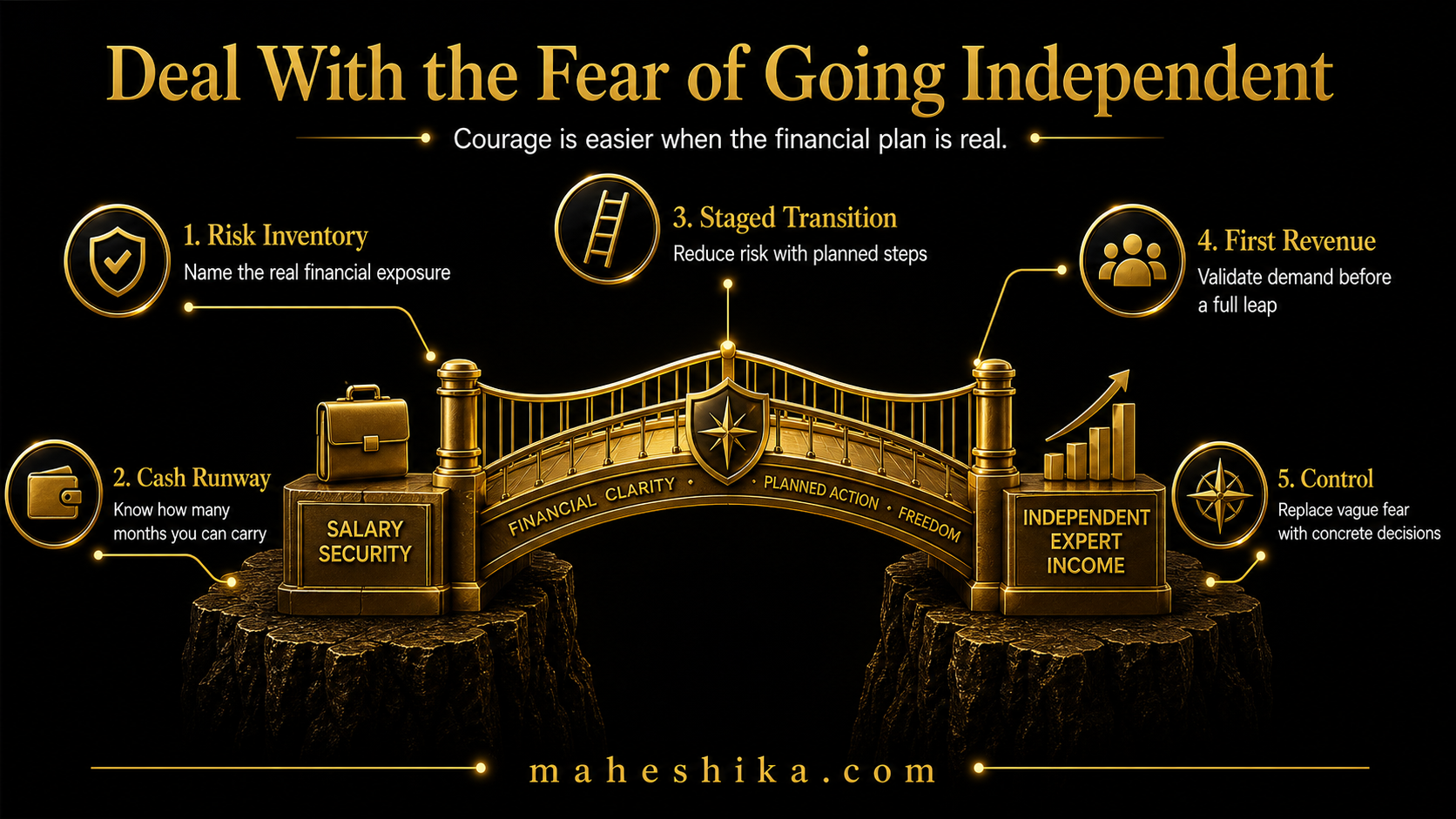
The fear is real. I am not going to tell you it is irrational or that you simply need to believe in yourself more. When you have a mortgage, children in school, a partner who depends on your income, and a lifestyle built on a reliable salary, the idea of walking away from that certainty is genuinely frightening. The fear deserves to be taken seriously, not dismissed.
What I will tell you is that the fear, left unexamined, tends to be far larger than the actual risk. And the risk itself, when mapped properly, is usually far more manageable than it appears from inside the anxiety.
Separate the fear from the facts
Fear works by vagueness. It says "what if everything falls apart?" rather than "what if I am without income for three months?" The first is paralysing. The second is a problem you can plan for.
Start by writing down your actual financial commitments: mortgage or rent, debt repayments, school fees, insurance, food, utilities. This is your survival number, the absolute floor below which you cannot go. Most senior professionals, when they do this exercise honestly, find their survival number is considerably lower than their current spending. The gap between what you spend and what you need gives you far more flexibility than you think.
Then calculate how long your current savings could cover your survival number. If the answer is six months, you have six months to build your first client engagements before you are in genuine difficulty. That is not recklessness. That is a business plan.
Build financial runway before you leap
Nobody serious about independence jumps without preparation. The professionals who navigate this transition well typically spend six to twelve months building runway before they hand in their notice. Runway means cash reserves: a minimum of six months of your survival number sitting in a separate account, untouched, designated as your independence fund.
This is not a luxury. It is the structural foundation that allows you to price correctly, choose clients selectively, and make decisions from confidence rather than panic. Without runway, you accept the first engagement offered regardless of fit, price out of fear, and end up working harder for less than you earned as an employee.
Building runway also gives you time to validate your offer before you depend on it. A small consulting engagement, a paid workshop, one advisory client you take on while still employed. These are not side hustles. They are proof of concept, and they reduce the emotional weight of the leap considerably.
Consider a phased transition rather than a cliff edge
The binary choice between "employed" and "independent" is a false one for many professionals. There are several transition structures worth considering depending on your circumstances.
Negotiate a consulting arrangement with your current employer. Many organisations will happily pay a departing senior professional a consulting fee for continuity work, especially if they cannot quickly replace the institutional knowledge you hold. This can provide six to twelve months of bridging income while you build your independent client base.
Reduce your contract before leaving entirely. Some roles allow for a shift from full-time to four days or three days a week. This gives you one or two days a week to build your independent practice, test your market, and generate early revenue before your employed income stops.
Time your departure strategically. If a bonus, share vesting, or pension milestone is six months away, it is usually worth waiting. Those funds can become your runway.
Related Reading
Validate before you commit fully
The most effective antidote to fear is evidence. Evidence that people will pay you, that your expertise has a market, that clients exist who need exactly what you offer. You do not need to have a thriving business before you leave employment. You need enough evidence that the demand is real.
One signed client is more powerful than months of planning. It changes your relationship to the risk because it makes it concrete rather than theoretical. If you can secure one consulting engagement, even a small one, before you leave your role, the fear recalibrates to something more proportionate. You are no longer wondering whether anyone will pay you. You already know they will.
Validation does not require a full launch. It requires a conversation. Tell three people in your network that you are exploring an advisory engagement in your area of expertise. Tell them what problem you would solve and what kind of organisation you would work with. Ask if they know anyone who faces that challenge. You will be surprised how quickly the conversations shift.
Free Tool
Start free: where do you actually stand?
Two free tools give you an honest answer in minutes. The AI Risk Score shows how exposed your role is. The Expertise Ownership Score shows how findable and owned your expertise is.
AI Risk Score Expertise Ownership ScoreHave the honest conversation at home
Financial commitments are rarely just about money. They are about the people who depend on you. If you have a partner or family, the fear of independence is often amplified by the weight of that responsibility, and by the stories you tell yourself about what they expect from you.
The most useful thing you can do is have an honest, numbers-based conversation with your partner or family. Not a motivational speech about your dreams, and not an anxiety spiral about worst-case scenarios. A practical conversation: here is our survival number, here is our runway, here is the plan for year one, here is what we will do if month six arrives and I have not hit my target. When the people around you understand the actual plan, the fear loses the power it draws from secrecy and vagueness.
The One Asset Your Runway Should Include
So the fear does not lift because you decide to be braver. It lifts because you replace it with a plan: a survival number you have actually written down, six to twelve months of runway sitting untouched, one validated client before you hand in your notice, a phased exit instead of a cliff edge. Handled this way, the risk stops being formless and becomes a number you can manage. Fear needs a plan, not more courage, and now you have one.
But runway and a signed client solve for cash. They do not solve for something quieter sitting underneath the whole decision. The moment you step outside the organisation, the title that made you findable goes with it. Eighteen years of judgement, expertise, and results, and nowhere anyone can see it unless you personally reintroduce yourself in every new room. In a market where AI can answer almost any question in a voice that sounds like everyone else's, the professionals who stay secure are not the ones with the biggest cash buffer. They are the ones who own a place the market can find without them in the room.
A personal website under your own name. Somewhere your thinking lives, your work is shown, and your signature is unmistakable, owned outright, findable in a search, impossible to reduce to a generic answer. That is not a nice-to-have sitting beside your financial plan. It belongs inside it, because it is the one asset that keeps working, and keeps bringing enquiries, whether or not you are the one making the pitch that day.
You do not have to build that alone, and you do not have to wait until the fear is fully gone to start. If you want it done properly, by someone who has navigated exactly this transition herself, let us talk.