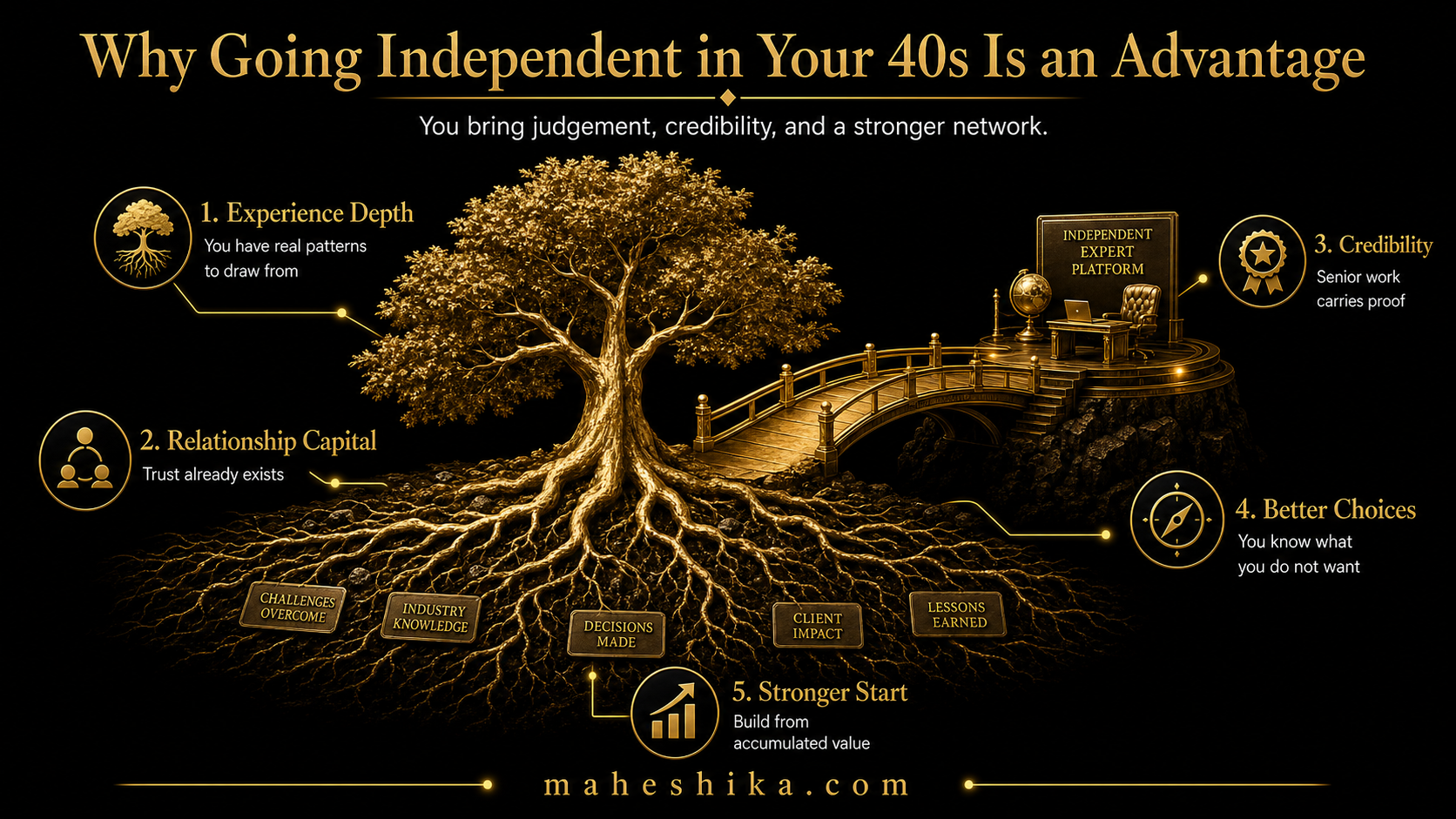
The cultural narrative around entrepreneurship and independence is skewed heavily towards youth. We celebrate the twenty-something who starts a business in a garage, the graduate who skips employment entirely to build something of their own. What the narrative consistently undervalues is the advantage of going independent with two decades of professional experience behind you.
I went independent in my forties, after eighteen years in enterprise commercial leadership. I have watched others do the same, and I have worked with dozens of senior professionals making the transition. The pattern is consistent: people who go independent with deep professional experience and a senior network build more stable, more profitable, and more personally satisfying businesses than most people who start with enthusiasm and energy but no track record.
You Have Already Solved the Hard Problems
The hardest part of building an independent consulting business is not the business mechanics. It is developing the expertise that clients will pay for. That part takes years, and it cannot be shortcut.
When a twenty-five-year-old goes independent, they have energy, optimism, and time. What they typically lack is the kind of depth that corporate clients commission at senior fees. They have not yet made the expensive mistakes that generate the most valuable learning. They have not yet built the pattern recognition that comes from seeing the same problems in multiple organisations across multiple cycles. They have not yet developed the emotional regulation and the confidence under pressure that senior clients expect from a trusted adviser.
At forty-five, you have all of those things. The decade of hard experience that would have been the most challenging decade of a younger independent's journey is already behind you. You arrive at independence with the product already built. The remaining work is commercialising it.
Your Network Is Your Most Valuable Asset
A senior professional who has spent fifteen to twenty years in substantial organisations has built a network that a twenty-year-old simply cannot have. Not because of any particular virtue, but because the network is a function of time and experience.
The people in that network have become CFOs, Managing Directors, Board Chairs, and Partners. They are in positions where they commission the kind of work you do, where they influence major decisions, and where a trusted recommendation from you or to you carries real weight. Your network is not just a list of contacts. It is a distributed system of trust that took decades to build and cannot be replicated quickly by anyone starting from scratch.
This is the single greatest structural advantage of going independent at forty-five rather than twenty-five. The twenty-five-year-old will spend years building the network that you already have. You can use yours from day one. Your first clients are almost certainly already in it.
Related Reading
Credibility Is Not Manufactured: It Is Accumulated
The consulting market for senior expertise is a credibility market. Clients are paying for the confidence that comes from working with someone who has done this before, who has been in the room when similar decisions were made, who knows what works and what does not from direct experience.
That credibility cannot be faked, and it cannot be accelerated. A twenty-five-year-old entrepreneur can build a successful business. But they cannot, in most cases, command the fees or the access to senior decision-makers that a forty-five-year-old with a board-level track record can. The credentials, the publications, the network, the case studies, all of it takes time to accumulate, and by the time you are in your forties, you have accumulated it.
Clients who commission senior advisers and consultants at meaningful fees are almost always looking for someone who has relevant seniority, a track record in their domain, and the credibility that comes from having operated at a comparable level to themselves. A consultant in their forties or fifties who has spent two decades at senior levels meets those criteria in a way that someone in their twenties structurally cannot, regardless of how talented they are.
Free Tool
Start free: where do you actually stand?
Two free tools give you an honest answer in minutes. The AI Risk Score shows how exposed your role is. The Expertise Ownership Score shows how findable and owned your expertise is.
AI Risk Score Expertise Ownership ScoreWhat You Lose, and the One Thing That Protects You
There are genuine trade-offs to going independent later rather than earlier, and it is worth being honest about them.
Time is the most significant. If you go independent at forty-five and build a successful practice over the next fifteen years, you will have built something valuable. But you will not have had the compounding effect of building that practice over twenty-five years. The earlier you start, the longer you have to build, and the more time compound growth has to work in your favour.
Risk tolerance also tends to decrease with age and commitments. A twenty-five-year-old with no mortgage and no dependants can absorb a slow first year more easily than someone in their mid-forties with significant financial obligations. This is real, but it is manageable. The preparation strategies that protect income through the transition, which are detailed elsewhere in this guide, are specifically designed for people who cannot afford to take an extended income risk.
What those trade-offs do not include is a meaningful disadvantage in the quality or profitability of the business itself. The businesses built by senior professionals with deep expertise and strong networks are structurally better businesses than those built by talented people without those assets, all else being equal. The market for senior expertise rewards experience, and experience is precisely what you have. So the honest answer to the age question is this: forty-five is not a smaller window than twenty-five, it is a stronger one, because the hardest, slowest part of the business is already built inside you.
There is one more thing worth being honest about, though, and it has nothing to do with age. The title, the org chart, the company name on your signature, all of it broadcast your seniority for you inside the business you are leaving. The day you walk out, that signal goes quiet. Meanwhile, the market you are stepping into is filling up with AI-generated answers that sound plausible, sound confident, and sound exactly like everyone else's.
The professionals who keep their seniority visible after they leave are the ones who own a space of their own: a personal website under their own name, holding the case studies, the track record and the thinking that took two decades to earn, searchable and unmistakably theirs. Not a rented profile. An asset you own outright, making your case for you at two in the morning while you are in front of a client.
You do not have to build the practice and the platform separately, or in that order. If you would like to talk through what yours would look like, let us talk.